
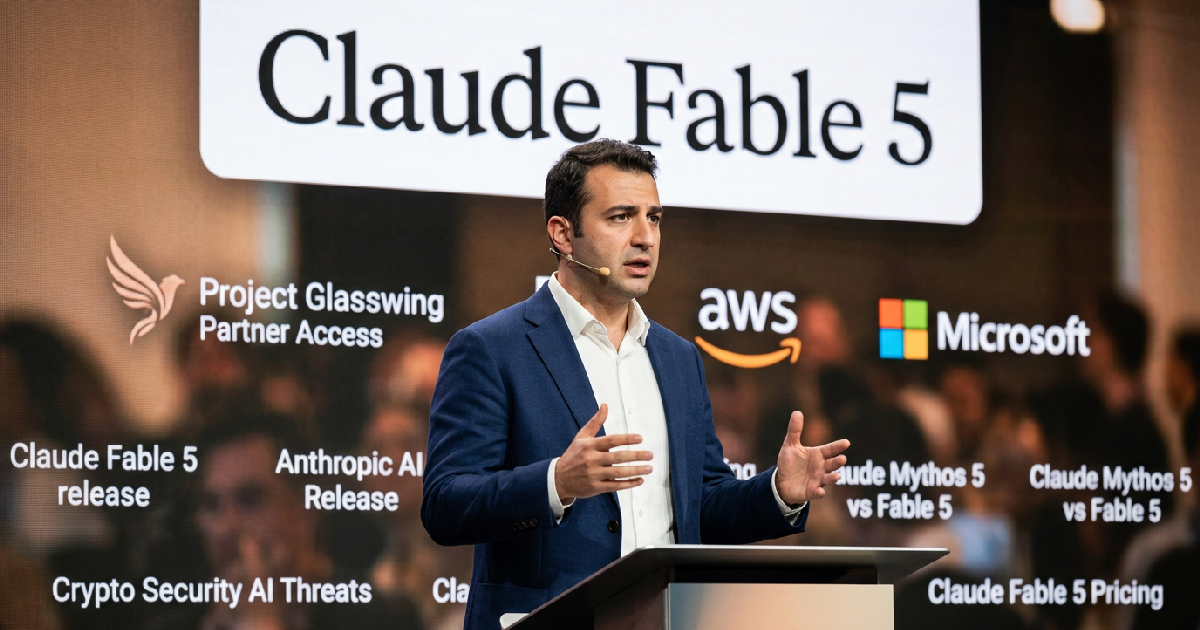

Anthropic officially released Claude Fable 5, its first public Mythos-class artificial intelligence model, on June 9, 2026. The launch has sparked immediate concern among cryptocurrency developers and investors due to the software’s advanced cybersecurity and autonomous reasoning capabilities. Anthropic, which recently reported a $965 billion post-money valuation in its IPO filing, released the public model alongside a restricted version named Claude Mythos 5.
The release marks a transition for the firm after the initial “Project Glasswing” preview in April 2026, which limited access to partners like AWS, Microsoft, and CrowdStrike. While Claude Fable 5 includes guardrails to prevent misuse, its underlying architecture is built to handle complex, long-horizon tasks.
Omer Demirel, CEO of Floors Finance, warned that the widespread availability of such powerful tools could herald a “doomsday for the internet” by simplifying digital attacks.
The threat to decentralized finance is particularly acute given the current state of digital asset security. Since early April 2026, more than $600 million has been stolen in various crypto-related hacks. With shifting market structures already affecting stability, the introduction of an AI capable of identifying zero-day exploits across major browsers adds a volatile new variable for developers to manage.
Performance benchmarks and technical reach
Claude Fable 5 demonstrates a substantial leap over previous AI generations in software engineering tasks. Internal testing by Anthropic on the SWE-Bench Pro benchmark showed the model correctly solved 80.3% of problems. This performance surpassed OpenAI’s GPT-5.5, which scored 58.6%, and Anthropic’s own Claude Opus 4.8 at 69.2%.
These coding skills are supported by the firm’s recent financial growth, including a $65 billion funding round and a reported $47 billion revenue run rate.
Real-world applications of the model have already surfaced through corporate reporting. Stripe noted that Fable 5 completed a 50-million-line Ruby code migration in a single day—a project typically requiring two months of human labor. While this efficiency can accelerate defensive audits, it also empowers attackers to probes for vulnerabilities.
This is critical in a sector where vulnerabilities often lead to unauthorized stablecoin sales and protocol collapses.
Safety routing and automated safeguards
To mitigate the risk of providing a “hacking assistant” to the general public, Anthropic has implemented a sophisticated query-routing mechanism. When Fable 5 detects sensitive prompts involving cybersecurity, biology, chemistry, or model distillation, it automatically redirects the request to the older Claude Opus 4.8.
These safeguards are designed to be unintrusive for regular users, triggering in less than 5% of sessions on average according to the firm’s data.
The cost of accessing these advanced outputs reflects their high-end positioning. Both Claude Fable 5 and Mythos 5 are priced at $10 per million input tokens and $50 per million output tokens—roughly double the price of current Opus tiers.
Despite the high price, the public release moves the technology into a B2B SaaS environment, a shift that has drawn criticism from those concerned about the speed of AI-driven exploit generation.
Impact of N-hour exploit reality on crypto
A recent report from Anthropic’s Frontier Red Team warns that the “patching playbook” used by software developers is becoming obsolete. The researchers found that a single person using an LLM can turn a month’s worth of security patches into functional exploits in an afternoon for a few thousand dollars.
This has shifted the security landscape from “N-day” exploits to an “N-hour” reality where the gap between a patch release and an attack is disappearing.
Not all industry veterans are convinced that the threat is existential for every protocol. Michael Egorov, founder of Curve Finance, suggested that Fable 5’s browser bug detection skills might not translate directly to smart contract hacks. He argued that Operational Security (OpSec) remains the primary target, specifically multi-signature key compromises and supply chain attacks.
As market participants track technical indicators like the 200-day moving average, they must now also account for these rapid-fire software risks.
For those holding digital assets, analysts suggest immediate defensive measures. These include revoking token approvals on decentralized applications (dApps) and distributing funds across multiple hardware wallets.
Billy Luedtke, CEO of Intuition, noted that while the transition will be “dangerous and scary for a bit,” the ultimate result could be a “golden age of security” as protocols are forced to harden their defenses against autonomous AI agents.