
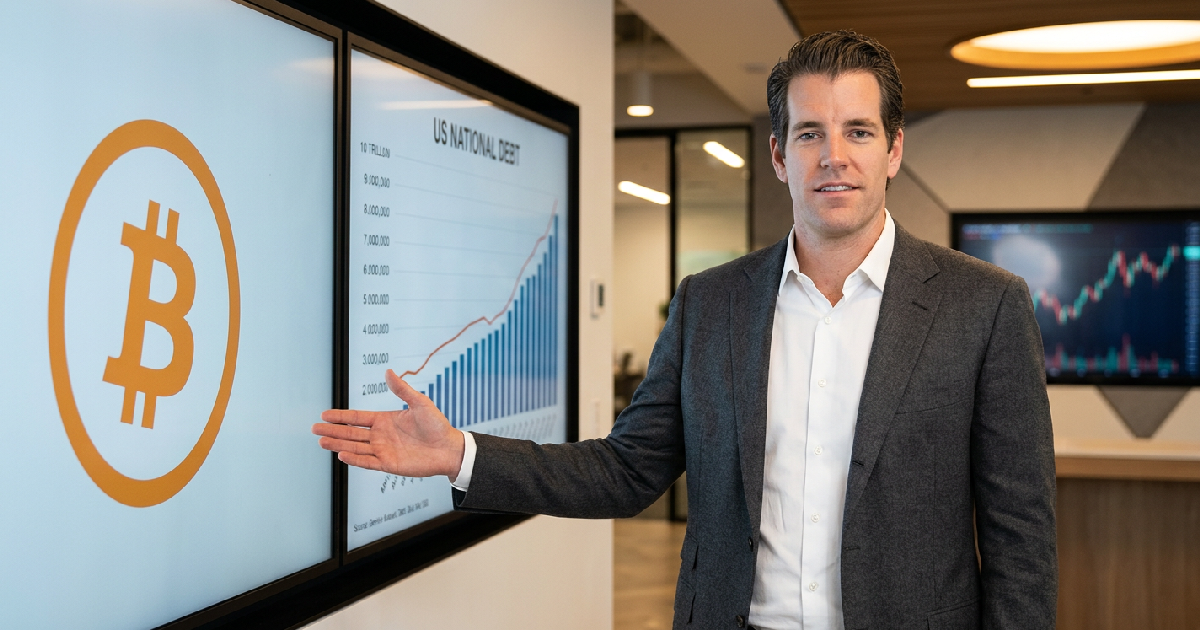

Cameron Winklevoss, co-founder of the Gemini cryptocurrency exchange, declared on May 22, 2026, that there are now 39 trillion reasons to buy Bitcoin, directly linking the asset’s value proposition to the ballooning United States national debt. 22 trillion—as a primary catalyst for investors to seek refuge in a decentralized currency with a strictly capped supply. The declaration comes as Bitcoin trades at approximately $74,000, while the Winklevoss twins continue to position the digital asset as a critical hedge against fiscal instability in the world’s largest economy.
The core of the Winklevoss brothers’ thesis rests on the contrast between the US government’s uncapped borrowing and Bitcoin’s hard limit of 21 million coins. Cameron Winklevoss has long championed this “Gold 2.0” narrative, arguing that as the dollar’s purchasing power is diluted by debt and spending, capital must naturally flow toward programmatic scarcity. This latest call reflects a broader sentiment among industry figures like Michael Saylor and Anthony Pompliano, who frequently cite government obligations as the ultimate advertisement for digital assets.
While the twins remain steadfast in their long term outlook, the market has not always been a straight line up. Late last year, Cameron Winklevoss urged investors to buy the dip when the price fell below $90,000, calling it a final chance for a rebound. However, the market saw further slides before stabilizing at current levels. This volatility remains a point of contention for critics, though proponents argue that short-term price action is irrelevant compared to the Bitcoin price analysis regarding its long-term role as a global store of value.
US national debt as a catalyst for Bitcoin adoption
The $39 trillion figure is more than just a psychological milestone; it represents a deepening fiscal challenge for American households. When the debt reached $37.63 trillion in 2025, financial commentator Jim Cramer noted that the burden amounted to nearly $955,708 per American family. As that figure expands past the $39 trillion mark, the “bull thesis” for Bitcoin strengthens in the eyes of those who view it as an insurance policy against traditional financial system failure.
Cameron Winklevoss and his brother Tyler Winklevoss have not restricted their support for the asset to social media posts. The twins recently made one of the largest cryptocurrency political donations on record, contributing $21 million worth of Bitcoin to a political action committee supporting US President Donald Trump’s re-election campaign. This move signals a strategic attempt to align the industry with a political platform that has increasingly embraced digital assets as a tool for American economic competitiveness.
This political maneuvering comes at a time when regulatory clarity remains a top priority for US-based exchanges. Investors are closely watching how legislative shifts might impact market liquidity, especially as updates to ETF filings continue to shape how institutional capital enters the space. For the Winklevoss brothers, the connection between partisan politics and Bitcoin is increasingly clear: they are backing leaders who recognize the debt crisis they believe Bitcoin was built to solve.
The road to the one million dollar price target
While Cameron Winklevoss focuses on the immediate “39 trillion reasons” to buy, Tyler Winklevoss has doubled down on a massive long-term valuation. Tyler Winklevoss recently stated that Bitcoin is currently “not even a tenth of what it will eventually be worth,” predicting that the price will one day reach the $1 million mark. He described the protocol as the “greatest innovation of the past century,” suggesting it could serve as the bedrock for the global economy for the next 500 years.
Such a valuation would require Bitcoin to almost entirely displace gold’s market capitalization. While gold remains the traditional “safe haven,” the transparency and portability of Bitcoin are winning over a younger generation of investors. Even as the market faces rising treasury yields and macro warning signs, the Winklevoss brothers maintain that the fundamental math of a fixed supply against an inflating debt will eventually force an upward repricing.
Currently, the market continues to grapple with the reality of high interest rates and their impact on speculative assets. Bitcoin’s current price of $74,000 is a far cry from the seven-figure predictions of its most ardent supporters, yet it represents a significant recovery from previous lows. The Gemini co-founders argue that as long as the US debt clock continues to tick higher, the fundamental reason for Bitcoin’s existence only grows stronger, regardless of temporary price fluctuations.
Strategic implications for the digital asset landscape
The aggressive stance taken by the Gemini founders underscores a shift in how Bitcoin is marketed to the public. It is no longer just “internet money” for the tech-savvy, but a macroeconomic tool for the preservation of wealth. This shift is evident in the twins’ ownership of Real Bedford F.C., an English non-league football club they have integrated into the Bitcoin ecosystem, further attempting to normalize the currency’s use in everyday commerce and sport.
Looking ahead, the intersection of the national election, the looming debt ceiling debates, and the continued integration of Bitcoin into institutional portfolios will likely dictate the next major move for the asset. If the US national debt continues its current trajectory toward $40 trillion and beyond, the chorus of voices led by the Winklevoss twins will only grow louder. For now, they remain convinced that the largest “buy signal” in history is written in the government’s own ledger.