
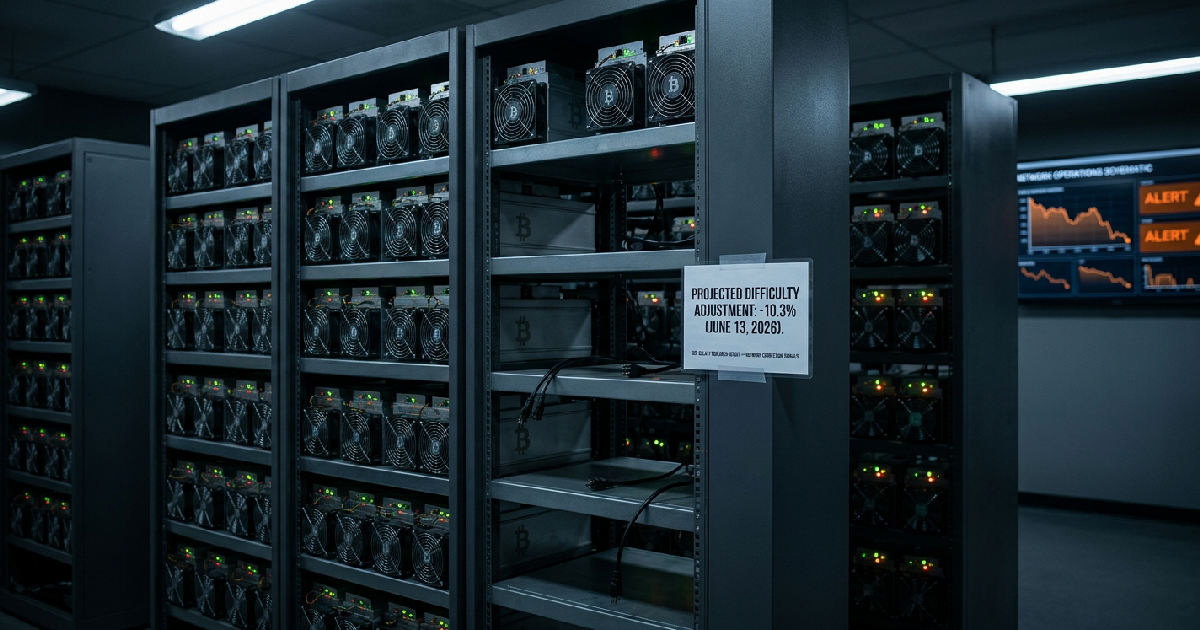

The Bitcoin network is bracing for a projected 10.3% downward difficulty adjustment on Saturday, June 13, 2026, marking what analysts expect to be the most significant network correction since 2021.
According to a new report from Galaxy Research, a prolonged decline in the asset’s price has squeezed profit margins for miners, forcing some operators to disconnect their hardware from the blockchain. This automatic recalibration is triggered when the total hashrate falls, ensuring the network remains functional for remaining participants struggling under heavy financial pressure.
Bitcoin’s difficulty adjustment mechanism is a self-regulating tool that modifies how hard it is for miners to find a new block roughly every two weeks, or 2,016 blocks. The previous adjustment occurred on May 29, 2026, at block height 951,552.
When operating costs exceed revenue—a state often called miner capitulation—less efficient firms shut down equipment, causing the network’s total computing power to drop. The upcoming June 13 correction aims to bring block generation times back to the 10-minute target.
The current revenue squeeze is rooted in several converging factors, notably the April 2024 halving which slashed block rewards from 6.25 BTC to 3.125 BTC. This 50% reduction in daily issuance was compounded by a significant price decline, with Bitcoin falling from approximately $124,000 in October 2024 to about $65,000 by February 2026.
While Bitcoin price stabilizes in cycles, the drop pushed the “hashprice”—the revenue earned per unit of computing power—to all-time lows of roughly $29 per petahash.
Historical context of mining difficulty drops
The projected 10.3% decline will rank as the eleventh-largest negative difficulty adjustment in the history of the blockchain. It follows a similarly large correction on February 7, 2026, when the network recorded an 11% drop. That earlier decline was driven by falling prices and severe winter storms that disrupted physical mining infrastructure.
These events underscore how Bitcoin signals indicate shifting market structure during periods of extreme external or economic stress.
To put a 10.3% drop in perspective, it is helpful to look at the deepest stress tests in the industry’s history. The largest recorded drop was a 27.94% decline on July 3, 2021, following China’s comprehensive ban on mining activities. Other major drops include an 18.
03% correction in October 2011 and a 15.95% decline in March 2020 during the pandemic-driven market panic. The upcoming weekend event represents the second major correction of 2026, reflecting the intensity of current market pressure.
Miner profitability has faced a sustained downturn for months. In September 2024, daily block reward gross profit fell to a record low of $16,100 per EH/s. By May 2024, total monthly mining revenue had dipped below the $1 billion mark for the first time that year, hitting approximately $964.24 million.
These tight margins have forced a change in corporate strategy, with many firms opting to liquidate holdings rather than accumulate reserves.
Market implications and long term support levels
Publicly traded Bitcoin mining companies sold over 32,000 BTC in the first quarter of 2026, a figure that exceeded all four quarters of 2025 combined. This strategic selling was often motivated by a need to fund operational improvements or secure profits following price surges earlier in the cycle.
This persistent sell-side pressure contributes to the price stagnation that eventually forces the network’s difficulty to adjust downward.
If bearish pressure continues and the current horizontal volume shelf near $62,000 fails to hold, analysts suggest the next global support level sits between $25,500 and $31,500. This range is based on historical volume profiles. However, many traders view these double-digit difficulty drops as contrarian buy signals. Historically, when the com/bitcoin-supply-on-exchanges-bitcoin-exchange-supply-six-year-low-binan/”>Bitcoin supply on exchanges reaches multi-year lows, a reduction in miner selling pressure can sometimes precede a price recovery.
The industry is also seeing a shift toward diversification. Some mining firms are repurposing their high-performance hardware for artificial intelligence (AI) and high-performance computing (HPC) workloads. These sectors often offer more stable contracts and economically attractive terms from megacap firms compared to the volatile margins of cryptocurrency mining.
For those who remain in the mining sector, the June 13 adjustment will provide a much-needed reduction in the cost of producing each block.
Future outlook for network security and efficiency
The upcoming difficulty drop serves as a reminder of Bitcoin’s built-in resiliency. By making the task of mining “easier” when players leave, the protocol ensures that those who stay remain incentivized to secure the network. Efficient operators with access to low-cost electricity are best positioned to survive this “Darwinian” process.
They will see their share of the network rewards increase as their less-efficient competitors go offline.
Beyond the immediate adjustment, the long-term health of the ecosystem remains tied to price action and energy costs. Global hashrate has already shown signs of softening, falling about 5.8% to 1,004 EH/s in the second quarter of 2026 from 1,066 EH/s in the first quarter.
This decline indicates that the revenue squeeze has already reached a tipping point for a significant portion of the global mining fleet.
Once the 10.3% adjustment is finalized this weekend, the network will have effectively lowered the “bar” for profitability. This should stabilize the ecosystem in the short term, allowing the blockchain to maintain its 10-minute block interval.
While the correction reflects deep financial stress for many participants, it is the exact mechanism designed by Satoshi Nakamoto to ensure that Bitcoin never stops producing blocks, regardless of market conditions.