
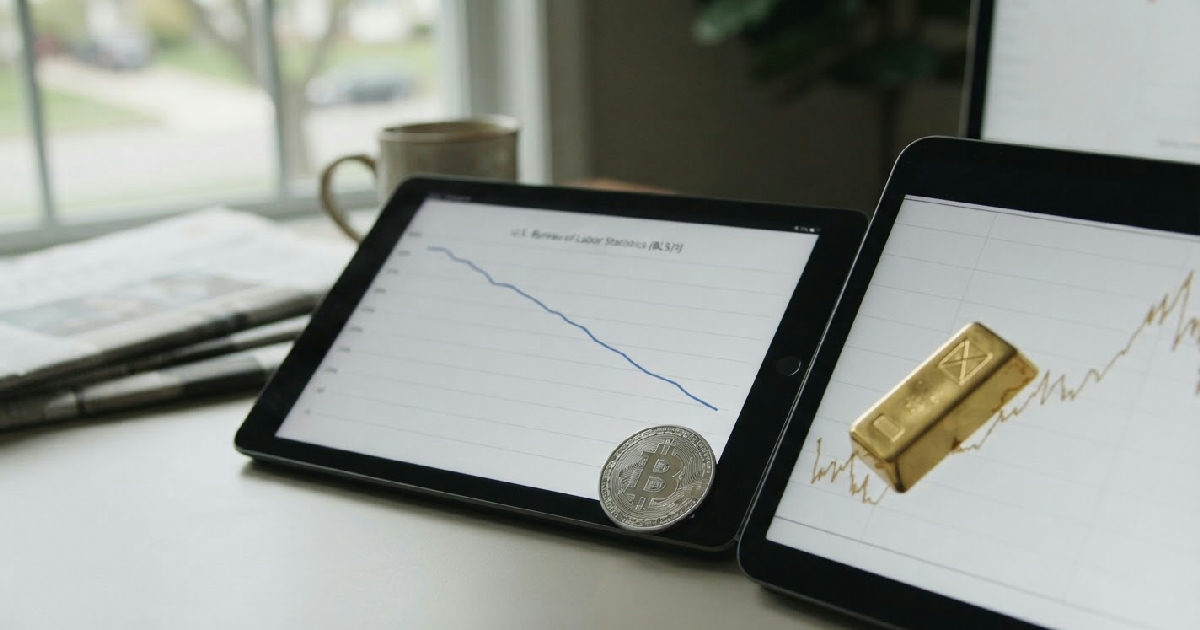

Bitcoin’s inflation response was muted on August 12, 2026, despite the U.S. Bureau of Labor Statistics reporting a cool-down in July Consumer Price Index (CPI) data. S. Bureau of Labor Statistics (BLS) released the July Consumer Price Index (CPI) data yesterday, August 12, 2026, showing a welcome cool-down in inflation pressures.
Bitcoin’s muted inflation response was notable, while gold prices climbed significantly on the news, reinforcing its traditional role as a safe-haven asset.
However, Bitcoin, often touted as a digital counterpart to gold and a hedge against inflation, barely moved, even dipping slightly before recovering. This divergent reaction highlights a persistent gap in how traditional and digital assets respond to macro-economic indicators, challenging some prevailing narratives in the cryptocurrency space.
July CPI cools, but market signals diverge
The latest U.S. inflation figures delivered some relief to a market anxious about persistent price pressures. Headline CPI rose just 0.1% for the month, with the annual rate slowing to 3.4%, down from 3.5% in June.
Core CPI, which strips out volatile food and energy costs, also eased to 2.5% annually, marking its slowest pace since February. Cheaper gasoline prices, down 2.9% month-over-month, contributed significantly to the overall cooling trend.
Traditional markets reacted positively, particularly gold. Spot gold surged as much as 1.6% to $4,438.20 per ounce, with prices hovering around $4,436 per ounce by day’s end. This strong performance underscores gold’s enduring appeal when inflation concerns abate and interest rate hike probabilities shift.
Bitcoin, however, showed a largely muted and somewhat volatile response. The cryptocurrency initially dipped a few hundred dollars from $64,400 before settling around $63,736, a slight 0.4% decline intraday.
While it later saw a minor bounce, its reaction pales in comparison to gold’s clear ascent. This disparity begs the question of whether Bitcoin truly functions as the “digital gold” some proponents claim it to be.
Fed policy shifts favor gold, less so Bitcoin
The cooling inflation data, coupled with a weaker U.S. jobs report from last week, has significantly altered expectations for the Federal Reserve’s next move. Traders are now pricing in a much higher probability of the Fed holding interest rates steady at its September meeting.
The CME FedWatch Tool currently indicates a 61.9% chance that the Fed will opt to maintain current rates, a notable increase from previous predictions that leaned towards another hike. This shift in sentiment typically benefits non-yielding assets like gold.
Gold historically performs well when the outlook for higher interest rates fades, as the opportunity cost of holding a non-income-generating asset decreases. Lindsay Rosner of Goldman Sachs Asset Management described the report as encouraging, suggesting it provides policymakers ample reason to pause.
However, economist Peter Schiff offered a dissenting view, arguing that the July CPI number might be misleading. He pointed out that the data still reflects May’s oil price collapse, failing to capture July’s rebound at the pump.
If Schiff’s assessment proves accurate, the next CPI report could present a less favorable picture, potentially rekindling inflation concerns. This perspective suggests that the current market relief might be premature.
Bitcoin’s missing capitulation phase
Despite the broader market relief, on-chain analytics firm CryptoQuant offered a more cautious assessment for Bitcoin. Their adjusted Net Unrealized Profit/Loss (aNUPL) metric, which tracks paper gains and losses across all holders, indicates a critical phase.
The current readings suggest that Bitcoin’s most committed long-term investors are experiencing deeper unrealized losses than the market as a whole. This pattern has historically preceded major cycle lows for Bitcoin, such as in December 2018 and November 2022.
Those previous bottoms saw Bitcoin plunge approximately 77% from its peak, accompanied by widespread emotional and financial exhaustion, or “capitulation.” While today’s market shows long-term holders in the red, the damage is considerably milder, with BTC trading roughly 50% below its cycle high of around $64,160.
CryptoQuant analysts noted that while Bitcoin displays conditions associated with macro bottoms, the complete emotional and financial exhaustion that characterized previous significant lows hasn’t fully materialized. This implies that a final, intense selling phase might still be needed.
Fidelity Digital Assets, a major institutional player, has also been monitoring similar trends, flagging long-term holder supply as a clear indicator of a forming bottom. Yet, the absence of full capitulation suggests that the market hasn’t yet experienced the deep, widespread panic selling seen in past bear cycles.
The emergence of spot Bitcoin exchange-traded funds (ETFs) since January 2024 introduces a new dynamic. These investment vehicles provide a mechanism for institutional capital to absorb coins from retail sellers, potentially preventing the kind of deep, rapid price depreciation that defined prior capitulation events. This institutional absorption could be moderating volatility.
Therefore, the trajectory of the aNUPL metric in the coming weeks will be crucial. A deeper slide would signal the classic final flush of selling pressure. Conversely, if Bitcoin maintains a higher low as aNUPL turns back towards zero, it would suggest the worst of the bear market has indeed passed without the need for a full capitulation event.
Redefining Bitcoin’s role in economic shifts
The differing responses of gold and Bitcoin to the July CPI data underline a fundamental debate about their respective roles in an evolving global economy. Gold’s immediate and significant rally reinforces its established status as a traditional inflation hedge and a safe haven during economic uncertainty.
Its predictable behavior in the face of shifting interest rate expectations provides investors with a clear, albeit conventional, avenue for portfolio protection. For centuries, gold has been the go-to asset when fiat currencies face inflationary pressures or when geopolitical instability rises.
Bitcoin, by contrast, continues to carve out its identity, still heavily influenced by factors beyond simple inflation hedging. While some champion it as “digital gold,” its price movements don’t always align with this narrative, as evidenced by yesterday’s performance.
The lack of a decisive upward move, even with cooling inflation and reduced Fed hike fears, suggests that the market still views Bitcoin with a different lens than gold. It highlights Bitcoin’s ongoing sensitivity to broader risk appetite and its own internal market dynamics, such as the incomplete capitulation identified by CryptoQuant.
This divergence isn’t necessarily a negative for Bitcoin, but rather a clarification of its current market phase. It indicates that while institutional adoption is growing, as seen with ETF inflows, the asset may not yet possess the same broad-based, immediate reactive characteristics to macro-economic data as gold does.
As the market awaits the next CPI report, due before the Federal Reserve’s September 16 decision, all eyes will be on whether Bitcoin can decouple its movements from the need for a traditional “final flush” or if it will eventually follow gold’s lead more closely. The answer will offer further insight into its maturity as a financial asset.