
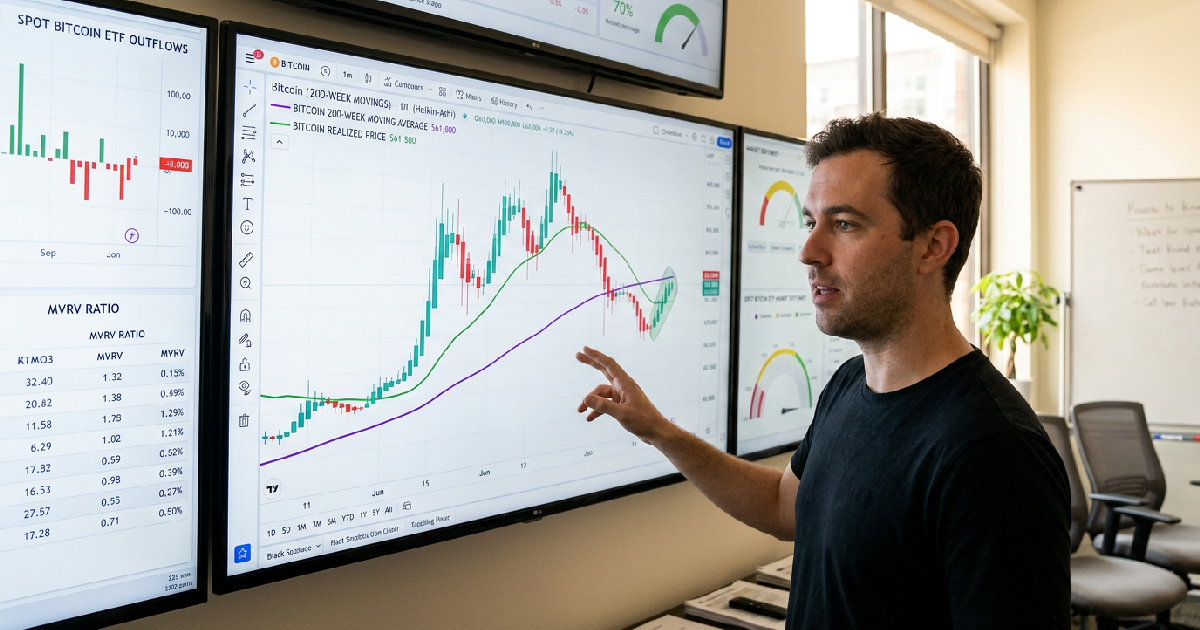

Bitcoin (BTC) briefly dropped below the $60,000 mark on June 11, 2026, reaching a bear market low of $59,000 before rebounding to approximately $62,623. This price action brought the digital asset into close proximity with its 200-week moving average (200WMA), a long-term support level flagged by analyst Benjamin Cowen at $61,800.
The interaction marks the first time Bitcoin has touched this critical technical line in the current market cycle.
The 200WMA, which smooths roughly four years of weekly closing prices, has historically acted as a significant support zone during bear markets. Cowen describes this periodic touch as a cyclical “date with destiny” that occurs roughly every four years.
While many traders watch this level as a potential floor, historical data shows that Bitcoin has previously slipped below it, notably spending seven months trading under the average between August 2022 and March 2023.
Recent volatility coincides with a sharp retreat in market participation. Total Bitcoin demand, encompassing both speculative futures and explicit spot buying, plunged to -652,000 BTC in the week prior to June 11. This represents the most substantial decline in demand recorded since January 2022.
The price dip to $59,000 was the first time Bitcoin traded below $60,000 since October 2024, testing the resolve of investors amid cooling institutional interest.
Historical context of Bitcoin moving average support levels
Traders often look to the 200WMA because previous touches in December 2018 and during the March 2020 COVID crash preceded major market recoveries. However, the current structure shows more complexity than a simple rebound. In the 2022-2023 cycle, Bitcoin did not immediately bounce into a bull run but instead faced sustained resistance after dipping below the line in June 2022 and August 2023.
Another technical anchor currently under observation is the 300-week moving average, which sits near $54,000. This indicator closely tracks Bitcoin’s overall realized price, which was recently recorded at $53,514. The importance of moving average analysis remains a central theme for market participants trying to identify where long-term value might stabilize.
The overall realized price represents the average cost at which all Bitcoin tokens last moved on the blockchain. Historically, macro cycle bottoms have often occurred when the market price falls below this realized value. With the spot price currently around $62,623, Bitcoin remains roughly 9% above this foundational “cost basis” for the entire network.
MVRV ratio suggests market is nearing undervalued territory
The Market Value to Realized Value (MVRV) ratio has dropped to 1.1 in June 2026, the closest it has come to a major discount signal in several months. This ratio compares Bitcoin’s total market capitalization with its realized capitalization. A reading approaching 1.0 suggests that the market is entering a fair valuation range, a condition that often precedes accumulation by long-term investors.
On-chain data reveals a significant gap between different investor cohorts. Long-term holders—those holding for more than 155 days—have an average cost basis of approximately $38,900. In contrast, short-term holders who entered the market more recently face a realized price of $74,091. This disparity highlights the pressure on newer entrants as shifting market structures continue to test speculative positions.
When the MVRV ratio falls toward or below 1.0, it typically indicates that a large portion of the market is holding at a loss. Previous cycle lows, including the 2018 bear market bottom, saw readings dip below this parity line before a sustainable recovery began. The current 1.
1 reading indicates that while the price is suppressed, it has not yet reached the extreme undervaluation seen in prior macro bottoms.
Institutional outflows and treasury demand pull back
Bitcoin’s struggle to maintain higher levels is exacerbated by a reversal in institutional demand. Spot Bitcoin ETFs have seen consistent selling pressure, with net outflows of 7,270 BTC on June 2 and 5,940 BTC on June 3. This shift has pushed 30-day ETF demand growth into unprecedented negative territory, suggesting that the initial wave of institutional adoption has hit a plateau.
Corporate treasury participation has also slowed from previous highs. Earlier in the cycle, corporate entities were contributing inflows that peaked above $500 million per day. However, as the price slipped toward the $60,000 mark, these inflows dropped significantly. This reduction in buy-side pressure leaves the market more reliant on organic retail demand and whale accumulation to defend current levels.
The cooling demand environment is further reflected in long-term spot demand, which has reached its lowest level since February 2024. As the supply of Bitcoin on exchanges remains a key metric for analysts, the market is now watching to see if the 200WMA holds as a psychological floor or if a further slide toward the $53,514 realized price is inevitable in the coming weeks.