
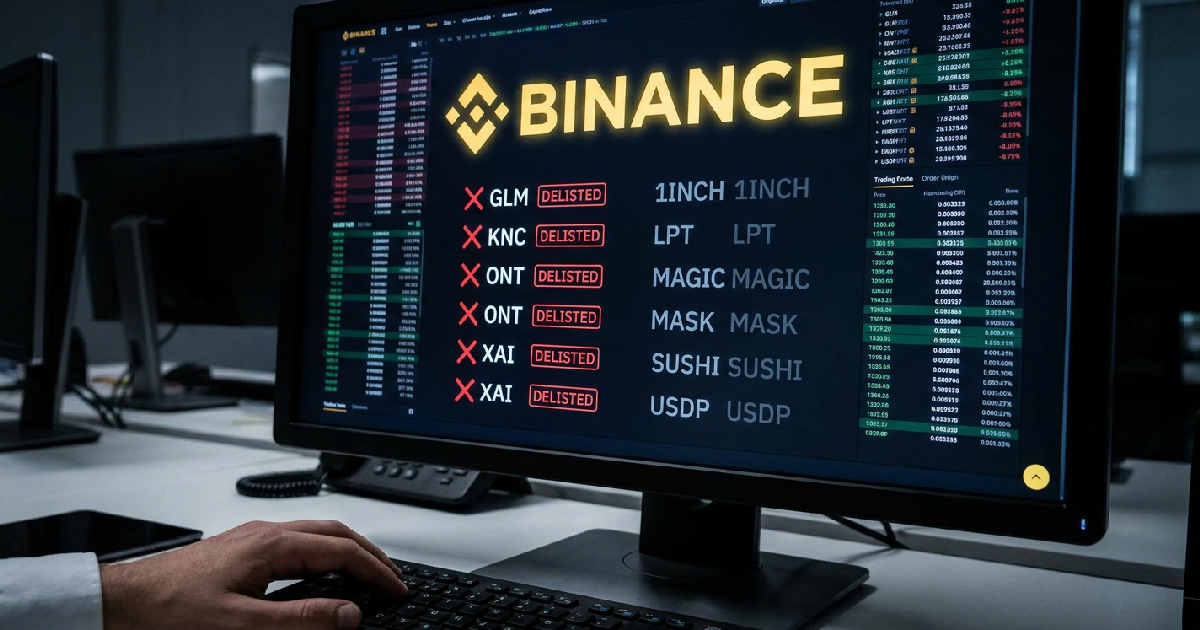

Leading cryptocurrency exchange Binance announced today it will delist ten crypto trading pairs from its spot and margin platforms this week. This move, scheduled for July 17, 2026, follows the exchange’s routine periodic reviews aimed at ensuring a high-quality trading environment.
The changes affect four spot trading pairs and six margin trading pairs, impacting various digital assets. Binance issued separate announcements on July 13 and July 14, advising users to adjust their positions accordingly.
Binance delisting crypto trading pairs from spot and margin
Four spot trading pairs will cease operations on July 17, 2026, at 03:00 UTC. These include GLM/BTC, KNC/BTC, ONT/BTC, and XAI/USDC. Binance confirmed it’ll also terminate Spot Trading Bot services for these specific pairs at the same time.
Users operating automated strategies for these pairs need to update or cancel their bots promptly. The delisting of these spot pairs doesn’t mean the underlying tokens are removed from Binance Spot. Users can still trade assets like Golem (GLM), Kyber Network Crystal (KNC), Ontology (ONT), and XAI through other available pairs, often against USDT or other stablecoins.
On the margin front, Binance will remove six pairs at 06:00 UTC on July 17, 2026. This includes cross-margin pairs 1INCH/USDC, LPT/USDC, MAGIC/USDC, MASK/USDC, and SUSHI/USDC. The isolated margin pair USDP/USDT is also affected.
The exchange has urged margin traders to close their positions and transfer assets from Margin Accounts to Spot Accounts before the deadline. Borrowing for the USDP/USDT isolated-margin pair was suspended earlier, on July 14, 2026, at 06:00 AM UTC, providing an advance warning.
Why Binance Delists Trading Pairs
Binance regularly reviews all listed spot and margin trading pairs to maintain its operational standards. This systematic evaluation covers several key aspects of each digital asset and its market activity. It’s part of a broader strategy to ensure a healthy and secure trading environment.
Primary factors influencing a delisting decision often include poor liquidity and consistently low trading volume. Tokens failing to generate sufficient activity can signal diminished market interest. This potentially leads to increased price volatility or manipulation risks.
Beyond market metrics, Binance also scrutinizes “project going-concern risk.” This includes factors such as low user adoption, a lack of consistent technical advancements, or an unresponsive project team. Regulatory compliance and security vulnerabilities also play crucial roles in these assessments, with projects facing legal issues risking removal.
Direct Impact on Traders and Assets
For traders invested in these specific pairs, the announcement necessitates immediate action. Outstanding orders on spot pairs will be automatically removed after the delisting time. Similarly, Binance Margin will close users’ positions, conduct automatic settlements, and cancel pending orders for the affected margin pairs.
Delistings often trigger immediate market reactions, with affected tokens experiencing sharp price declines. Some see double-digit losses following the announcement. Data from 2026 indicates that delisted tokens typically lose 80% of their market value within 30 days of notice.
This makes immediate withdrawal to a non-custodial wallet critical for capital preservation. Users are strongly advised to close their positions and/or transfer assets from Margin Accounts to Spot Accounts before the cessation of Margin trading to avoid potential losses during the approximately three-hour delisting process, when updating positions will be impossible.
The ability to trade base assets, such as Golem (GLM) or Kyber Network Crystal (KNC), through other available pairs on Binance offers a critical buffer. This means the tokens themselves aren’t being delisted from the broader exchange.
However, the immediate impact can still be significant for those who’ve built strategies around the removed pairs, especially for automated trading bots. Bitcoin price analysis often considers such changes in trading pair availability, as BTC-paired assets are directly affected.
The Broader Market Context
Binance’s commitment to maintaining a high-quality, compliant trading market is a constant balancing act. It operates in a rapidly evolving industry. The exchange must adapt to dynamic regulatory landscapes and market conditions, making periodic reviews and subsequent delistings an essential part of its operational strategy.
This is particularly relevant as the broader crypto industry faces increasing scrutiny and calls for greater transparency from global regulators. The specific tokens involved, like Golem (GLM), Kyber Network Crystal (KNC), and Ontology (ONT), represent projects with diverse applications. Their underlying technologies continue to evolve within the wider blockchain ecosystem.
Such decisions by major exchanges shape not only individual trading choices but also influence how projects prioritize development and market engagement. Projects whose pairs are delisted often face reduced visibility and trading activity.
This can present significant challenges for their future growth and investor confidence, highlighting the importance of deep project fundamentals over mere exchange listings. Bitcoin exchange supply, for instance, reflects broader market sentiment that can be influenced by such events.