
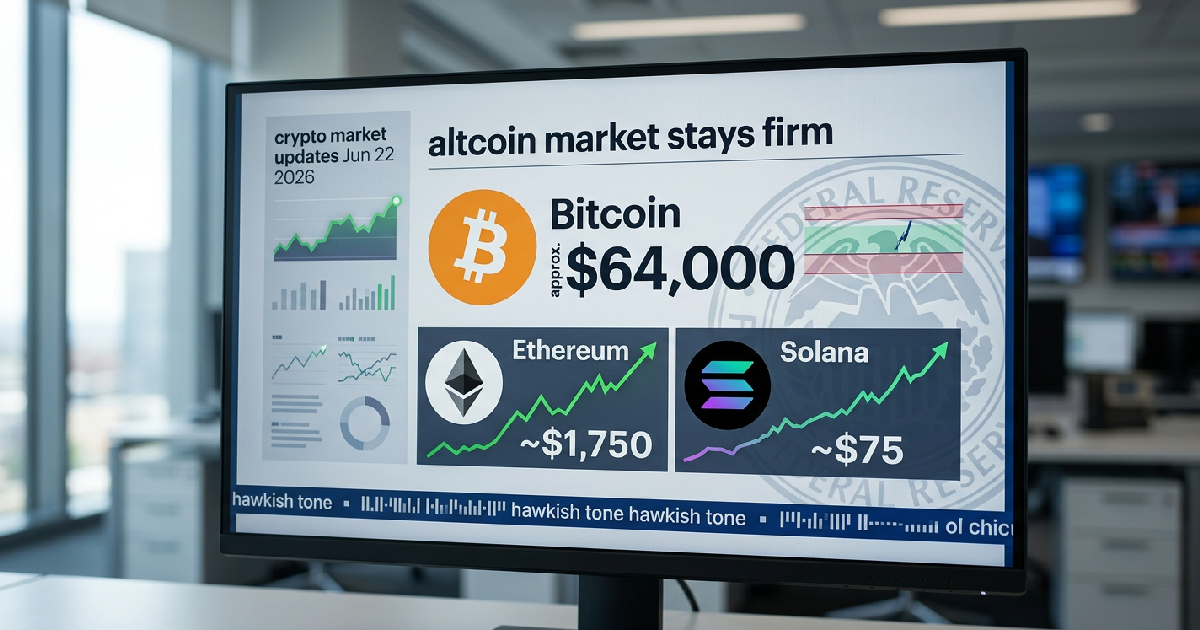

Bitcoin was trading near $64,000 on June 22, 2026, as the digital asset faced significant resistance and a hawkish tone from the Federal Reserve. While Bitcoin struggled to maintain upward momentum, the broader altcoin market stayed firm, with Ethereum and Solana trading at $1,750 and $75, respectively, according to data from Yusuf Islam at Analytics Insight.
The leading cryptocurrency experienced volatility over the weekend, slipping Sunday evening following the failure of peace talks in Switzerland. Although the asset rebounded from a low of $63,300, it met stiff resistance near $64,800.
Altcoin market resilience and Bitcoin dominance
This current price action follows a more optimistic period exactly one week ago, when Bitcoin jumped from below $64,000 to above $67,000 in a single day following news of a June 19 deal between the U.S. and Iran.
Major tokens like Ethereum, Solana, and BNB remained steady as of June 22, despite the fluctuations in Bitcoin’s price. Analyst reports from DaanCrypto suggest that several altcoins have actually outperformed Bitcoin over the last three months.
This period of relative stability for alternative assets comes as Ethereum price prediction analysis indicates a strengthening outlook for the network, even as Bitcoin maintains a market dominance of 56.2% on CoinGecko.
Key details
The current market dynamics show a clear divide between Bitcoin’s macro-driven movements and the steadiness of layer-1 assets. While Bitcoin’s market cap holds at $1.285 trillion, its recent price trajectory has been choppy.
After moving to $66,400, the price dropped by roughly $4,000 before recovering into the $63,000 to $64,000 range over the most recent weekend. Brief price spikes to $63,200 and $64,800 were also recorded during this consolidation phase.
Macroeconomic pressures and geopolitical influence
Geopolitics and central bank policy remain the primary drivers of current market sentiment. Remarks from Donald Trump regarding Iran, alongside the failed diplomatic efforts in Switzerland, have contributed to the cautious atmosphere. Additionally, the Federal Reserve opted to keep interest rates unchanged, but the new chairman’s hawkish stance has weighed on Bitcoin’s ability to break through key resistance levels.
For many investors, these macro headwinds make Bitcoin price analysis critical for identifying the next directional move. The market is currently squeezed between the $63,300 support floor and the $64,800 resistance ceiling. This sideways movement has led some traders to pivot toward altcoins, where decentralized ecosystem developments are providing a different value proposition compared to Bitcoin’s “digital gold” narrative.
Institutional activity and long-term network upgrades
Beneath the daily price fluctuations, institutional players continue to engage with the network through large-scale staking. Earlier this year, Bitmine Immersion Technologies moved 94,670 ETH into the proof-of-stake validator network. This massive transaction, worth approximately $204 million at the time, brought the firm’s total staked holdings to over 3.14 million ETH.
Such moves are designed to earn yields of 3% to 4% annually while reducing immediate sell pressure on the secondary market.
The underlying technology of these networks is also slated for significant changes. The Ethereum network is preparing for the Glamsterdam upgrade in the first half of 2026, followed by the Hegota upgrade late in the year. These updates are intended to make the blockchain lighter and more performant.
As Russia push to expand asset whitelists for tokens like SOL, these technical improvements could play a role in how altcoins maintain their firmness in a fluctuating market.
As the second half of 2026 approaches, the market remains fixated on whether Bitcoin can flip the $64,800 level into support. Without a clear catalyst, the leading cryptocurrency may continue to trade within its current range, while holders look to the resilience of the altcoin sector for signs of a broader recovery.