
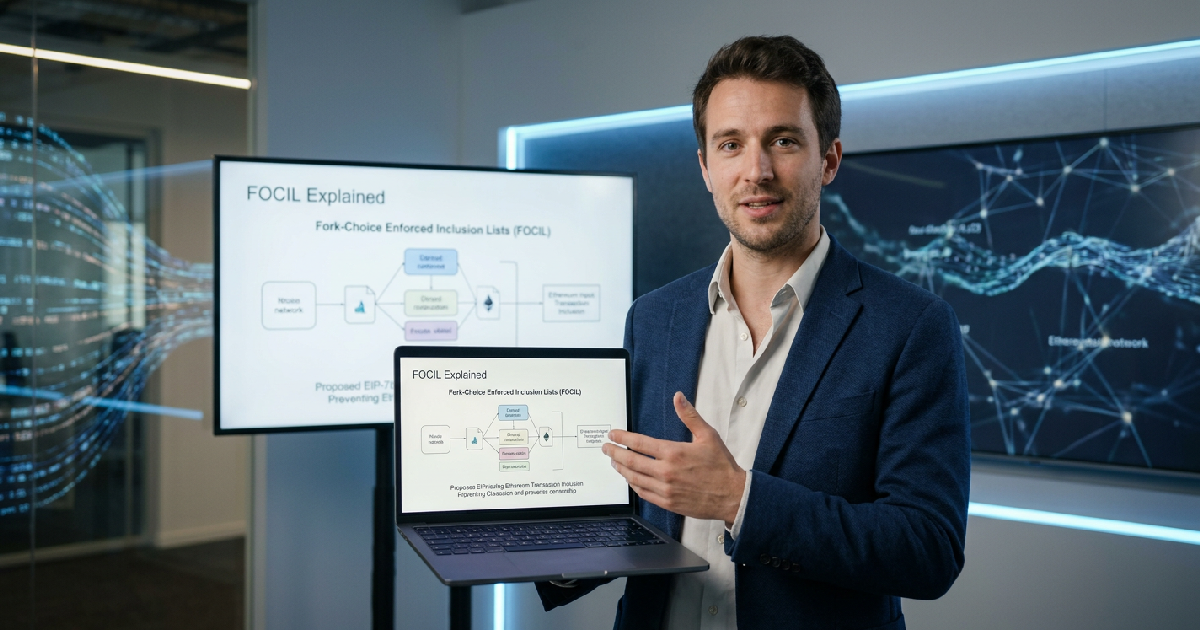

Thomas Thiery, a researcher with the Ethereum Foundation’s Robust Incentives Group, continues to champion EIP-7805, a protocol upgrade designed to safeguard the network against transaction censorship. Known as Fork-Choice Enforced Inclusion Lists (FOCIL), the mechanism was formally proposed on November 1, 2024, to ensure that valid transactions are included on-chain within a bounded timeframe regardless of builder preferences. By integrating these lists directly into the Ethereum fork-choice rule, the proposal aims to decouple censorship resistance from the increasingly centralized block production process.
The development addresses a growing concern within the ecosystem: the concentration of block building among a few sophisticated actors. These builders currently have the power to exclude or delay transactions, which threatens the neutral nature of the network. FOCIL provides a protocol-level recourse for users, removing the requirement to trust builders. This technical shift is considered vital as the Ethereum network outlook remains focused on supporting higher gas limits and the broad adoption of zkEVMs.
Unlike previous designs such as EIP-7547, which introduced a one-slot delay for forced inclusions, FOCIL enables same-slot inclusion. This means transactions submitted during slot N can be forced into the block for slot N+1, representing a significant efficiency gain. The proposal also remains “anywhere-in-block,” meaning it does not dictate exactly where forced transactions must sit. This flexibility is intended to reduce the incentives for builders to use side channels to circumvent the rules.
How FOCIL uses committees to decentralize inclusion
The core of EIP-7805 is its committee-based structure. In each Ethereum slot, 16 validators are pseudorandomly selected to serve as Inclusion List (IL) committee members. When including the block proposer, 17 different actors are involved in the selection of transactions for each slot. Each committee member builds a local inclusion list based on their own view of the mempool, with each list capped at 8 kilobytes to manage network bandwidth.
Once these lists are broadcast, the proposer and all attesters for the next slot monitor and store them. The builder must then include transactions from these collected lists to satisfy the protocol’s requirements. This decentralized approach requires only a “1-out-of-N” honesty assumption. If even one member of the committee is honest and includes a transaction, the protocol can theoretically ensure its eventual placement on the blockchain.
This move toward hardcoded censorship resistance comes at a time when other assets are seeing varied volatility. While traders monitor XRP speculative activity or Bitcoin supply levels, Ethereum developers are prioritizing the long-term neutrality of their base layer. Researcher Jihoon Song recently highlighted this progress at the EthCC conference, detailing how FOCIL protects the network from bribing and extortion attacks.
Enforcement through the fork-choice rule
The “Fork-Choice Enforced” designation indicates that these lists are not merely suggestions. Under FOCIL, the force-inclusion mechanism is a primary component of the consensus process. Attesters are required to vote only for blocks that both include the committee’s listed transactions and satisfy specific IL constraints. Any block that fails to meet these criteria is ignored by attesters and cannot become the canonical version of the chain.
This creates a strict economic consequence for non-compliant builders. If a builder attempts to censor a transaction that appears on the committee’s lists, their entire block risks being rejected. This shift moves enforcement from the social layer to the technical layer. It effectively removes the dependency on the altruism of a single proposer and places it in the hands of the broader validator set and the fork-choice rule.
FOCIL also incorporates “conditional inclusion” to ensure network stability. This means the protocol will still accept blocks that lack some transactions from the inclusion lists if the block is already full or if the transactions cannot be appended to the end. This prevents the mechanism from becoming a bottleneck during periods of high congestion or creating new vectors for denial-of-service attacks.
Implementation timeline for the Hegotá upgrade
FOCIL was originally introduced as a concept in June 2024 by Thomas Thiery, Barnabé Monnot, Francesco D’Amato, and Julian Maue. While the Stakers Union formally voted to support EIP-7805 for the Glamsterdam upgrade, the proposal was ultimately deferred. It has now been proposed as a headline feature for the Hegotá upgrade, allowing for more extensive testing of node performance and bandwidth requirements.
Currently, the proposal does not include an explicit incentive mechanism for committee members. Instead, it relies on the altruistic behavior of validators to construct these lists. However, researchers have noted that future extensions could include EIP-1559-style priority fees, where a portion of the transaction fees is directed to the IL creators. This would further align the economic interests of validators with the security of the network.
The focus on FOCIL persists even as Ethereum navigates key support levels amidst shifting institutional interest. By formalizing these rules, the Ethereum Foundation’s Robust Incentives Group aims to provide a long-term solution to builder centralization. The goal is to ensure Ethereum remains a permissionless platform where any protocol-valid transaction is guaranteed a place on the ledger.