
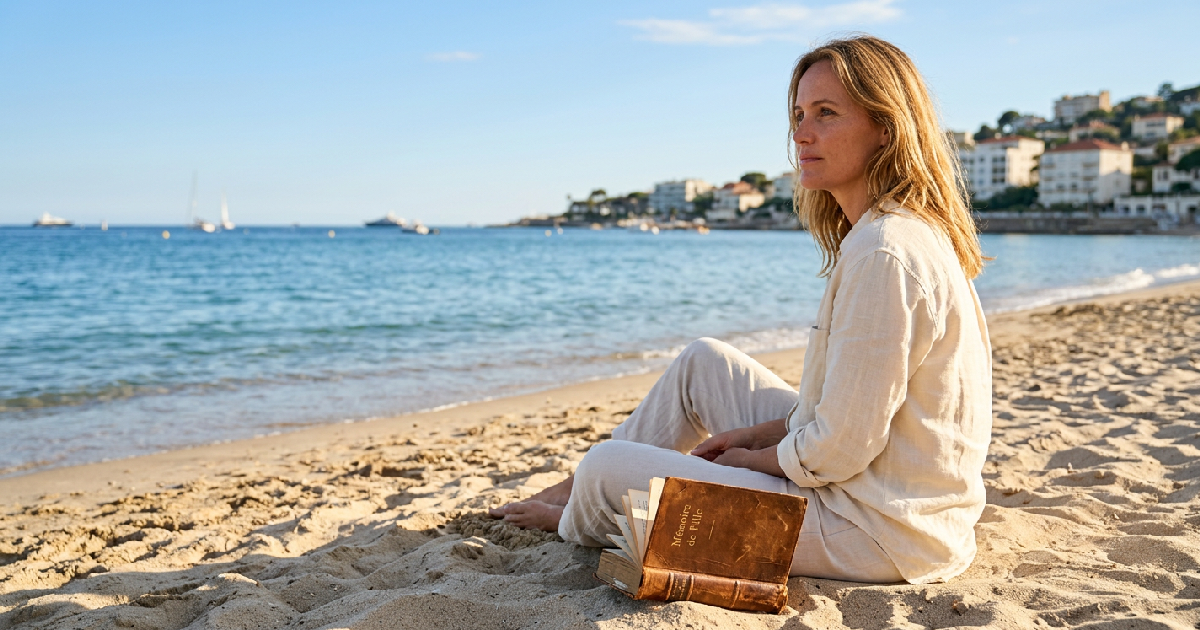

Director Judith Godrèche premiered her second feature film, “A Girl’s Story” (Mémoire de Fille), in the Un Certain Regard section of the 79th Cannes Film Festival on May 17, 2026. The production is a direct adaptation of the 2016 autobiographical novel by Nobel Prize-winning author Annie Ernaux, exploring a formative and traumatic summer in 1958. Godrèche, a central figure in France’s MeToo movement, wrote and directed the 117-minute drama, which features her daughter, Tess Barthélémy, in the lead role of young Annie.
The film navigates a dual timeline, opening with an older Annie Ernaux, portrayed by Valérie Dreville, during a conference in Rouen. This present-day lens frames the core narrative set nearly seven decades earlier in Yvetot and a summer camp in Normandy. The story centers on 18-year-old Annie’s first sexual encounter with H., the head counselor played by Victor Bonnel. What Annie initially misinterprets as a romantic awakening is revealed through the film’s progression as a brutal and isolating experience that leads to her ostracization by her peers.
For Godrèche, the project serves as a cinematic bridge between Ernaux’s literary interrogation of memory and the director’s own public advocacy for victims. This follows her 2024 short film, “Moi Aussi,” which also debuted at Cannes. By casting her daughter as the younger version of the protagonist, Godrèche adds a layer of personal intimacy to a story that has already been celebrated in literary circles for its unflinching honesty regarding shame and the female experience in mid-century France.
Judith Godrèche explores memory and trauma in A Girl’s Story
The adaptation of “A Girl’s Story” arrives at a time of heightened sensitivity in the French film industry regarding historical accounts of misconduct. Godrèche uses a meticulous approach to recreate 1958, juxtaposing the strict Catholic environment of Yvetot with the perceived freedom of the Normandy holiday camp. The film highlights how the young Annie struggled to name her experience at the time, a theme that resonates with modern discussions surrounding consent.
The production involved a significant collaboration of European partners, including Windy Production’s Carole Lambert and Moana Films’ Marc Missonnier. Financing and support came from France 2 Cinéma, Canal+, and the Normandie region, among others. While the film industry often navigates shifts in viewer interest, much like how investor sentiment shifts in other sectors, this film leans into the discomfort of historical truth rather than avoiding it.
Critical reception at the festival has focused on the performance of Tess Barthélémy. As the young Annie, she carries the weight of the character’s transition from a naive teen to a “judged” woman. The narrative does not shy away from the cruelty of the other counselors, who turn on Annie following her encounter with H. This social policing becomes a central pillar of the film’s second half, illustrating how the victim often bears the social cost of the perpetrator’s actions.
A feminist re-evaluation of Annie Ernaux’s 1958 summer
Screenwriter and director Judith Godrèche maintained the specific narrative voice of the source material, which Annie Ernaux originally wrote using both first and third-person perspectives. By including the older Annie as a framing device, the film allows the audience to see the Nobel laureate looking back at “the girl from ’58.” This structure emphasizes that the events of a single summer can ripple through a person’s entire life.
The cinematography captures the transition from the stifling atmosphere of Annie’s home life to the outdoors of the camp, though the freedom of the latter proves to be an illusion. Supporting cast members Ariane Labed, playing Annie’s mother, and Louise Labèque contribute to a world that feels lived-in and historically accurate. The score, composed by the musical duo Faux Amis, provides a modern sonic backdrop to the period setting, bridging the gap between past and present.
As the Cannes Film Festival heads toward its conclusion on May 23, “A Girl’s Story” is positioned as a major contender in the Un Certain Regard category. Many observers have noted that Godrèche has successfully transitioned from being a performer to a vital voice in European cinema. Just as institutional participation defines growth in financial markets, the backing of major French broadcasters like France Télévisions signals strong confidence in the film’s cultural potential.
Distribution and future outlook for the Nobel Prize adaptation
International sales for the film are being handled by Paradise City Sales, while Jour2Fête will manage the theatrical release in France. Given the success of previous Ernaux adaptations—most notably Audrey Diwan’s “Happening,” which secured the Golden Lion at Venice—expectations for “A Girl’s Story” are high for its upcoming global rollout. The film’s runtime of just under two hours allows for a deep dive into the nuances of the source text.
The production began filming in late October 2025, moving between the Paris region and Normandy to capture the specific geography of Ernaux’s youth. The collaboration with Belgium’s Umedia and various regional funds underscores the cross-border interest in Ernaux’s work since her Nobel win in 2022. This film not only reinforces her status as a titan of contemporary literature but also establishes Godrèche as a director capable of handling delicate material.
Following its Cannes run, “A Girl’s Story” is expected to travel to other major international festivals before its general release. The film stands as a definitive statement on the “MeToo” era in France, proving that the most powerful way to address current social issues is sometimes to look deeply and honestly at the past.