
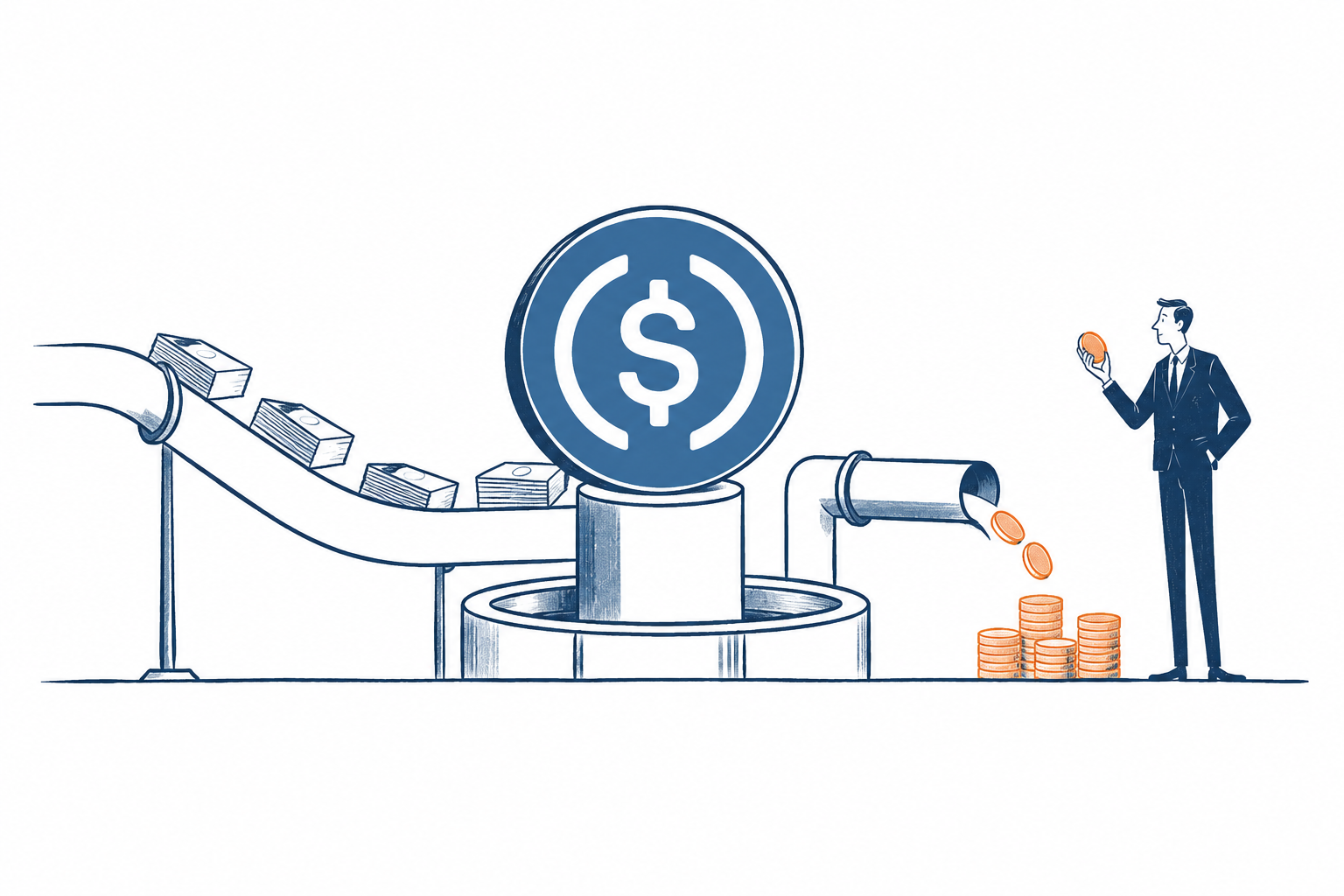

At first glance, Circle’s business model looks almost too simple to sustain a major financial technology company. Users send US dollars into the system, Circle issues an equal amount of USDC and the company holds those dollars so anyone can cash out at a strict one-to-one rate.
Circle does not charge retail users a fee every time they transfer USDC across a blockchain, nor can it simply take the incoming cash and spend it on corporate expansion. So where is the actual business?
To understand how Circle makes money, you have to stop looking at USDC as a software product sold to consumers and start viewing Circle as a specialized financial intermediary. The company operates at the intersection of crypto rails and traditional fixed-income markets.
Its core revenue comes not from moving digital tokens, but from the interest generated by the massive pool of cash and short-term government debt sitting quietly behind them. Yet between those headline interest numbers and Circle’s bottom line lies a complex web of revenue-sharing agreements and operational expenses that dramatically alters how much profit the company actually keeps.
Why User Deposits Are Liabilities, Not Revenue
The foundation of any fiat-backed stablecoin is trust in its peg—the guarantee that one digital token can always be redeemed for one physical dollar. Maintaining that guarantee dictates how Circle treats every dollar that enters its accounts.
When an institutional client or exchange deposits $10 million with Circle, the company mints 10 million new USDC and puts them into circulation. When a holder wants out, the process runs in reverse: the tokens are returned, permanently destroyed (or “burned”), and $10 million in cash is wired back to the user.
From an accounting and operational standpoint, the dollars Circle receives during issuance are not sales revenue. They are liabilities. Every USDC circulating in a crypto wallet represents an active obligation that Circle must be ready to honor on demand.
Because those funds are strictly ring-fenced to back the token supply, Circle cannot treat incoming deposits as free cash flow.
This structure also explains a common point of confusion for newcomers to digital assets: why holding USDC in a standard self-custody wallet does not automatically pay you interest. Unlike a high-yield savings account where a bank shares a portion of its lending returns with depositors, USDC is designed primarily as a digital settlement instrument—a stable medium of exchange.
Circle captures the financial return generated by the underlying collateral, while token holders get price stability and borderless transferability.
Inside the Circle Reserve Fund and the Yield Engine
If the principal must stay untouched to guarantee redemptions, Circle’s primary revenue engine relies on putting that idle capital into safe, liquid instruments that generate yield.
According to Circle’s reserve framework, USDC is backed entirely by cash and high-liquidity cash equivalents. Rather than taking risky bets on corporate bonds or volatile assets—which could jeopardize redemptions during a market panic—the company keeps the overwhelming majority of its reserves inside the Circle Reserve Fund.
Registered in the United States as a government money market fund, this vehicle holds short-dated US Treasury bills and overnight repurchase agreements (often called “repos,” which are ultra-short-term loans collateralized by government securities). The remaining portion of the reserves sits as cash held across regulated banking partners.
This setup turns Circle’s balance sheet into a massive interest-rate machine driven by two distinct variables:
- Circulating supply: The average total volume of USDC in the market. All else being equal, a larger circulating supply means a larger reserve pool generating daily interest and dividends;
- Prevailing interest rates: The yield paid by short-term US government debt.
Here lies an important nuance that often catches casual observers off guard: stablecoin adoption and issuer revenue do not always move in lockstep. If USDC circulation grows by 20% over a year, you might assume Circle’s revenue automatically jumps by the same percentage. However, if the Federal Reserve cuts interest rates during that same period, the yield earned on every reserved dollar drops.
An expanding token supply can be partially—or even entirely—offset by a lower-rate environment. Conversely, during periods of elevated Treasury yields, even a flat or modestly growing reserve base can produce substantial gross interest income.
While Circle also generates supplemental revenue from developer tools, subscriptions, and enterprise payment integrations, those streams remain secondary. The yield earned on reserve assets is the structural heartbeat of the company.
The Hidden Price of Adoption: Sharing Yield With Distributors
Looking strictly at reserve yields creates the illusion of an effortless, ultra-high-margin business. After all, managing short-term Treasury bills requires far fewer physical branches than a traditional retail bank. Why wouldn’t Circle pocket almost all of that interest?
The answer comes down to distribution. Issuing a stablecoin is only half the battle; getting millions of traders, merchants, and apps to actually use it requires massive reach. Circle does not control the primary venues where retail and institutional users buy, hold, and trade crypto. Instead, it relies on an ecosystem of exchanges, digital wallets, and payment processors to put USDC in front of end users.
That distribution network is not free.
The commercial relationship between Circle and Coinbase is the clearest example of how this dynamic works. Coinbase plays a central role in supporting USDC liquidity, integrating the token across its retail and institutional products, and encouraging adoption.
In exchange, Coinbase receives ongoing payments tied directly to the net yield generated by USDC reserves. The exact split reflects several factors, including how much USDC is held directly on Coinbase’s platform versus circulating across the broader crypto economy.
In Circle’s financial reporting, these payouts are recorded as distribution costs—and they represent a major slice of the pie. Coinbase is not the only partner in this equation, either. Circle has also established commercial arrangements with major global platforms like Binance, providing financial incentives tied to the integration and usage of its digital assets.
This reveals a fundamental tension at the center of Circle’s business model. To scale USDC and defend its market share against rival stablecoins, Circle needs deep integration across the world’s largest exchanges and fintech apps.
Yet the more heavily Circle relies on incentivized distribution channels to drive that growth, the larger the share of reserve yield it must hand over to its partners. Growth expands the top-line reserve pool, but distribution agreements ensure that Circle never keeps 100% of the upside.
Gross Yield Versus Net Profit in the Stablecoin Business
Even after distribution partners take their contractual share, the remaining reserve income still has to fund an expensive, highly regulated global operation before a single dollar becomes net profit.
Running a major stablecoin infrastructure requires continuous investment across several heavy cost centers:
- Blockchain engineering and multichain support: USDC does not live on a single network. Maintaining native deployments, cross-chain transfer protocols, and smart contract security across Ethereum, Solana, Base, and dozens of other blockchains requires extensive engineering talent;
- Compliance, licensing, and regulatory overhead: Operating within US and international financial frameworks demands rigorous anti-money laundering (AML) monitoring, sanctions screening, financial audits, and state-by-state or country-specific money transmitter licenses;
- Corporate operations and taxes: Standard administrative expenses, security infrastructure, and corporate tax obligations further narrow the gap between gross revenue and net income.
This distinction is why analyzing a stablecoin issuer requires looking past headline reserve figures. Financial statements separate gross reserve income—the total interest earned before partner payouts—from what remains after distribution and transaction costs are deducted.
A massive pool of Treasury bills can generate impressive top-line numbers while leaving a much tighter operating margin once partner splits and regulatory expenses are accounted for.
Understanding how Circle makes money ultimately comes down to separating the collateral from the business. The billions of dollars sitting in cash and short-term Treasuries belong economically to the users holding USDC, serving strictly as the anchor that keeps the token pegged to a dollar.
Circle’s real business lives in the spread—the interest generated by those safe assets, minus the steep cost of convincing the crypto ecosystem to distribute and adopt the token.