
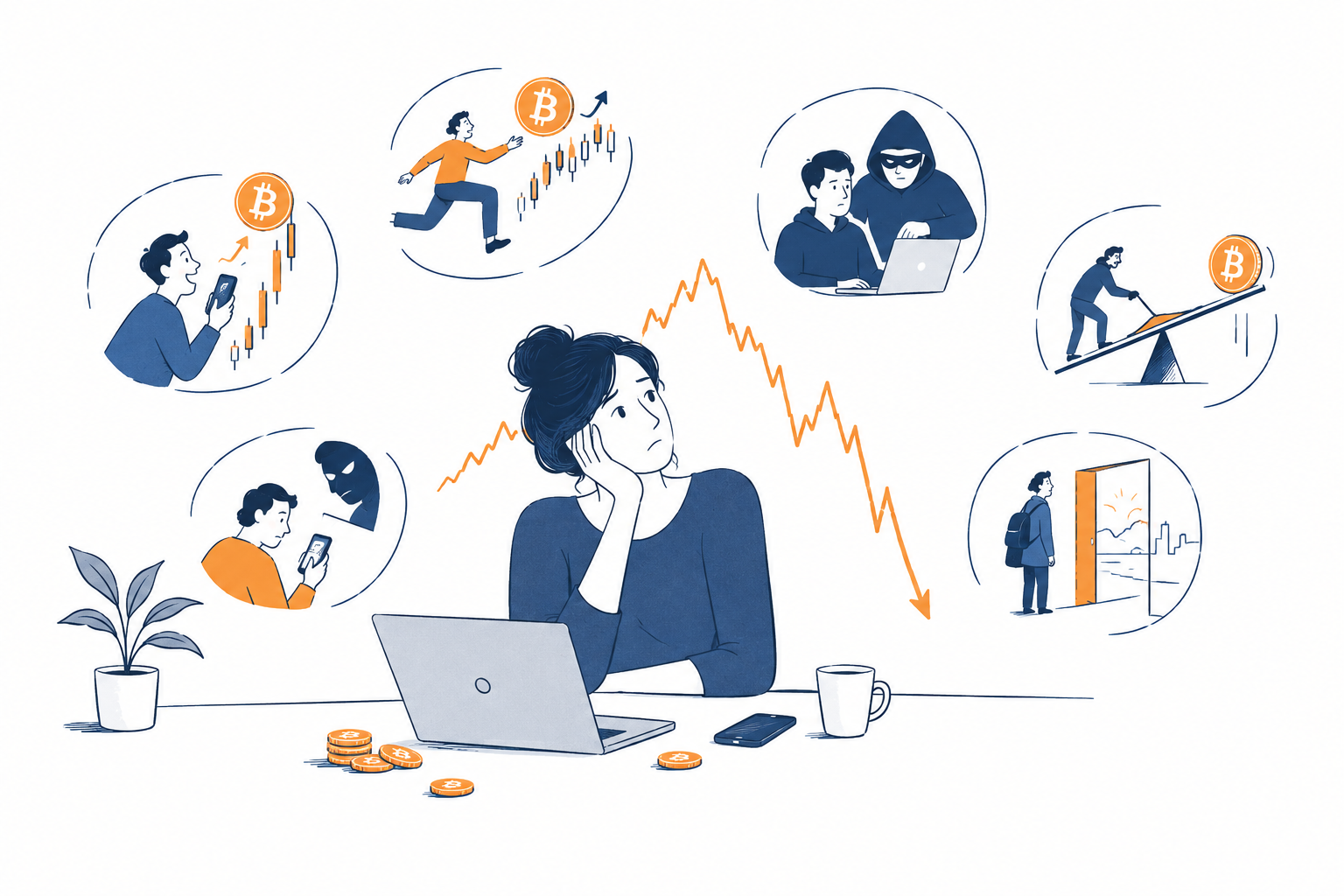

A rising Bitcoin price does not necessarily mean that everyone holding cryptocurrencies is making money. Someone who bought BTC before a rally may be sitting on substantial gains, while another investor who entered later could already be at a loss. Both are participating in the same market, but their financial outcomes are very different.
The discrepancy becomes easier to understand when looking beyond price movements. Investment timing, the type of asset held, available liquidity and the use of leverage can all determine whether a market rally translates into an actual return.
In other words, the performance of the crypto market and the performance of an individual portfolio are two different things. Understanding why they diverge helps explain why people lose money in crypto even during periods of rising prices.
Rising Bitcoin prices can attract buyers just as the rally starts running out of steam
One of the most common reasons investors lose money in crypto is entering the market after a substantial price increase.
When Bitcoin starts climbing, media coverage tends to intensify, conversations about potential gains become more frequent and previously uninterested investors may begin considering an entry. This behaviour is often associated with FOMO, or fear of missing out: the anxiety of watching an opportunity pass without participating.
The problem is that buying decisions can become increasingly influenced by recent performance rather than an assessment of the asset’s risks. An investor sees Bitcoin rising by 20% and assumes the same movement will continue, without considering how much of the expected optimism may already be reflected in the price.
Research published by the Bank for International Settlements (BIS) illustrates this relationship. Using data on crypto exchange app adoption across 95 countries between 2015 and 2022, researchers found that rising Bitcoin prices were followed by an increase in new users.
The study also estimated that between 73% and 81% of retail investors probably lost money on their initial Bitcoin investment as prices subsequently declined. This was an estimate based on app usage and market data, rather than a direct measurement of every investor’s portfolio.
Nevertheless, it highlights how new participants can enter during periods of rising prices and still experience losses.
Social influence can reinforce the same behaviour. In its 2024 consumer research, the UK’s Financial Conduct Authority (FCA) found that friends and family were the main reason for purchasing cryptoassets for 20% of respondents who had bought them.
None of this means that buying after a rally automatically leads to a loss. The important distinction is that an asset’s recent performance does not guarantee the price will continue moving in the same direction.
A rising market does not mean every cryptocurrency is gaining value
Another explanation is that investors often treat the cryptocurrency market as though all its assets move together.
Bitcoin can appreciate significantly while smaller altcoins remain stagnant or lose value. A market-wide performance indicator may reflect the growth of a handful of large assets, without representing what is happening across every token.
Liquidity also makes a considerable difference.
A cryptocurrency’s market capitalisation is generally calculated by multiplying its circulating supply by its latest market price. However, this figure does not represent the amount of money available to buy every token at that valuation.
Consider a token trading at $2. If its circulating supply is 10 million units, its implied market capitalisation is $20 million. Yet this does not mean investors could sell all 10 million tokens for $2 each.
That depends on market depth: the volume of buy orders available at different prices. When demand is limited, a large sell order can exhaust the available buyers and push the execution price down.
This is particularly relevant for smaller tokens, memecoins and projects where a significant proportion of the supply is concentrated in a relatively small number of wallets.
A price displayed on an exchange can therefore give investors a misleading impression of what their holdings are worth in practice. They may see an apparently profitable position but discover that selling it would require accepting a considerably lower price.
The distinction is between the value assigned to an asset by its latest trade and the value an investor can actually realise when selling.
Leverage can wipe out a position before the market has time to recover
Some investors lose money despite correctly anticipating the longer-term direction of the market because they take on more exposure than their capital can support.
Leverage allows traders to control a position larger than the amount of money they initially deposit. While this can amplify potential gains, it also magnifies losses when prices move against them.
For example, an investor using $1,000 as collateral with 10x leverage controls a $10,000 position.
A 5% decline in the underlying asset represents a $500 loss, equivalent to half of the initial collateral, before fees and other costs. A larger adverse movement can consume most or all of the available margin.
This is where liquidation becomes important. If the position’s remaining collateral falls below the exchange’s required maintenance margin, the platform can automatically close the trade to limit further losses.
The investor may therefore lose their position during a temporary market decline, even if the asset subsequently recovers.
The scale of this risk became particularly visible on 10 October 2025, when more than US$19 billion in leveraged crypto positions were reportedly liquidated within 24 hours, according to CoinGecko’s review of the market event.
Liquidations do not necessarily represent the same amount in realised losses for every participant, but they illustrate how quickly leveraged positions can be forced out of the market.
This creates an important distinction between holding an asset and trading it with leverage. An investor with an unleveraged position may be able to wait through a downturn. Someone trading with borrowed exposure might not have that option.
Frequent trading can erode returns even when prices are moving up
Another reason people lose money in crypto is the cost and difficulty of trying to profit from every market movement.
Cryptocurrency exchanges generally charge trading fees, while the difference between buying and selling prices — known as the bid-ask spread, adds another cost to each transaction.
There is also slippage, which occurs when an order is executed at a different price from the one expected. This is especially relevant in less liquid markets, where even relatively modest orders can move prices.
These expenses may appear small individually, but they accumulate when someone repeatedly buys and sells assets.
Frequent trading also introduces a behavioural problem: investors must make several decisions correctly to benefit from short-term price movements.
Someone might sell Bitcoin during a correction because they expect a further decline, only to watch prices recover before they manage to buy back in. Even if their original market outlook was correct, the timing of their decisions may have reduced their overall return.
The opposite can happen as well. An investor may hold a profitable position for too long, waiting for an increasingly ambitious price target, and eventually give back much of the accumulated gain.
The maths of recovering losses makes this particularly important. An asset that falls by 50% must subsequently gain 100% to return to its original value. After a 90% decline, it needs to rise by 900%.
A large loss therefore requires a disproportionately larger recovery, making capital preservation an important part of long-term market participation.
Why do people lose money in crypto even when the market is rising?
A rising cryptocurrency market does not guarantee that individual investors will benefit from it. Market performance reflects movements in asset prices, while personal returns depend on when someone entered, what they bought and how they managed their positions.
Investors who buy after substantial rallies can find themselves exposed to market corrections. Those holding less liquid tokens may discover that the displayed price does not reflect what they can actually sell for, while leveraged traders risk having positions liquidated before a recovery takes place.
Trading costs and poorly timed decisions can further reduce returns, even when the broader market continues moving upwards.
Ultimately, losing money in crypto is not necessarily a sign that someone misjudged the direction of the market. It can mean that their position, timing or trading strategy was poorly suited to the way that market moved.
Understanding this distinction is essential when evaluating crypto performance. A rising market tells investors what happened to prices. It does not tell them what happened to everyone’s money.