
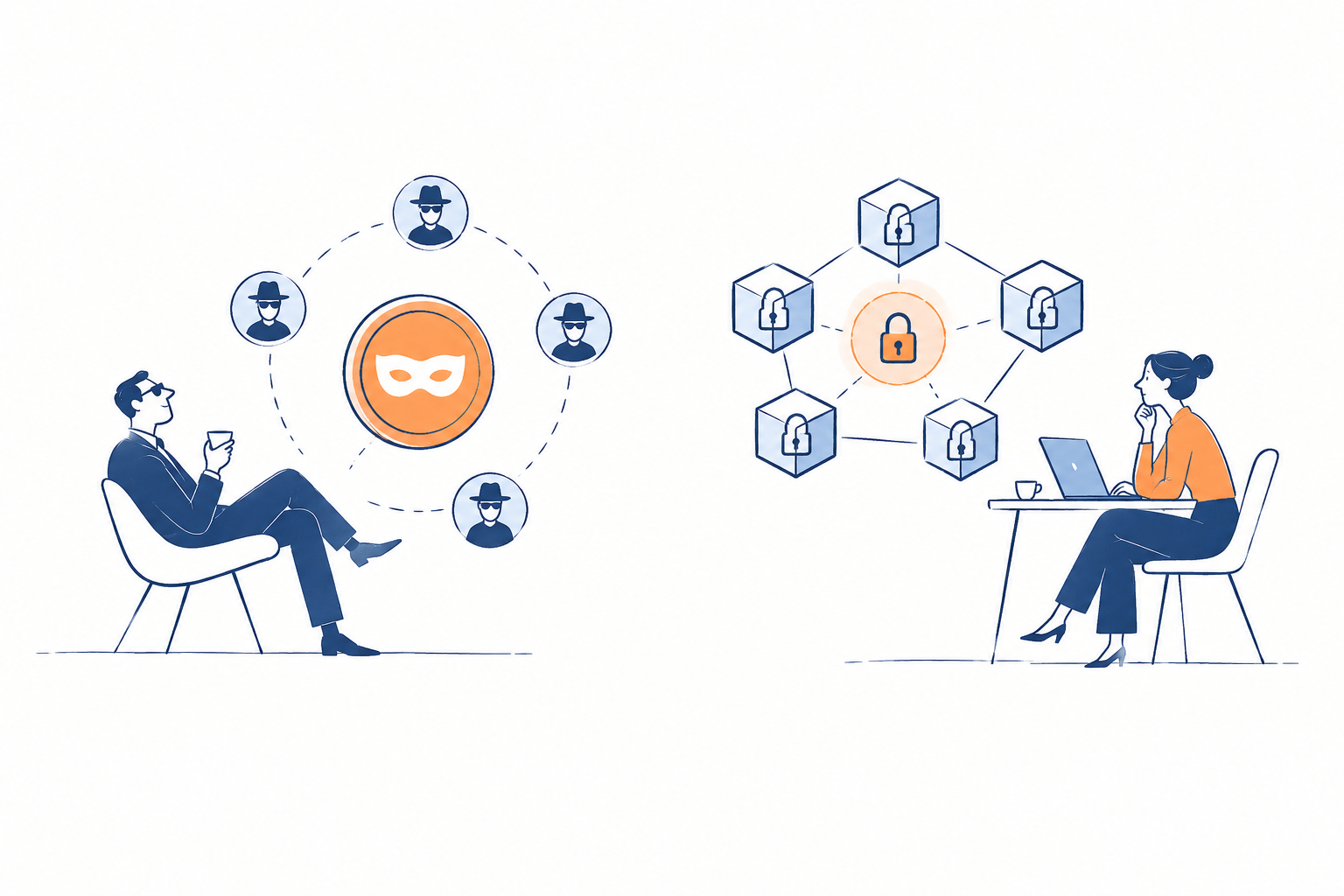

A blockchain can be transparent by design and still offer users ways to keep sensitive information private. That distinction is easy to miss because the same cryptographic techniques can appear in very different systems.
This is where privacy coins vs privacy-preserving blockchains becomes a useful comparison. Monero and Zcash were built around financial privacy, while broader blockchain privacy systems can use similar ideas to protect smart contracts, identity claims or application data.
The difference is not which technology they use. It is what privacy is meant to protect, and where it sits in the architecture.
What is the difference between privacy coins and privacy-preserving blockchains?
A privacy coin is a cryptocurrency designed with transaction privacy as a central part of the asset itself. Its architecture aims to make information such as the sender, recipient or amount harder to trace, depending on the network.
A privacy-preserving blockchain, by contrast, is a broader concept. Privacy can function as infrastructure that applications use when they need confidentiality, rather than being the defining purpose of the currency.
That means a privacy-focused system does not necessarily have to hide every activity on a network. It might allow a user to prove they meet a requirement without revealing their identity, or let a smart contract process sensitive information without publishing all of its inputs.
The simplest way to think about the distinction is this: Privacy coins put financial privacy at the centre of the currency. Privacy-preserving infrastructure makes privacy a capability that different applications can use.
Privacy coins begin with a transaction that should reveal less
On a conventional public blockchain, transactions are designed to be independently verifiable. That transparency makes it possible to inspect activity on a block explorer, but it can also expose financial relationships that users never intended to make public.
Privacy coins approach the problem at the transaction level.
Monero is a clear example. Its protocol uses ring signatures, RingCT and stealth addresses to protect different parts of a transaction. Ring signatures help obscure the true sender, RingCT hides the amount, and stealth addresses prevent payments from being publicly linked to the recipient’s published address. Monero makes these privacy protections mandatory rather than offering a transparent transaction mode.
This architecture also supports another important property: fungibility. In simple terms, units of the currency are less likely to be treated differently because observers cannot reconstruct the same transaction history they could on a transparent blockchain.
Zcash takes a different approach.
Its network supports both transparent and shielded transactions. Shielded transactions use zero-knowledge cryptography to keep addresses and transaction amounts private, while transparent transactions expose financial information publicly. Users therefore have a choice between different levels of visibility.
Both projects are privacy coins, but they demonstrate an important point: even that category does not describe a single technical model.
Privacy becomes a broader problem when the blockchain does more than move money
The argument changes once privacy is needed for something other than a payment.
Imagine a blockchain application that wants to check whether someone is over a certain age. It could ask for a complete identity document and publish the relevant information onchain. But that would reveal far more than the application actually needs.
A different approach would be to prove only the required fact.
This is where zero-knowledge proofs become useful. They are cryptographic techniques that can prove a statement is true without revealing the underlying information used to prove it.
Ethereum provides a useful example of this broader model. The base network is public by design, meaning addresses, balances, transactions and contract activity can be observed. But developers can build privacy applications on top of that infrastructure using zero-knowledge proofs and other techniques.
The application might use privacy for anonymous voting, identity verification, claims or other interactions. The blockchain does not have to become a privacy coin for those functions to exist.
That is the conceptual leap.
Privacy stops being exclusively a property of the money moving through the network and becomes a tool that developers can apply to specific parts of an application.
Similar cryptographic tools do not make the systems the same
This is where the distinction can become confusing.
Privacy coins and privacy-preserving applications can rely on overlapping technologies, including zero-knowledge proofs, commitments, stealth addresses and other cryptographic mechanisms.
But the presence of a particular technology does not determine the category.
Consider two systems that both use zero-knowledge proofs.
In one, the technology might be used to shield the details of a cryptocurrency payment. In another, it might allow a user to prove membership in a group without revealing which member they are.
The cryptography overlaps. The product does not.
That is why defining a project simply by the technology it uses can produce a misleading comparison. A privacy coin is primarily organised around private financial transactions, while privacy-preserving infrastructure can use confidentiality selectively across many types of activity.
Ethereum’s own privacy roadmap explicitly frames this idea around selective disclosure: privacy does not have to mean hiding everything. It can mean choosing what information to reveal, to whom and under which conditions.
Privacy does not always mean disappearing from the record
That idea introduces an important nuance.
For some users, total invisibility would be inconvenient. A business may need to demonstrate that a payment was made. An auditor may need to inspect financial information. A customer may need to prove eligibility to a service without revealing unrelated personal details.
The more useful question, then, is not simply whether information is public or private.
It is who gets to see what.
Zcash’s shielded transaction model illustrates this tension particularly well. A user can keep financial information away from public view while retaining mechanisms for controlled access to certain transaction information.
Monero offers another illustration. Its privacy is designed to be the default, but the protocol still includes mechanisms such as view keys that can give selected parties access to certain wallet information for purposes such as auditing.
This is very different from the idea that privacy means making a blockchain impossible to inspect under any circumstances.
In many real applications, the more valuable feature may be control over disclosure, rather than absolute secrecy.
The real difference is where privacy lives
The distinction between privacy coins and privacy-preserving blockchains becomes much clearer when viewed as an architectural question.
A privacy coin starts with a currency and asks how its transactions can reveal less. The privacy mechanism is therefore tightly connected to the movement and ownership of that asset.
Privacy-preserving infrastructure starts with a broader question: which information does this application need to reveal, and which information can remain private while the network still verifies what matters?
That distinction does not make one model a replacement for the other.
Someone primarily concerned with the confidentiality of financial transactions has a different requirement from a developer building a private identity system or a smart contract that handles commercially sensitive information.
The future of blockchain privacy may therefore be less about choosing between “private” and “public” networks than about making privacy more precise.
The important shift is not simply from visible blockchains to invisible ones. It is from privacy as a property of a particular currency to privacy as something that can be designed into individual interactions.
That is ultimately the more useful way to understand the difference: not by asking which system hides more, but by asking what it protects, when it protects it and who controls the boundary between private and public information.