
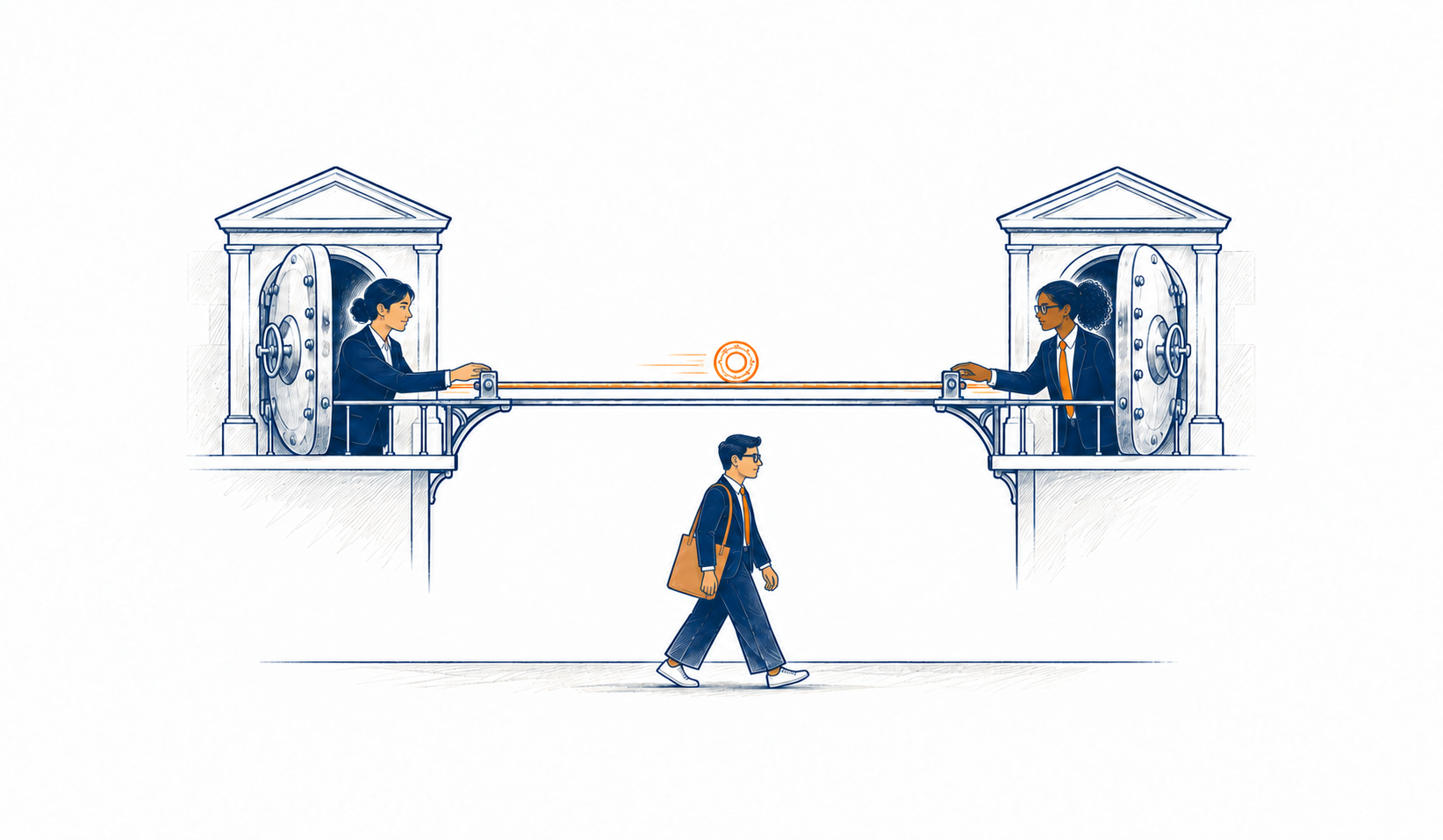

Stablecoins became valuable partly because they could move dollars outside traditional banking rails.
North Dakota is now testing the opposite idea.
More than 90 banks and credit unions are gaining access to Roughrider Coin, a blockchain-based dollar instrument developed by Fiserv and the state-owned Bank of North Dakota. Transactions run on Solana, VersaBank acts as the issuer and Fireblocks provides digital asset infrastructure.
But Roughrider Coin is not being launched as another digital dollar for consumers.
The public cannot buy it, hold it as an investment or keep it in a personal crypto wallet. It was designed specifically for transactions between participating financial institutions.
That makes the project more than another stablecoin launch.
It shows how banks can adopt some of the architecture pioneered by stablecoins while keeping the money itself inside the banking system.
The Customer Does Not Need a Crypto Wallet
For a North Dakota bank, accessing Roughrider Coin does not require building a separate crypto operation.
Fiserv has integrated the asset into Commercial Center, the platform financial institutions already use for commercial banking services.
That distribution model may be as important as the blockchain underneath it.
A bank employee does not necessarily need to interact directly with Solana, manage a DeFi application or route funds through a crypto exchange. Blockchain becomes another rail embedded inside software the institution already uses.
The operational experience can remain familiar even when the infrastructure moving the value changes.
This offers a different route to blockchain adoption in banking.
Instead of convincing individual institutions to become crypto companies, infrastructure providers can add tokenized money to products banks already use.
The bank adopts the function before it needs to adopt the crypto experience.
Roughrider Coin Sits Somewhere Between Stablecoins and Bank Deposits
The terminology around the project is important.
Fiserv discusses stablecoins as part of its broader digital asset platform. Bank of North Dakota describes Roughrider Coin more specifically as a tokenized deposit for financial institutions.
That distinction separates it from assets such as USDC and USDT.
Public stablecoins are designed to circulate broadly. Individuals, exchanges, businesses and financial applications can hold and transfer them, subject to the rules surrounding each asset and platform.
Roughrider Coin has a narrower perimeter.
Bank of North Dakota says each token represents a dollar on deposit, while access is restricted to participating financial institutions. Consumers cannot purchase or invest in it.
The blockchain rail is therefore open to a much smaller financial universe than the networks normally associated with stablecoins.
Money moves on-chain, but it does not leave the institutional banking perimeter.
Distribution Could Matter More Than Building New Blockchains
Bank of North Dakota occupies an unusual position in the U.S. financial system.
As a state-owned bank, it works with local financial institutions rather than operating purely like a conventional retail bank. That relationship creates a network through which more than 90 banks and credit unions can gain access to the new infrastructure.
Fiserv adds another dimension.
Its technology already sits inside thousands of financial institutions. That means the long-term significance of its digital asset platform is not simply whether Roughrider Coin succeeds in one state.
It is whether blockchain-based financial services can eventually be distributed through the same technology vendors that already power banking.
That changes the adoption problem.
If every bank has to select a blockchain, build wallet infrastructure, integrate custody and develop its own tokenized deposit system, adoption remains technically demanding.
If those capabilities become features inside existing banking software, the threshold becomes much lower.
The winning infrastructure may therefore be the one banks barely notice they have adopted.
Banks Can Copy Stablecoins Without Using Public Stablecoins
The project also complicates the idea that stablecoins and bank deposits are competing forms of digital money.
Stablecoins demonstrated several characteristics that conventional bank money historically struggled to offer in the same package: continuous blockchain settlement, programmability and transferability across digital infrastructure.
Banks can adopt those characteristics without necessarily surrendering deposits to third-party stablecoin issuers.
Tokenized deposits offer one path.
Instead of moving money from a bank account into a privately issued public stablecoin, the deposit itself receives an on-chain representation that can move within an authorized financial network.
The technological outcome can look similar.
The financial structure is different.
In one model, a stablecoin issuer creates the digital money used by financial institutions.
In the other, banks bring their own money onto blockchain infrastructure.
Roughrider Coin belongs much closer to the second model.
Blockchain Adoption Does Not Have to Reach Consumers
That leads to an unusual measure of success.
A consumer could bank with one of the participating institutions for years without ever owning Roughrider Coin.
They might never see its ticker, open a crypto wallet or know that Solana is involved somewhere in the infrastructure.
The project could still work.
If banks use the token to move money between themselves more efficiently, consumer ownership is irrelevant to its core purpose.
That is a significant departure from the way crypto adoption is usually discussed. Success does not have to mean millions of new token holders.
It can mean a relatively small number of financial institutions moving increasingly large amounts of money through blockchain infrastructure.
Fiserv and Bank of North Dakota are effectively testing whether the technology behind stablecoins can become useful to banks without turning stablecoins into a product banks need to sell to their customers.
If that model expands, some of the largest users of on-chain money may not be consumers at all.
They may be the banks that stablecoins were once expected to bypass.