
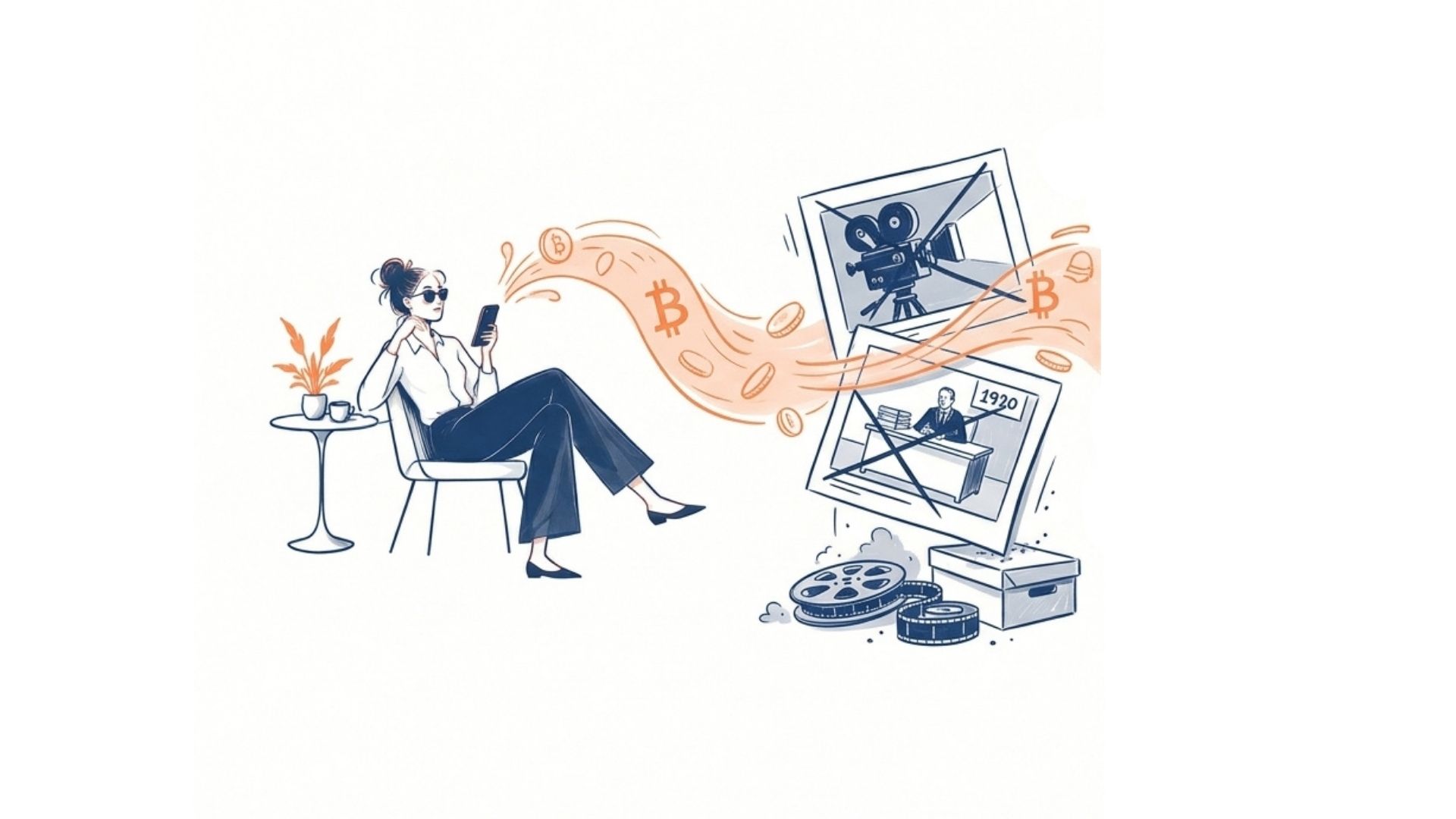

A person sitting down to watch a stream or buy something inside a game is not looking for a lesson in blockchain infrastructure.
They want the payment to work.
That sounds obvious, but it gets to the heart of why crypto payments have found a particularly interesting testing ground in digital entertainment. Gaming platforms, streaming services and other online products operate in environments where the product is already digital, the user may be anywhere in the world and a few seconds of friction can be enough to abandon a transaction.
That combination gives crypto an unusual place to prove its usefulness.
The question, then, is not simply whether entertainment companies should accept cryptocurrency. It is whether they can build a payment experience in which the underlying blockchain becomes almost invisible.
Why entertainment suits crypto payments better than the high street
Consider the difference between buying a physical product and paying for something that exists entirely online.
A traditional retailer has to deal with delivery, local payment methods, returns and a variety of operational costs. A gaming platform selling an in-game item, or a streaming service charging for a subscription, already operates inside a digital environment.
That makes the payment layer easier to experiment with.
Cross-border transactions are another part of the equation. A digital service can attract users from dozens of markets without changing the nature of the product. Yet conventional payment systems can still introduce differences between countries, currencies, banks and card networks.
Crypto networks offer a different model. A transaction can be settled on a blockchain rather than passing entirely through traditional payment infrastructure. Stablecoins — cryptoassets designed to maintain a relatively stable value, often by tracking a fiat currency — are particularly relevant because they reduce one of the most obvious problems with using highly volatile assets for everyday purchases.
This does not mean crypto automatically becomes the better payment method. It means digital entertainment provides a useful environment in which the trade-offs can be tested under real user-experience pressure.
The real problem was never the wallet address
Early crypto commerce often treated the payment itself as the user’s responsibility.
A customer might be shown a wallet address, asked to select a blockchain network, calculate a network fee and then wait for the transaction to be confirmed. The merchant could technically say it accepted crypto, but much of the work had simply been transferred to the customer.
For a product built around immediacy, that is a poor fit.
Imagine opening a game because you want an item immediately, only to stop and work out whether you are sending a token over the correct network. The underlying technology may be functioning exactly as designed, but the commercial experience is not.
The evolution of crypto payments therefore depends less on adding more payment options and more on removing unnecessary decisions.
A crypto checkout can handle the wallet connection, display the amount clearly, identify the appropriate network and communicate transaction status without forcing the user to understand what is happening underneath.
That is a subtle but important shift.
The technology is still on-chain. The experience no longer needs to feel like it.
When crypto disappears from the checkout
The most important development in digital payments may be the disappearance of the payment technology itself.
People already expect digital services to remember their preferences, confirm transactions quickly and show exactly what happens after they press a button. A crypto payment that introduces a completely different mental model immediately feels like an exception.
That is why the distinction between accepting crypto and designing around crypto matters.
A platform can add a “Pay with crypto” button to an existing checkout and leave everything else unchanged. Another can build the payment flow around the behaviour of users who already hold digital assets.
The second approach might mean supporting familiar wallets, showing prices in a currency users recognise, abstracting away network selection or using a payment provider that handles blockchain settlement in the background.
This is where the idea of a crypto payment gateway becomes more interesting. The gateway does not simply connect a wallet to a merchant. It can act as an abstraction layer between blockchain infrastructure and the interface the customer actually sees.
For the user, there is a payment.
For the platform, there is a blockchain transaction.
Those two things do not necessarily need to look the same.
Payments alone do not create a crypto-native experience
A frictionless transaction solves one part of the problem, but it does not automatically make a platform feel native to crypto users.
The same principle applies to rewards.
Traditional entertainment businesses have spent years building loyalty programmes around points, discounts and promotional offers. Digital assets create the possibility of making some of these mechanisms more transparent or programmable, but adding a token to a rewards system does not automatically improve it.
The useful question is what the asset actually does.
Could it simplify a payment? Could it make rewards easier to transfer? Could it connect activity across different parts of a digital ecosystem? Or is it simply another badge attached to a conventional loyalty scheme?
This distinction matters because blockchain can make ownership and transaction history more visible, but visibility is not the same thing as utility.
The strongest use cases are likely to be those in which the technology removes a genuine constraint rather than adding a layer of novelty.
A payment test with unusually high pressure
Digital entertainment also exposes weaknesses quickly.
Users can compare experiences almost instantly. If one platform takes several steps to process a payment while another completes it with a familiar tap, the difference is immediately visible.
Gaming makes this especially clear. Purchases can happen inside fast-moving environments, while creators and platforms may also need to distribute funds across borders.
Streaming has a different rhythm, but the principle is similar. Subscription payments need to be predictable and easy to repeat. A recent example in Latin American streaming involved DGO and SKY+ enabling eligible subscribers to pay for subscriptions using dollar-denominated stablecoins through the Exodus Card, including access for SKY+ customers in Brazil.
The significance is not simply that another company now accepts crypto.
It is that the payment is being inserted into a familiar consumer product rather than presented as a standalone blockchain experience.
That distinction may prove more important than the asset itself.
What entertainment can teach the rest of digital commerce
The long-term lesson from crypto payments may have less to do with entertainment than with interface design.
Blockchain networks were built around different assumptions from traditional payment systems. They can enable global settlement, programmable transactions and direct transfers of digital assets, but they also introduce concepts that ordinary consumers were never trained to think about.
The commercial challenge is therefore one of translation.
A platform has to preserve whatever advantage the underlying infrastructure provides while hiding complexity that adds no value for the customer.
That is already becoming part of the broader payments conversation. The UK’s Financial Conduct Authority has been examining stablecoin use cases in retail payments and is developing a regulatory framework for stablecoin-related activities, reflecting growing interest in blockchain-based payment infrastructure alongside the need for consumer and market safeguards.
None of this guarantees that crypto will replace cards or bank transfers.
It suggests something more specific.
Digital entertainment is useful as a laboratory because it forces payment technology to meet the same standard as the rest of the product: fast, understandable and easy enough that the infrastructure disappears into the experience.
That may be the real test for crypto payments. The technology does not necessarily win when customers become more aware that they are using blockchain. It may win when they stop having to think about it at all.