
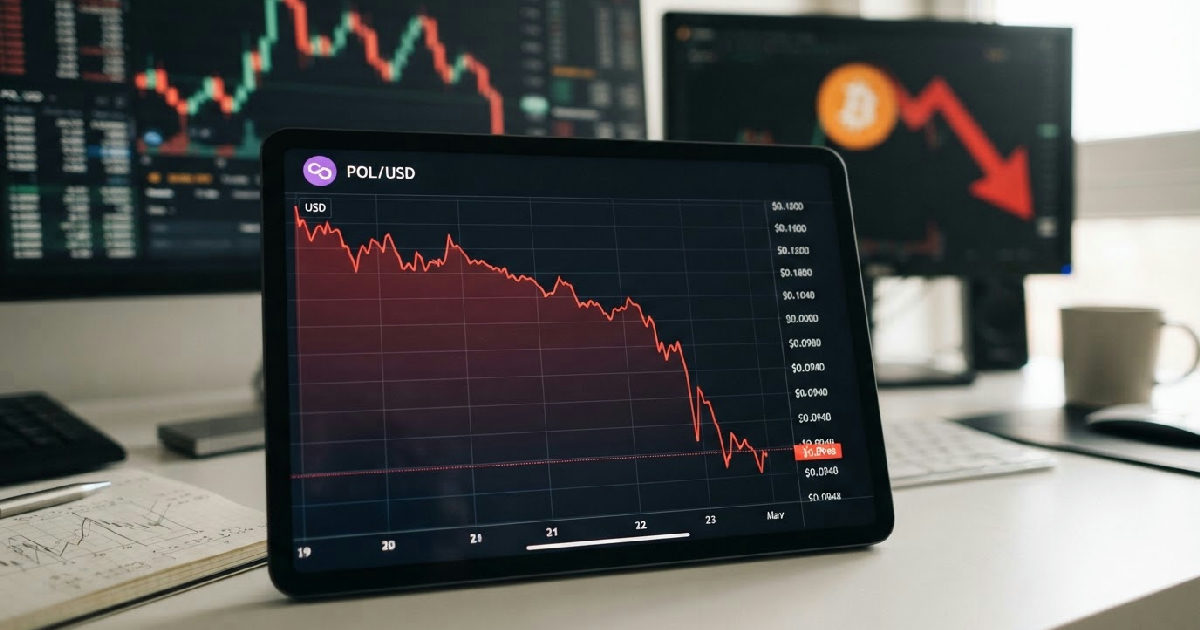

Polygon’s native token, POL, experienced a sharp decline on September 1, 2026, falling by 8.9% to a low of $0.093. This significant drop saw the altcoin breach the critical $0.1 support level, signaling intensified selling pressure across the broader cryptocurrency market. The move has put POL’s immediate future under scrutiny, as investors weigh the likelihood of further depreciation below the $0.09 mark.
The downturn for Polygon comes amidst a wider capital rotation, often termed ‘Bitcoin Season.’ Funds are shifting from higher-risk altcoins into Bitcoin, alongside a lack of specific positive catalysts for Polygon driving this negative sentiment. POL was trading around $0.094 at the time of writing, with 24-hour trading volume surging 54.8% to $87.6 million, indicating heavy sell-side activity.
Intense Selling Pressure Grips Polygon POL Token Price
The substantial increase in trading volume during a price pullback strongly suggests that investors are actively reducing their exposure to Polygon. This dynamic often reflects a lack of confidence and fear in the market, frequently preceding additional price losses during extended periods of weakness. The spot market data supports this narrative, with the Spot netflow turning positive.
The spot netflow recently turned positive, suggesting that funds are entering exchanges. This inflow of tokens onto trading platforms can often precede selling, reflecting a prevailing sentiment among holders to reduce their positions. When investors opt to cash out during a downtrend, it typically amplifies the downward pressure on the token’s price.
Polygon, initially known as Matic Network, was founded in 2017 by Jaynti Kanani, Sandeep Nailwal, and Anurag Arjun. Mihailo Bjelic joined as a fourth co-founder shortly after its inception, shaping the project’s early direction.
The network aims to enhance transaction speeds and reduce costs for decentralized applications. Its token, renamed POL in September 2024 as part of a broader protocol upgrade, now faces a significant test of investor conviction. Similar market shifts have previously impacted other digital assets, as Bitcoin enters a new bull market, often at the expense of altcoins.
Derivatives Market Reflects Deeper Bearishness
The selling pressure on Polygon is even more pronounced within the derivatives market. Data from Coinalyze reveals that Polygon Perpetuals recorded a sell volume of 46.79 million, significantly outweighing the buy volume of 43.2 million. This disparity points to an aggressive stance from sellers in the futures market.
The delta, a measure of order book imbalance, dropped further into negative territory, reaching -9.8 million. Concurrently, net buying also registered a negative figure of -98 million. These metrics collectively indicate that a substantial number of traders are closing their Perpetual positions, signaling a strong bearish outlook.
A similar trend emerged in the Futures market, with $23.6 million in outflows against $22.1 million in inflows. This resulted in a net outflow of -$1.55 million, a pattern that has persisted over the last five days.
This consistent period of higher outflows in the derivatives market has directly coincided with Polygon’s recent price depreciation. Such aggressive positioning can often exacerbate spot market movements, as traders bet on continued declines.
Technical Outlook Signals Continued Pressure
Technical analysis suggests intensifying bearish momentum for Polygon, confirming a weakening of bullish sentiment and a strengthening of the prevailing downtrend. Such shifts often precede further price adjustments in altcoin markets, particularly during periods of broader market uncertainty.
Market observations indicate that upside potential for POL appears to be waning, while downside momentum gains strength. This convergence of factors suggests that the current bearish trend is likely to continue unless significant buying pressure emerges to counter the selling activity.
If bears maintain this level of pressure, Polygon could easily fall below the psychological $0.09 threshold. The next anticipated support level rests at $0.082, which would mark a further substantial dip.
To invalidate this bearish outlook, however, POL would need a daily close above $0.1 and a reclaim of the $0.11 resistance level. Broader market sentiment, influenced by upcoming U.S. labor data and FOMC meetings, could dictate such shifts. For example, Ethereum staking bottlenecks also illustrate how network issues can impact investor confidence in the altcoin ecosystem.
The Road Ahead for Polygon POL
The immediate future for Polygon’s POL token appears precarious, heavily influenced by the prevailing ‘Bitcoin Season’ and broader market sentiment. Its market capitalization currently stands at approximately $990.3 million, a significant figure yet vulnerable to continued selling pressure.
The token’s all-time high of $1.29 highlights its previous growth. However, its all-time low sits at $0.07, a level that could be revisited if the current downtrend accelerates.
The 200-day Exponential Moving Average (EMA) at $0.09 has historically acted as a macro support floor. A decisive break below this level, especially with high trading volume, could lead to a swift move towards the $0.07 mark.
While the Relative Strength Index (RSI) at 51.9 indicates neutral territory, other indicators suggest a market stalemate with a slight bearish tilt. Competitors like Arbitrum, Base, and Optimism continue to vie for market share in the DeFi space, adding long-term competitive pressure on Polygon.
The crypto market faces potential volatility stemming from significant macroeconomic events. This includes upcoming U.S. labor data releases and the Federal Open Market Committee (FOMC) meeting scheduled for September 15, 2026.
Markets are currently pricing in a nearly 60% chance of a rate hike, a development that could further dampen investor appetite for riskier assets like altcoins. Such macro factors can override project-specific developments, pushing even robust ecosystems into defensive positions.
For Polygon to recover, it needs to decouple from this weak altcoin sentiment. This would likely require either a significant positive catalyst within its own ecosystem or a broader shift in market dynamics. Until then, the risk of POL dropping below $0.09 and testing lower support levels remains elevated.
The leadership at Polygon Labs, including CEO Marc Boiron and Executive Chairman Sandeep Nailwal, will closely watch these market movements as the network navigates this challenging period. The fate of many altcoins during such periods is often tied to the overall market’s strength and resilience, as evidenced by analysis on Bitcoin’s realized capitalization shifts and its impact on liquidity.