

Crypto exchanges solved a problem Wall Street once refused to solve.
They gave investors somewhere to buy digital assets directly.
For years, that distinction mattered. Stocks, bonds and funds lived inside brokerage accounts, while Bitcoin and other cryptocurrencies largely required a separate platform, a separate account and often an entirely separate relationship with money.
Charles Schwab is beginning to make that separation less necessary.
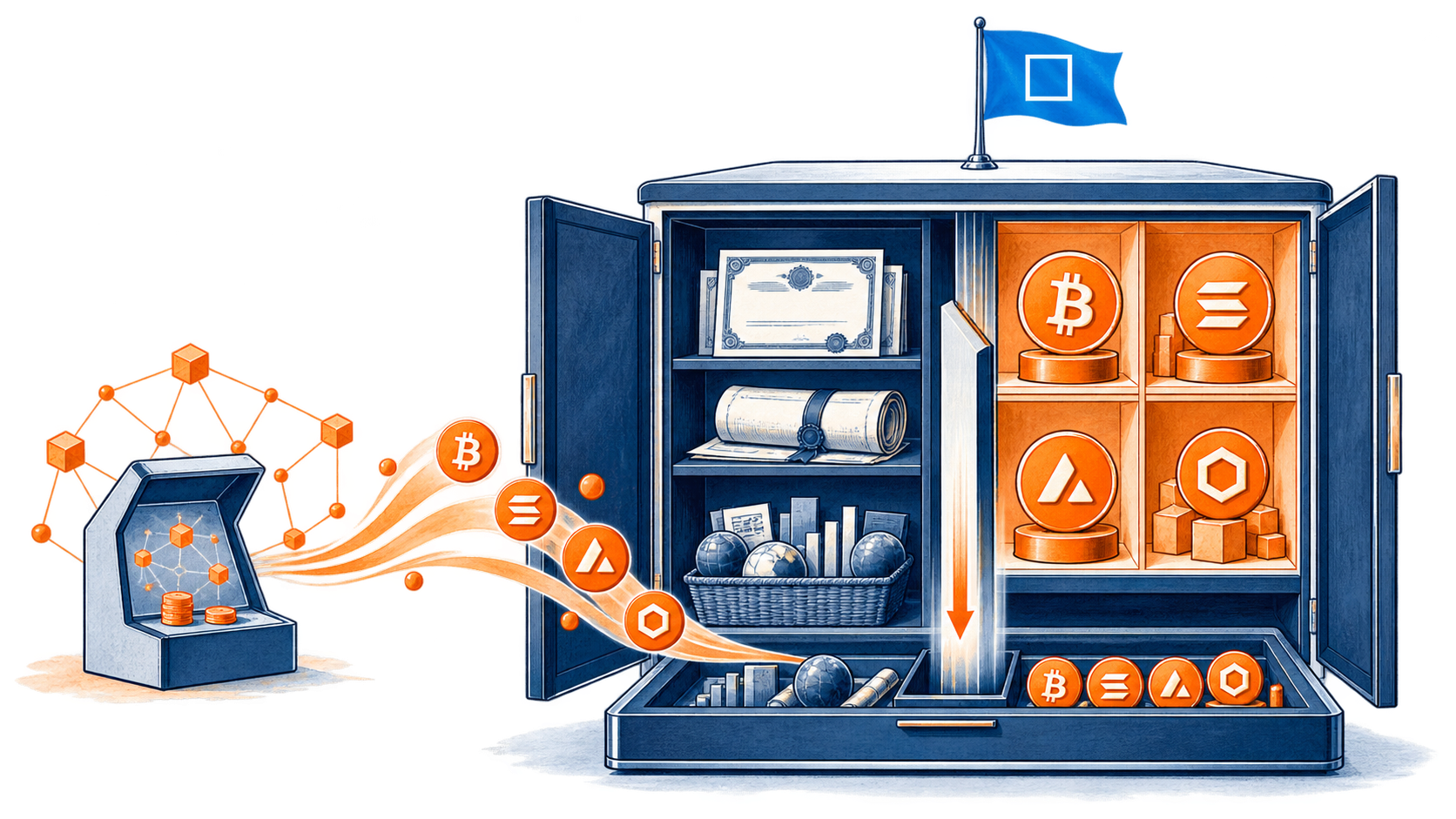
The brokerage plans to add Solana, Avalanche and Chainlink to Schwab Crypto in the coming months, expanding a service that currently offers direct trading in Bitcoin and Ethereum.
Five cryptocurrencies hardly constitute a serious challenge to the hundreds of assets available on Coinbase, Kraken or Binance. But catalog size is not Schwab’s most important advantage.
Distribution is.
Schwab already has 39.9 million brokerage accounts and $13.04 trillion in client assets. It does not need to build a new financial relationship with someone who wants to buy Solana. For millions of investors, that relationship already exists.
The question is whether offering enough crypto inside that relationship can remove one of the main reasons to open an exchange account in the first place.
The Next Crypto Customer May Already Be Inside a Brokerage
Exchanges grew partly because traditional financial institutions left a gap.
An investor interested in digital assets could find Bitcoin, Ethereum and thousands of smaller tokens on specialized platforms long before major brokerages were willing to offer them directly.
That created a powerful customer-acquisition engine for the crypto industry. Interest in a new asset frequently meant opening an account with a crypto company.
Schwab can approach the same customer from the opposite direction.
Its users already arrive to buy stocks, ETFs, options and other investments. Crypto can be added to an existing portfolio rather than becoming the reason for creating a separate one.
There is evidence that this demand already sits inside Schwab’s customer base. The company says its clients hold roughly 20% of spot crypto exchange-traded products, and before launching direct trading it had identified interest among customers who held crypto elsewhere in bringing those assets into Schwab.
Adding SOL, AVAX and LINK makes that proposition more meaningful.
Bitcoin and Ethereum have already become relatively easy to access through conventional investment products. Altcoins are where specialized crypto platforms have retained a much clearer distribution advantage.
Schwab is now beginning to test how much of that advantage can be absorbed by a brokerage account.
Convenience Can Be a Competitive Moat
Crypto exchanges have spent years expanding beyond trading.
They added payments, cards, derivatives, lending products and, increasingly, access to traditional financial assets. The strategic logic is straightforward: give customers fewer reasons to move their money somewhere else.
Schwab already begins from that destination.
Its customers can manage large portions of their financial lives within the same ecosystem. Adding crypto does not require the company to reinvent itself around digital assets; it requires digital assets to fit into an infrastructure that already manages trillions of dollars.
That makes convenience more consequential than the number of tokens available.
A customer who wants exposure to hundreds of cryptocurrencies will still need a specialized platform. But many investors do not want hundreds of cryptocurrencies. They want a small number of assets alongside the stocks, ETFs and cash they already own.
For those investors, the comparison between Schwab and a crypto exchange is no longer simply about which platform offers more.
It is about whether opening another platform is worth the additional friction at all.
Brand familiarity reinforces that advantage. In Schwab’s own research ahead of its crypto launch, investors identified factors including reputation, asset security and transparent pricing when choosing where to trade digital assets.
Those are areas where an established brokerage does not enter the competition empty-handed.
Owning Crypto Is Not the Same as Using It
There is still a boundary Schwab has not crossed.
Schwab Crypto currently does not allow customers to deposit digital assets from external wallets or withdraw them to addresses they control, although the company says transfers are planned.
That limitation matters because it separates two very different kinds of crypto customer.
One wants price exposure. The investor buys Bitcoin or Solana, holds the position and eventually sells it, much as they would another investment.
The other wants the asset itself.
That customer may move Bitcoin into self-custody, use tokens in on-chain applications, stake assets or interact directly with blockchain networks. A brokerage that keeps crypto inside a closed investment account cannot yet reproduce that experience.
This is where specialized exchanges retain a structural advantage. They sit much closer to the networks on which the assets actually exist.
But the distinction also reveals which part of the exchange business is becoming vulnerable.
Schwab does not need to replace everything an exchange does. It only needs to satisfy investors whose primary objective is ownership rather than participation in the crypto economy.
That could be a very large group.
Crypto’s Gateway Is Becoming Less Crypto-Native
The first stage of institutional adoption brought traditional capital into products built around crypto.
The next may change where investors encounter crypto in the first place.
If a customer can buy stocks, ETFs, Bitcoin, Ethereum and a growing selection of altcoins from the same account, crypto stops requiring a dedicated financial destination. It becomes another category competing for allocation inside an existing portfolio.
That does not make exchanges obsolete. Their broader asset selection and closer connection to blockchain networks remain difficult for conventional brokerages to replicate.
But it changes what an exchange has to offer in order to remain necessary.
Simply providing a place to buy crypto was once enough.
As Schwab and other traditional platforms absorb that function, specialized exchanges increasingly have to compete on everything that happens after the purchase: custody flexibility, transfers, staking, on-chain access, broader markets and crypto-native financial services.
For years, Wall Street’s distance from crypto created the space in which exchanges became enormous businesses.
Schwab’s expansion suggests that some of that distance is now disappearing.
The biggest threat to the crypto exchange may not be another exchange. It may be the brokerage account the investor never had a reason to leave.