
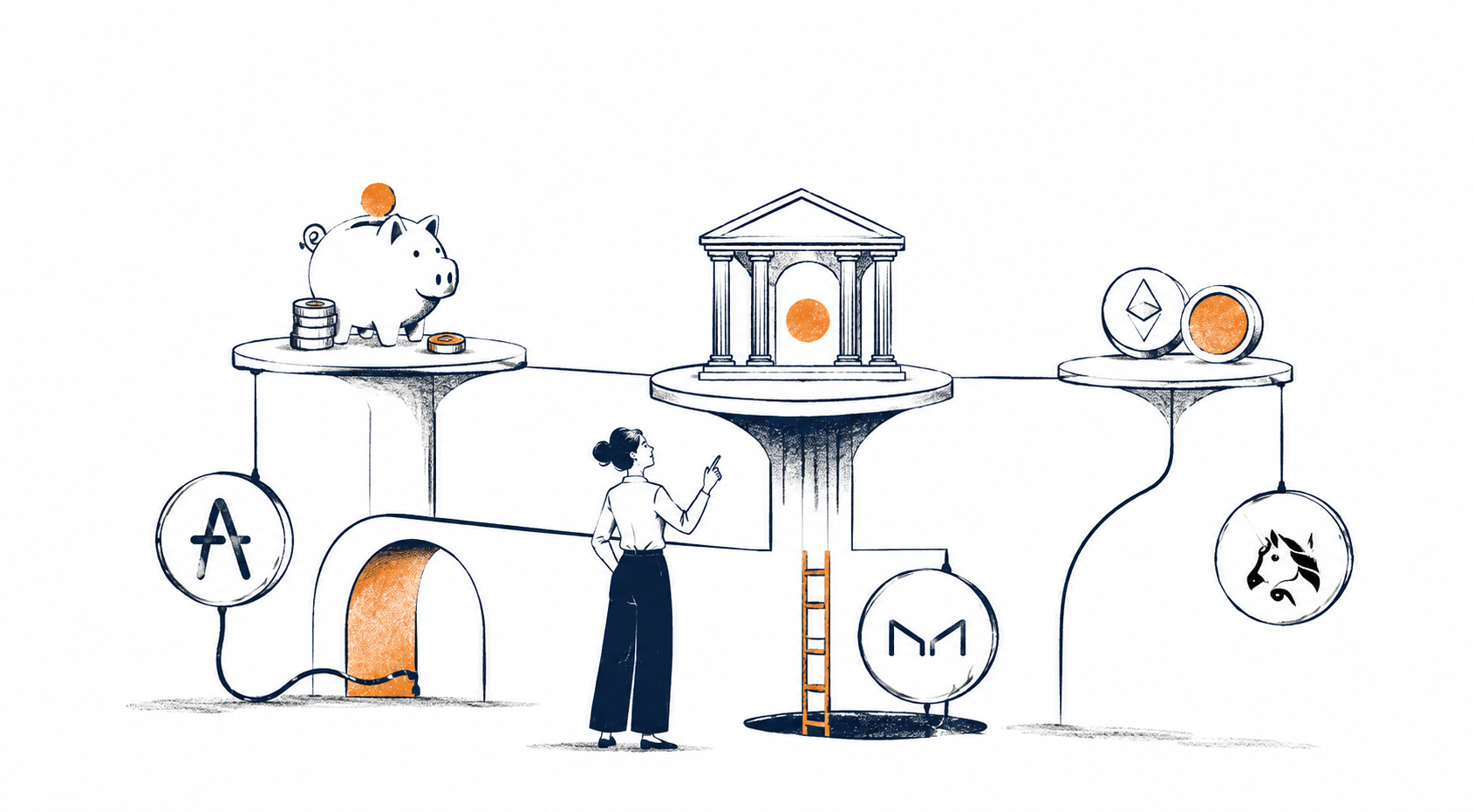

DeFi can look like a list of unrelated names. Aave lends, Uniswap swaps tokens, Curve focuses on specific markets, and MakerDAO built infrastructure around a decentralised stablecoin.
For someone new to decentralised finance, it is not obvious what connects these projects — or why there are so many of them.
The useful way to approach the main DeFi protocols is not as a ranking. It is as a map of financial functions.
Traditional finance separates lending, trading, market making and money creation across different institutions. DeFi breaks many of those functions into blockchain-based protocols, each with its own smart contracts and rules. Once that distinction is clear, the ecosystem becomes easier to navigate.
DeFi is not one service — it is a collection of financial building blocks
A DeFi protocol is a set of rules implemented in smart contracts: programmes stored on a blockchain that can execute transactions automatically. A protocol might provide a market for swapping tokens, match supply and demand for borrowing, or organise liquidity for trades.
Users generally interact through crypto wallets rather than opening an account with a bank or broker. That does not make DeFi risk-free. Smart-contract bugs, volatile collateral, governance decisions and liquidity problems can all matter.
The important point is that different protocols solve different problems.
That distinction also explains why the sector can support several protocols doing broadly similar things. Competition in DeFi is often about design: which assets are supported, how liquidity is organised and how the system deals with risk.
Aave and Compound make lending programmable
Aave is one of the clearest examples of a DeFi protocol featuring a traditional financial function recreated with smart contracts. Users supply supported assets to liquidity pools, while other users borrow against collateral.
Aave describes this as overcollateralised borrowing, meaning borrowers generally need to deposit more value than they take out.
Interest rates respond to market conditions such as pool utilisation. The DeFi protocol also enforces rules around collateral and can liquidate positions that no longer meet the required threshold. There is no loan officer approving each transaction; the rules are executed on-chain.
Compound follows a similar lending model, although its architecture and market design are different. Compound III, for example, allows users to supply assets and borrow a designated base asset against approved collateral.
The distinction matters because “DeFi lending” is not one product. Two protocols can offer a similar service while making different choices about supported assets, collateral factors and risk controls.
For beginners, this is one of the most useful lessons in the entire ecosystem: the existence of several large protocols does not necessarily mean they are all competing to become the same thing. Their differences are often the reason they exist.
Uniswap turned token trading into an on-chain market
If Aave represents lending, Uniswap represents one of DeFi’s most recognisable approaches to token trading.
A decentralised exchange, or DEX, allows users to trade through blockchain-based contracts rather than handing custody of funds to a centralised exchange.
Uniswap became closely associated with liquidity pools and automated market makers. Instead of relying on a traditional order book, liquidity sits in smart contracts and the protocol’s mechanism determines trading prices.
For a beginner, the key idea is simple: the pool provides the inventory traders use.
Liquidity providers contribute assets to those pools, while traders swap against them. As the balance of the pool changes, the quoted price changes too.
This created a new role for users: they could provide market liquidity rather than simply trade. It also showed how a blockchain could host part of the market infrastructure itself.
That is a significant shift from the traditional model. A centralised exchange can coordinate buyers, sellers and liquidity through a company. A DEX attempts to encode much of that coordination in software.
Curve shows why one DEX does not fit every market
Curve is also a decentralised exchange, but its design became particularly associated with markets where assets have similar values, especially stablecoins.
That specialisation matters. A liquidity mechanism designed for two volatile assets does not necessarily need to behave like one designed for assets intended to trade close to one another.
Curve’s StableSwap design was built around this problem, aiming to facilitate efficient stablecoin trading with low slippage.
The broader lesson is that DeFi does not need one universal design. Different protocols can optimise for different market structures, assets and trade-offs.
This helps explain why looking only at rankings can be misleading. A protocol does not need to be the biggest DEX overall to matter. It may be important because it solves a narrower liquidity problem particularly well.
MakerDAO shows that DeFi can build financial infrastructure
MakerDAO is useful as a different type of example because its role went beyond trading or lending. Its system was built around DAI, a decentralised stablecoin designed to maintain a relatively stable value against the US dollar.
The basic model involved users locking collateral in smart-contract-based vaults and generating DAI against it, subject to system rules. Positions could be liquidated when they no longer met those requirements.
There is an important naming change here. MakerDAO has transitioned to the Sky ecosystem, with USDS as its newer native stablecoin, while DAI remains part of the ecosystem and transition history. For readers searching for “MakerDAO”, the older name remains relevant because it is the name associated with much of the project’s history.
This is another important distinction between the main DeFi protocols. Some provide a service such as trading or borrowing. Others become infrastructure that creates an asset which can then be used elsewhere.
A stablecoin created in one system can later appear in lending markets, trading pools and other on-chain applications. One protocol can therefore become part of another protocol’s foundation.
The real DeFi story begins when protocols connect
This is where memorising the main DeFi protocols becomes less useful.
A user might swap ETH on a DEX, deposit another asset into a lending protocol and then use that deposit as collateral to borrow a stablecoin. That stablecoin could then move into another application.
This ability to combine applications is known as composability. It is one of DeFi’s defining features because protocols can become building blocks for other protocols.
For users, that can make the ecosystem more flexible. An application does not necessarily need to build every financial function from scratch. It can rely on existing liquidity, assets or infrastructure created elsewhere.
But composability creates a paradox.
Interconnected systems can be more useful because assets and liquidity can move between them. Yet the same dependencies can create additional ways for problems to spread. A smart-contract flaw, unreliable price feed or failure in a widely used asset can affect applications that depend on it.
DeFi gains flexibility from the same interdependence that makes the ecosystem harder to understand.
For a beginner, that is a more useful risk lesson than simply memorising that smart contracts can be hacked. The risk is not always contained within one application. In a highly interconnected system, one component can become part of another component’s risk profile.
TVL helps measure scale, but it does not tell the whole story
Total Value Locked, or TVL, is one of the most common metrics used to compare DeFi protocols. Broadly, it measures the value of assets deposited or allocated to a protocol’s contracts.
TVL can give a useful sense of scale. But it should not be treated as a safety score.
A large protocol can still face smart-contract vulnerabilities, risky collateral, governance problems, liquidity shocks or dependencies on other applications. A smaller protocol may have a narrow but important role that does not show up in a simple ranking.
TVL helps answer “how much value is committed here?” It does not answer “how safe is this protocol?” or “which protocol is best?”
That distinction is especially important for beginners because a ranking can create a false sense of certainty. Size tells you something about usage and importance. It does not, by itself, tell you whether the underlying design is robust.
How to think about the main DeFi protocols
A simple mental map is to connect each protocol with the financial function it helps perform.
Aave and Compound are associated with lending and borrowing. Uniswap is a major reference point for decentralised token trading and liquidity pools. Curve specialises in liquidity for markets such as stablecoins. MakerDAO, now part of the Sky ecosystem, is closely associated with decentralised stablecoin infrastructure.
Seen together, these protocols look less like competing apps and more like components of a financial system assembled from smart contracts, tokens and blockchain infrastructure.
That is the more useful way to learn DeFi. Instead of asking only which protocol is biggest, ask what job it performs, what assumptions its design makes and which other systems it depends on.
The ecosystem then becomes easier to understand — and its central trade-off becomes clearer: the same connections that make DeFi composable can also make its risks travel from one piece to another.