
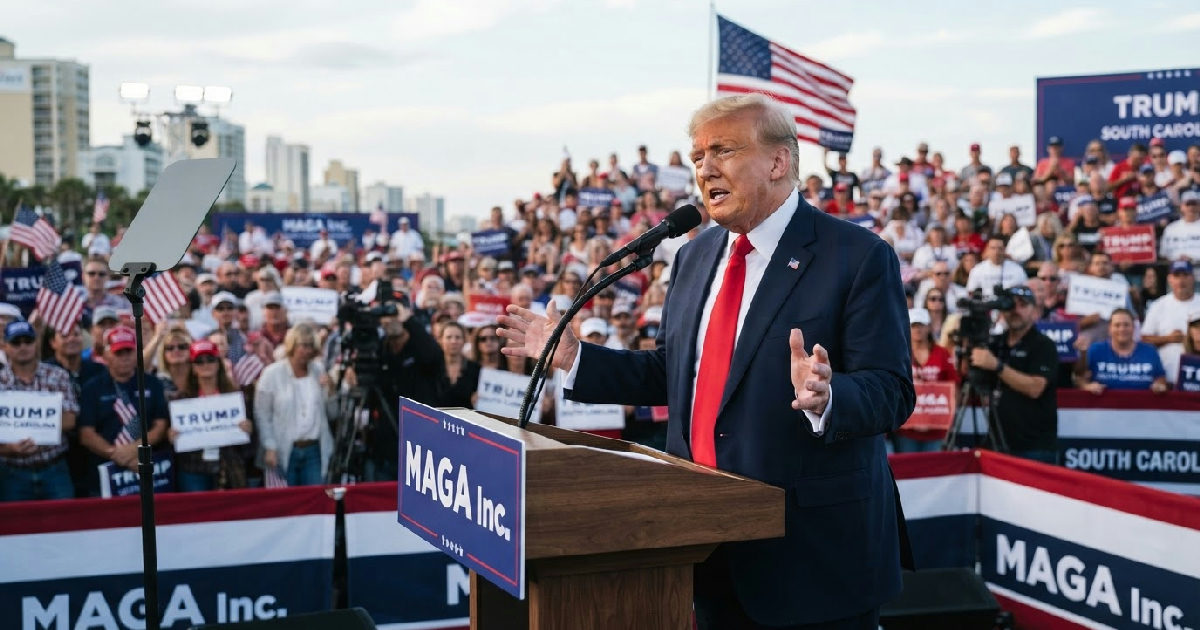

President Donald Trump enters the political fray, lending his considerable influence and financial firepower to the Republican effort to control Congress in the upcoming midterm elections. His intervention, starting with a rally in South Carolina, sharpens the focus on a battle that could determine the future of cryptocurrency and artificial intelligence regulation in the United States.
Trump is scheduled to appear at a rally in Myrtle Beach this Friday, August 21, to support U.S. Senator Darline Graham in her GOP primary runoff. More significantly, reports indicate he plans to deploy funds from his $400 million MAGA Inc. super PAC to aid Republican candidates, a move that injects a powerful and unpredictable variable into the final months of the campaign.
Donald Trump enters the campaign trail in South Carolina
The first stop for Trump is the Myrtle Beach Convention Center, where he will campaign for Senator Darline Graham. Appointed by Governor Henry McMaster on July 13, 2026, Graham filled the Senate vacancy created by the tragic death of her brother, Senator Lindsey Graham. As the first woman to represent South Carolina in the U.S. Senate, her campaign carries historical weight.
The rally is a key test of Trump’s continued influence within the GOP. One party operative told Politico that Trump “probably has the ability to move the needle in Republicans’ favor better than anyone else.” His endorsement and campaign support are seen as crucial for Graham as she faces a primary runoff against Representative Ralph Norman in the deeply conservative state.
Event logistics highlight the significance of the visit, with road closures expected and local law enforcement resources being fully deployed. Doors for the rally open at 3:00 PM US/Eastern, with the main event starting at 7:00 PM. The outcome of this race and others like it will directly shape the legislative environment for emerging technologies.
The future of the CLARITY act and crypto regulation at stake
For the cryptocurrency industry, the stakes in the midterm elections are exceptionally high. The composition of the next Congress will almost certainly decide the fate of the Financial Innovation and Technology for the 21st Century Act, often called the CLARITY Act. This landmark piece of legislation, which aims to create a comprehensive regulatory framework for digital assets, is currently stalled.
The bill faces a critical cloture vote on September 15, which requires 60 votes to advance—a high bar in a divided Senate. A Republican-controlled Congress is widely seen as more likely to pass the industry-backed bill.
Should Democrats retain or expand their majority, the bill’s prospects would dim, leaving rulemaking to the Securities and Exchange Commission (SEC) and the Commodity Futures Trading Commission (CFTC), an approach many in the crypto sector fear would be disjointed and restrictive.
This election follows years of intense debate and several White House crypto meetings aimed at finding a path forward.
The lack of a clear legislative framework has created persistent uncertainty in the market. While some assets have seen gains, such as the recent Ethereum price surge following shifts in Treasury policy, the industry’s long-term stability is seen as dependent on the kind of certainty a law like the CLARITY Act could provide.
Without it, the U.S. risks falling behind other jurisdictions that have moved faster to implement clear rules.
Tech industry pours record funds into election cycle
The political battle is being fueled by an unprecedented influx of cash from the tech sector. Crypto, AI, and online betting firms have contributed to a record $517 million in corporate spending this election cycle, according to data from Public Citizen. This massive spending campaign is designed to secure a favorable regulatory environment for years to come.
Much of this funding has flowed to Republican-aligned super PACs. Andreessen Horowitz partners Marc Andreessen and Ben Horowitz have each contributed $4 million this cycle, with most of it reportedly going to Trump’s MAGA Inc. The crypto-focused super PAC Fairshake has also amassed a war chest of approximately $130 million to support its preferred candidates.
The AI industry has been similarly active. AI-focused PACs have raised $107 million, with Andreessen Horowitz and OpenAI President Greg Brockman backing the ‘Leading the Future’ PAC. On the other side of the issue, the pro-regulation ‘Public First Action’ has raised $80 million, with significant backing from AI firm Anthropic, illustrating the deep divisions within the tech world itself on the right path forward.
A complex political calculus for tech’s future
Despite the massive spending, the political outcome is far from certain. The tech industry faces its own headwinds. In Ohio’s Senate race, for example, a backlash against the environmental and resource impact of data centers is reportedly harming Senator Jon Husted’s campaign. A Gallup poll from this spring found that 71% of Americans would prefer not to have new data centers built near their homes.
This sentiment creates a complex calculus for politicians who court tech funding while trying to appeal to a sometimes-skeptical electorate. For Republicans, accepting help from Trump and tech giants is a strategic necessity in a difficult election year, but it also ties the party’s fortunes to divisive figures and industries.
Ultimately, the November elections will serve as an early indicator of whether the tech industry’s financial might and Trump’s political capital can successfully shape a Congress more amenable to their interests. The results will have lasting consequences, potentially affecting everything from developer roadmaps to ambitious price targets, like Mark Connors’ Bitcoin projection, that rely on a stable and predictable regulatory landscape.