
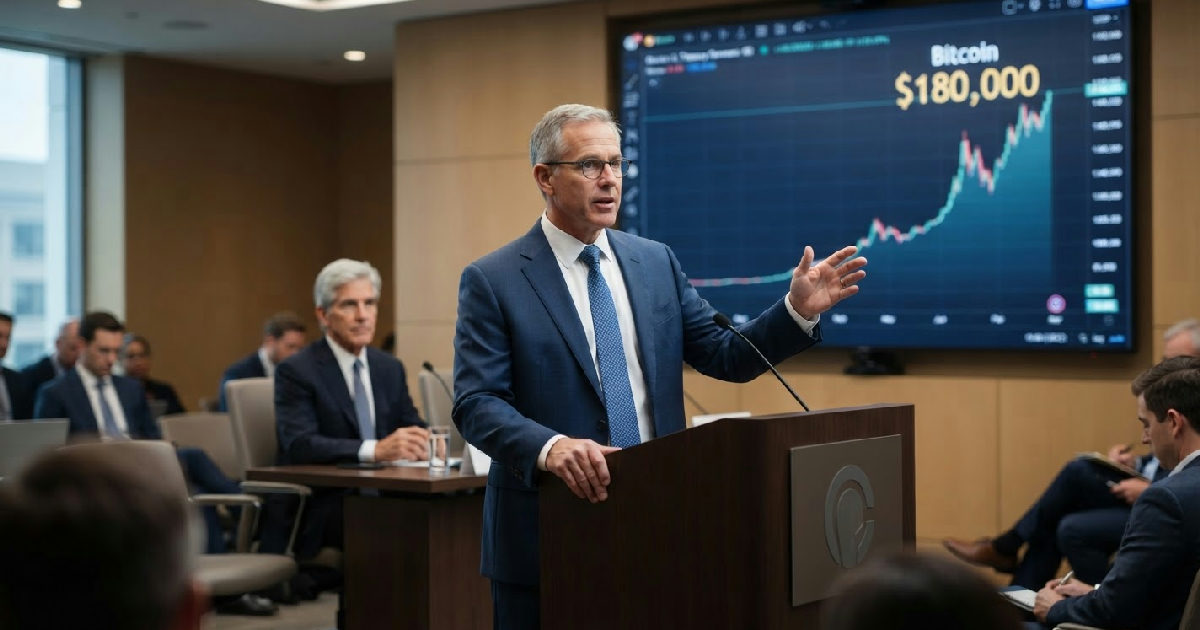

Mark Connors projects Bitcoin could reach $180,000 following U.S. Treasury Secretary Scott Bessent’s expanded long-dated bond buybacks. S. Treasury Secretary Scott Bessent’s recent announcement regarding expanded long-dated bond buybacks has prompted a significant revision in the outlook for Bitcoin, with macro strategist Mark Connors of Risk Dimensions now projecting the cryptocurrency could reach an initial target of $180,000.
Connors made these statements on August 20, 2026, suggesting that the Treasury’s move could fundamentally alter macro conditions that have previously weighed on risk assets, including digital currencies.
Treasury bolsters bond market, Mark Connors projects
The strategist believes these unprecedented interventions by the U.S. Treasury signal a turning point for market liquidity. Bitcoin immediately responded to Bessent’s remarks, climbing to nearly $73,000. This shift marks a notable departure from Connors’ earlier expectations for BTC’s price trajectory.
Treasury Secretary Scott Bessent announced on a Thursday prior to August 20, 2026, that the U.S. government intends to routinely buy back long-dated bonds. He indicated these buybacks could expand beyond the previously stated $4 billion. Bessent told CNBC, “We want to show that [bond] yields do not reflect underlying fundamentals. We have a big toolkit.”
This strategic intervention comes as the 10-year Treasury yield traded around 4.68%, up three basis points on the day but below its session high, following Bessent’s comments.
The 30-year Treasury yield had touched 5.337% on a Tuesday prior to August 19, 2026, marking its highest level since 2007, before reversing sharply to 5.192% after the buyback news. Bitcoin’s price saw gains, with a broader Bitcoin climbs past.
Connors, a seasoned bond-market investor, characterized the Treasury’s action as an “unusual and important intervention.” He views it as a direct response to the mounting pressure from rising long-term borrowing costs. The implication is clear: the government is proactively addressing challenges in finding buyers for its substantial debt.
High Treasury yields typically divert capital from riskier assets, like cryptocurrencies, towards the perceived safety of government bonds. By supporting bond prices through buybacks, the Treasury aims to contain yields. This action could effectively remove a significant macroeconomic headwind for Bitcoin and other digital assets.
The initial $4 billion in buybacks is modest, but Connors anticipates a substantial expansion. He projects that Treasury support could eventually escalate to between $10 billion and $30 billion per month. This far surpasses the current $4 billion figure and underscores the potential for a sustained liquidity injection.
Path to $180,000 Bitcoin price target emerges
Connors has significantly revised his Bitcoin outlook due to these Treasury developments. Previously, he expected BTC to remain subdued until November, aligning with its traditional four-year cycle. He is now less certain investors will face such a prolonged wait.
He explicitly stated, “When that happens, that’s when bitcoin starts to seek that first $180,000 price threshold.” This suggests a direct causal link between the expanded Treasury actions and Bitcoin’s potential upward movement. His broader target range for the current cycle, extending through 2030, sits between $180,000 and $360,000.
Another crucial factor Connors highlighted involves potential changes to the supplementary leverage ratio (SLR). The SLR dictates how much Treasury debt banks can hold relative to their capital. Easing these constraints could enable banks to absorb more government bonds, further bolstering market liquidity, which could lead to an Ethereum price surge and wider crypto market strength.
This isn’t the only analyst projecting a substantial rise for Bitcoin. JPMorgan analysts, led by Nikolaos Panigirtzoglou, projected in November 2025 that Bitcoin could climb to around $170,000 over six to twelve months, based on improving volatility dynamics against gold. Others, including Standard Chartered and VanEck, have also set targets in the $150,000 to $180,000 range for late 2025 or early 2026.
The mechanism at play here is simple: increased government liquidity often spills over into risk assets. As the Treasury actively manages its debt and yields, it inherently creates a more favorable environment for assets like Bitcoin, which thrive on abundant capital flows. The move could provide a fundamental support system, easing price pressures.
Immediate market dynamics and potential headwinds
While the long-term outlook appears bullish, immediate market dynamics present their own complexities. Bitcoin’s hold above $72,000 is particularly significant for crypto traders. Jim Ferraioli, director of crypto research at Charles Schwab, noted that earlier modeling revealed a substantial concentration of leveraged Bitcoin short positions around this price point.
Should BTC sustain its position above $72,000 or continue its ascent, traders who bet on lower prices could face considerable pressure. They may opt to close their positions voluntarily or encounter liquidation, a process that forces them to buy Bitcoin to cover their shorts. This forced buying can create a powerful upward price momentum, triggering further liquidations in a cascading effect.
However, Connors emphasized that the short-term squeeze isn’t the core narrative. He views Bessent’s buyback plan as a crucial indicator of broader U.S. liquidity. If Treasury support expands as he expects, and long-term yield pressure diminishes, a major macroeconomic headwind for Bitcoin could genuinely begin to dissipate.
Even with this optimistic outlook, Connors highlighted a near-term risk. He warned that Bitcoin could come under pressure if the U.S. CLARITY Act fails to advance by around September 15. This legislation is vital for market sentiment, even as regulators generally afford crypto companies some operational latitude. The regulatory landscape remains a critical component for market sentiment, especially concerning potential 30% Bitcoin swing.
Connors stressed the importance of the regulatory environment, stating, “Near-term price risk is predicated on Clarity. I do think we will fall from $72,000 if Clarity doesn’t progress from that September 15 date that’s laid out.” This suggests that policy certainty plays a substantial role in maintaining bullish sentiment, despite improving macro conditions.
Broader implications for crypto market liquidity
The U.S. Treasury’s shift towards more aggressive bond buybacks isn’t just about yield curves; it fundamentally impacts the availability of capital. When the government actively reduces its outstanding debt in the market, it effectively injects liquidity back into the financial system. This increased liquidity can then seek opportunities in various asset classes, including the burgeoning cryptocurrency sector.
This dynamic stands in contrast to periods when government bonds aggressively compete with risk assets for capital. A more stable bond market, underpinned by Treasury support, could reduce the allure of traditional safe havens. This potentially redirects investment flows towards assets like Bitcoin, which are often characterized by higher risk but also higher potential returns.
Furthermore, the Treasury’s intervention signals a broader governmental awareness and proactive approach to economic stability. Such actions, while not directly aimed at supporting Bitcoin, create an environment of reduced systemic financial stress. This fosters investor confidence in broader markets, which indirectly benefits the crypto ecosystem. The interplay of macro policy and digital assets is becoming increasingly apparent, often influencing investor decisions around risk assets.
The potential for changes to the supplementary leverage ratio (SLR) also bears watching. If regulatory adjustments provide banks with more flexibility to hold Treasury debt, it could further enhance financial system liquidity. This would complement the buyback efforts and could provide an additional tailwind for Bitcoin, validating Connors’ multi-pronged outlook for significant price appreciation.