
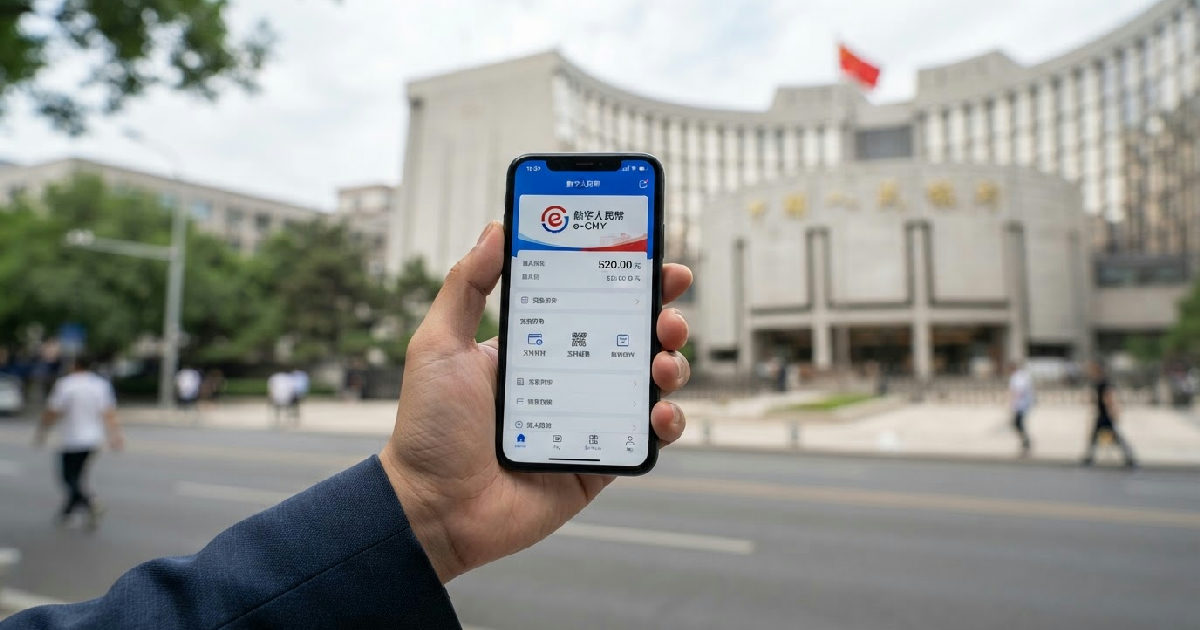

The People’s Bank of China (PBOC) has formally committed to the “steady development” of the digital yuan (e-CNY) as a core strategic task within its newly released 2026-2030 reform and development plan. Published on August 10, 2026, this comprehensive blueprint signals Beijing’s deepened resolve to integrate its central bank digital currency into the nation’s financial infrastructure, while also advancing the internationalization of the renminbi.
This explicit inclusion of the e-CNY in the PBOC’s 15th Five-Year plan elevates the digital currency beyond a pilot project, embedding it firmly into China’s long-term financial strategy. The move underscores a maturing approach to the e-CNY, building on recent operational enhancements, such as the introduction of interest-bearing balances, and signaling a measured but determined expansion both domestically and across borders.
Digital yuan as a core strategic pillar
The PBOC’s 2026-2030 reform and development plan outlines nine distinct action areas, with the digital yuan specifically addressed under the fifth priority: “financial infrastructure and central bank services.” This section highlights the central bank’s ambition to modernize its payment systems, enhance financial statistics, treasury, and cash services, and fortify anti-money laundering regulations.
By listing the e-CNY within this critical pillar, the PBOC is signaling its intention to treat the digital currency as an integral component of China’s financial plumbing. This formalizes the e-CNY’s position alongside traditional monetary policy tools and macro-prudential supervision, indicating its growing importance in maintaining financial stability and efficiency.
The overarching plan also emphasizes refining monetary policy and macro-prudential tools, supporting the real economy in sectors like technology and green transition, and deepening the two-way openness of financial markets. The e-CNY’s role is now clearly delineated as a tool to achieve these broader economic and financial objectives, rather than a standalone technological experiment.
Domestic evolution and legal framework refinements
The digital yuan has undergone significant domestic evolution, notably with a pivotal change that took effect on January 1, 2026. On this date, an upgraded framework for e-CNY management allowed commercial banks to begin paying interest on client e-CNY balances. This shift transforms the digital yuan from a purely digital cash equivalent into a form of digital deposit money, broadening its appeal and utility.
These interest-bearing balances are now integrated into commercial banks’ asset-liability management systems and are protected by deposit insurance, aligning the e-CNY more closely with traditional bank deposits. Furthermore, the PBOC has incorporated digital yuan operations into its reserve requirement framework. Wallet balances held with authorized commercial banks will contribute to the reserve requirement calculation base, while non-bank payment institutions are mandated to deposit 100% reserves.
The legal framework surrounding the e-CNY also remains a point of discussion. At the 2026 National People’s Congress, Deputy Fu Xiguo suggested revising the PBOC’s governing law, last updated in 2003. His argument centered on the existing law’s failure to explicitly define the e-CNY as legal tender, indicating ongoing efforts to solidify its legal standing within China’s monetary system.
The e-CNY project, initially labeled DCEP, commenced research in 2014, with the digital yuan formally launching in April 2022. By the end of November 2025, cumulative digital yuan transactions had reached an impressive 3.48 billion, totaling 16.7 trillion yuan, equivalent to approximately 2.37 trillion U.S. dollars. This substantial transaction volume underscores the currency’s growing presence in China’s domestic payment landscape.
Accelerating cross-border ambitions
Beyond domestic deployment, the PBOC’s new five-year plan explicitly links digital yuan development to its overarching goal of widening the use of the renminbi (RMB) in international trade and investment. The central bank is committed to building out a robust cross-border payment network and developing offshore RMB markets, with the e-CNY positioned as a key enabler.
Several cross-border initiatives are already demonstrating rapid progress. Project mBridge, a multi-central-bank settlement platform, continues to expand its reach. Its members include mainland China, Hong Kong, Thailand, the United Arab Emirates, and Saudi Arabia. Industrial Bank recently extended mBridge services to Macau, facilitating a 500 million yuan ($74 million) equity deal.
The corporate client count for this service jumped 176% year-on-year in the first half of the year, with Bank of China’s Fujian branch pushing over HK$10 billion ($1.28 billion) through mBridge in what was described as the platform’s largest single transfer to date.
Other significant cross-border developments include Guangdong province’s draft five-year plan, which is currently open for public comment until September 5, 2026. This provincial plan specifically calls for larger cross-border e-CNY payment trials and the exploration of additional use cases for the digital currency.
Furthermore, China has already completed its first cross-border digital yuan payment with Singapore, where ICBC branches settled nearly 10 million yuan in shipping fees via the upgraded CBETS platform. A pilot in Laos also marked the first cross-border transaction involving the digital yuan, signaling broader regional engagement.
The PBOC’s strategy also includes strengthening Shanghai as an international financial center and reinforcing Hong Kong’s standing, both of which are crucial hubs for the internationalization of the renminbi and potential staging grounds for expanded e-CNY use.
Implications for the global digital currency landscape
China’s steadfast commitment to digital yuan development, as codified in its latest five-year plan, carries significant implications for the global digital currency landscape. It signals to other nations exploring central bank digital currencies (CBDCs) that China views its e-CNY not as an experimental project, but as a fundamental, long-term component of its financial sovereignty and international economic strategy.
The dual-speed approach – a cautious, controlled domestic rollout coupled with more aggressive exploration of cross-border use cases – highlights China’s pragmatic strategy. Domestically, the focus is on stability, integration, and user adoption through incremental steps like interest-bearing accounts.
Internationally, the e-CNY is being leveraged as a tool to enhance the efficiency of cross-border payments and to gradually expand the global influence of the renminbi, potentially offering an alternative to existing settlement systems.
This sustained push by the PBOC underscores a global trend towards digital currencies, but China’s top-down, state-driven approach offers a distinct model. Its integration within a comprehensive financial reform plan suggests a long-term vision where the digital yuan plays a critical role in both modernizing domestic payments and reshaping international financial flows, all while maintaining strict oversight and control.