
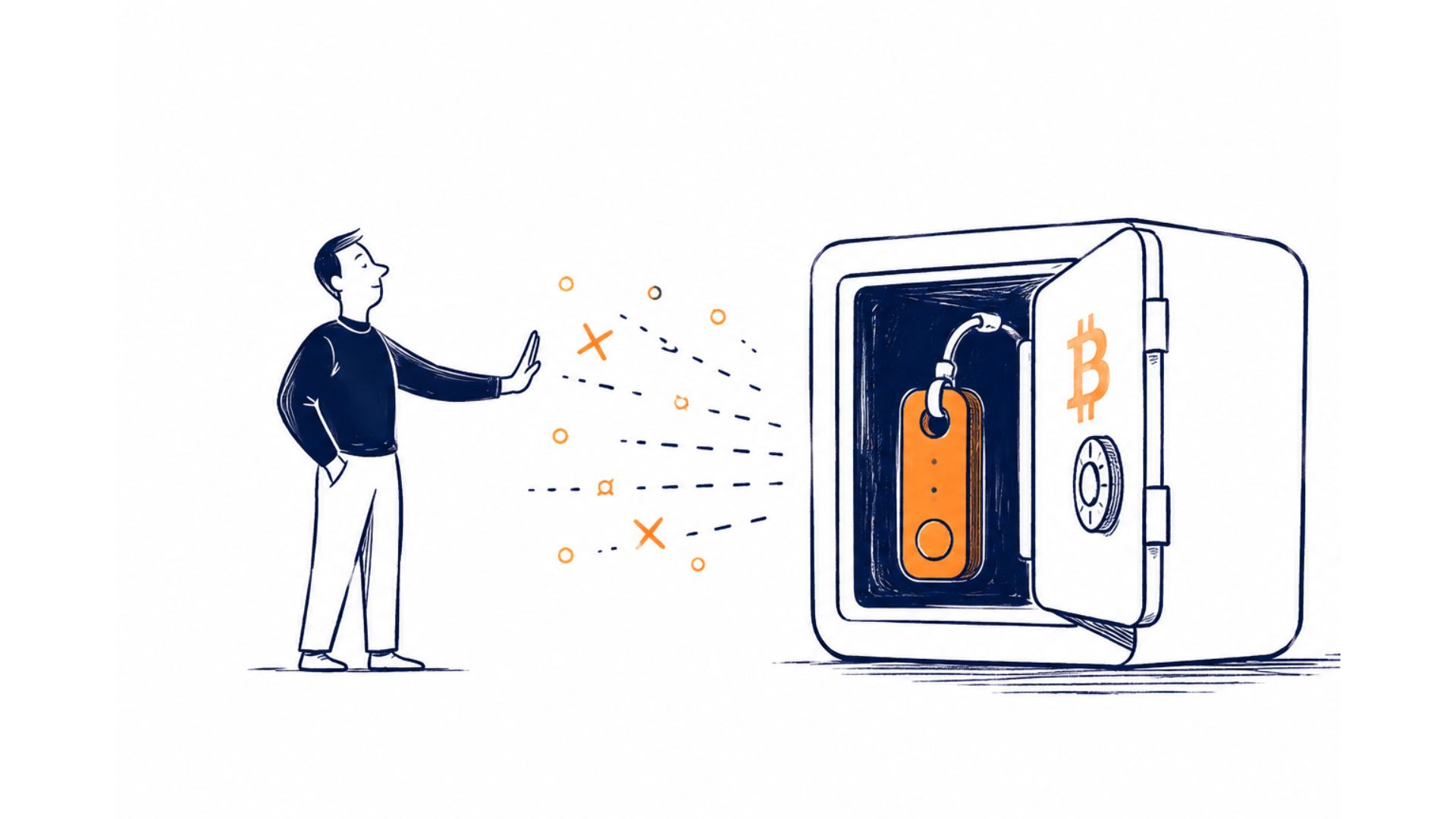

The appeal of an air-gapped wallet is easy to understand: if a device holding your Bitcoin private keys never connects to the internet, an attacker cannot simply reach those keys through an online connection.
But that does not make an air-gapped wallet invulnerable.
The distinction matters because self-custody is ultimately a problem of managing keys, not storing Bitcoin inside a physical device. Your Bitcoin remains recorded on the blockchain. The wallet protects the private key that allows transactions to be authorised.
An air gap changes how that key interacts with the outside world. It can remove entire categories of remote attacks, but it also introduces more steps, more responsibility and a different set of things the user needs to trust.
So the more useful question is not whether an air-gapped wallet is “safe”.
It is what kind of risk does the air gap actually remove?
An air-gapped wallet is built around one important separation
A conventional software wallet operates on a device that may be connected to the internet. A hardware wallet creates a stronger separation by keeping the private key inside a dedicated device rather than exposing it to the computer or phone handling the rest of the transaction.
An air-gapped wallet takes that separation further.
The signing device is designed to operate without a direct network connection, typically avoiding Wi-Fi, Bluetooth and data connections to an internet-connected computer. Instead, transaction information can be transferred through methods such as QR codes or removable storage.
That distinction is important because cold wallet, hardware wallet and air-gapped wallet are not interchangeable terms.
A cold wallet generally refers to a wallet whose private keys are kept offline. A hardware wallet is a physical device designed to protect and use those keys. An air-gapped wallet describes a particular security architecture in which the signing device remains isolated from networked devices.
The goal is not to put Bitcoin “inside” an offline machine.
It is to make sure the key needed to move that Bitcoin does not have to enter an internet-connected environment.
How can a Bitcoin transaction be signed if the wallet is offline?
This is where the concept becomes much more practical.
Suppose you want to send Bitcoin. An internet-connected computer or phone can prepare the transaction with the recipient’s address and the amount to be sent.
But preparing a transaction and authorising it are separate steps.
The unsigned transaction can be transferred to the offline wallet, often using a QR code or microSD card. The air-gapped device receives the information and uses its private key to produce the required digital signature.
The signed transaction is then transferred back to the connected device, which can broadcast it to the Bitcoin network.
In simplified form:
Connected device → unsigned transaction → offline wallet → signed transaction → connected device → Bitcoin network
At no point in this process does the private key need to move to the internet-connected machine.
That is the core security benefit.
The transaction can cross the gap. The key does not.
This type of workflow is already used by air-gapped Bitcoin setups, including systems based on QR codes and physical media.
What the air gap actually protects you from
The biggest advantage of an air-gapped wallet is not that it makes every attack impossible. It is that it removes certain paths an attacker might otherwise use.
Consider a malicious programme running on your laptop.
If your private key is held by a software wallet on that same machine, the malware is operating in an environment that has direct access to the wallet software and potentially the signing process.
A properly isolated signing device creates another boundary.
The computer can prepare a transaction, but it does not possess the private key required to authorise it. A remote attacker therefore has a much harder problem: compromising the connected computer is no longer equivalent to obtaining the signing key.
This is why air-gapping is best understood as attack-surface reduction.
It removes communication channels rather than somehow making the underlying cryptography stronger.
That is a meaningful security improvement for users who want long-term Bitcoin self-custody. But it is also where the misconception begins.
An offline key can still be compromised in other ways.
Going offline does not make the wallet trustworthy by default
An air gap only addresses part of the security model.
The device still has hardware and software. It still needs to generate private keys correctly, protect them and sign transactions accurately.
That creates a crucial distinction between network security and device security.
A vulnerability in firmware, for example, does not necessarily require an internet connection at the moment an attacker exploits it. If the device itself was compromised, or if malicious software was introduced through another part of the setup, physical isolation may not be enough.
Researchers have also demonstrated that air-gapped systems can, under specific attack conditions, leak information through unconventional channels. These attacks are considerably more specialised than the threats facing an ordinary Bitcoin user, but they demonstrate an important principle: an air gap is a security boundary, not an absolute guarantee.
For most users, more immediate risks are much less exotic.
The seed phrase remains critical.
If someone obtains the recovery words, the security provided by an air-gapped device can become irrelevant. The same is true if the user approves a fraudulent transaction because the address or amount was not checked carefully.
In other words, keeping the key offline does not protect the user from giving the key’s authority away by mistake.
The connected computer can still be part of the problem
There is another subtle risk in the air-gapped model.
The online device may not have access to the private key, but it still participates in creating the transaction.
Imagine that malware alters the recipient address before the transaction reaches the offline signer. If the user simply approves what appears on the connected computer, the air gap has not solved the underlying problem.
This is why transaction verification matters.
The strongest air-gapped setups allow the user to inspect important transaction details on the signing device itself before approving the signature. The point is to establish a trusted checkpoint between the potentially compromised online environment and the private key.
That makes the screen on the hardware wallet more important than it might initially appear.
The question is not only:
“Is my private key offline?”
It is also:
“What exactly am I asking that offline key to authorise?”
That is a much more useful way to think about hardware wallet security.
So, is an air-gapped wallet actually safer for Bitcoin?
For the specific threats it is designed to address, yes.
An air-gapped architecture can reduce exposure to remote attacks by preventing the signing device from establishing the connections through which those attacks could occur. Current explanations of air-gapped wallets commonly identify this isolation as the main security advantage.
But “safer” does not mean “safe regardless of how it is used”.
Compared with a more connected hardware wallet, an air-gapped setup can introduce additional operational steps. Instead of connecting a device and confirming a transaction, the user may need to move information via QR codes or removable storage, inspect the transaction, sign it offline and then transfer it back.
That friction is not necessarily a flaw.
It is part of the security model.
The fewer convenient connections a device has, the fewer communication paths there are to secure. But the user also becomes more responsible for following the process correctly.
That trade-off matters because security is partly behavioural.
A theoretically stronger setup that a user does not understand may be less effective than a simpler setup they can operate correctly every time.
The real trade-off is isolation versus responsibility
This is perhaps the most important point when evaluating an air-gapped wallet.
The technology can remove a connection, but it cannot remove the decisions surrounding that connection.
You still need to protect the seed phrase. You still need to understand what you are signing. You still need to consider the integrity of the hardware and firmware. And you still need a reliable recovery process if the physical device is lost or damaged.
That is why an air-gapped wallet should not be viewed as a magic vault for Bitcoin.
It is better understood as one layer in a broader self-custody system.
For someone holding Bitcoin for the long term and prioritising minimising digital exposure, the additional complexity may be worthwhile. For someone making frequent transactions, the extra steps may create more friction than they are willing to manage.
The strongest setup, therefore, is not necessarily the one with the most impressive security feature.
It is the one where the user understands which risks have been removed, which risks remain and where their own actions become the final security boundary.
An air gap can keep a private key away from the internet.
It cannot, by itself, tell you whether the transaction you are signing is the right one, whether the seed phrase is safe or whether the device deserves your trust.
That is the real limit of offline security — and also why the air gap can be so useful.