
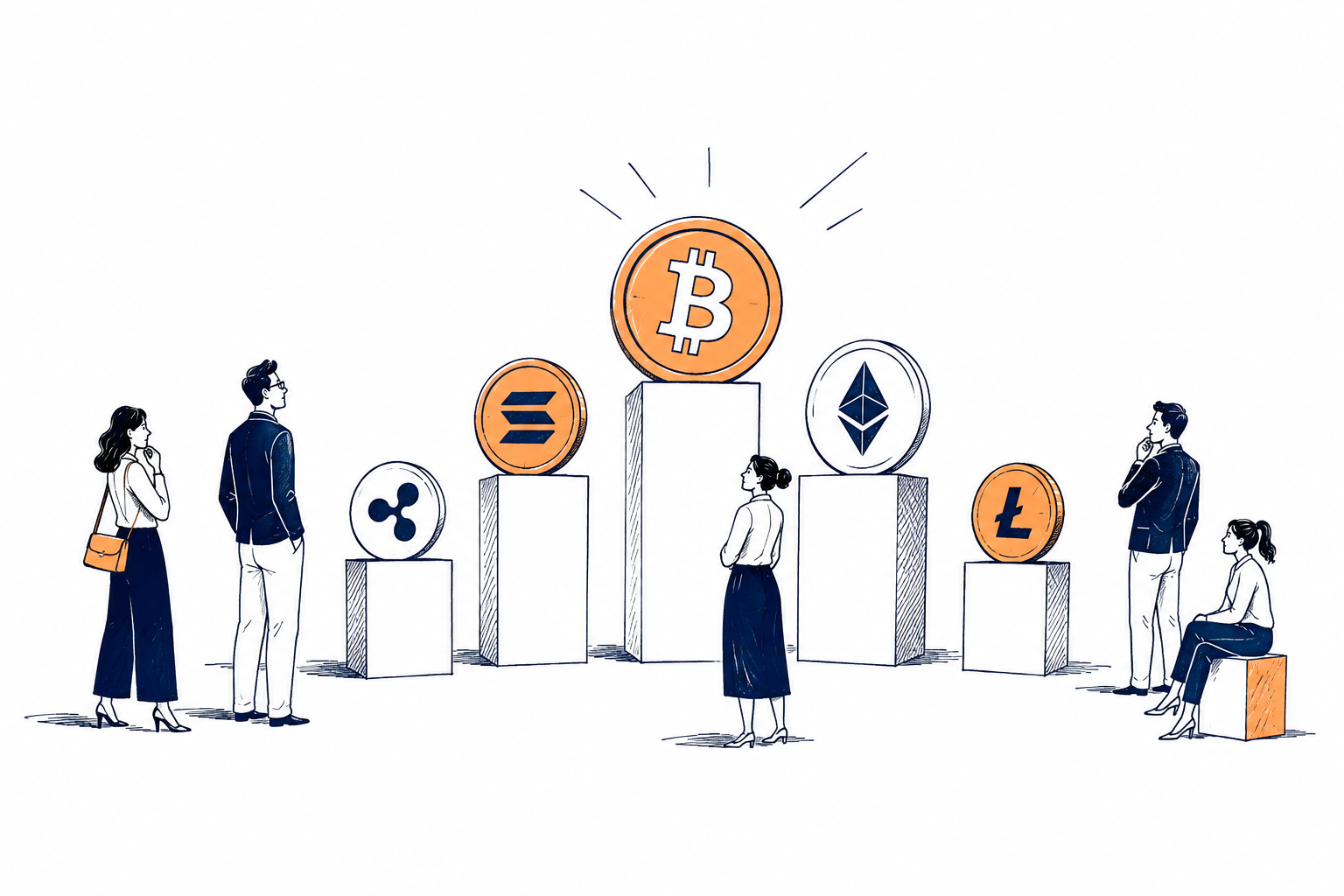

Asking which are the most popular cryptocurrencies sounds like it should produce a simple list. Bitcoin, Ethereum and a handful of other familiar names usually come to mind quickly.
The problem is that “popular” can mean several different things in crypto. An asset may have one of the largest market capitalisations, attract huge trading volumes, be widely available on exchanges or simply have an unusually large community.
Those measures do not always point to the same coins.
That is why a useful look at the most popular cryptocurrencies should go beyond a ranking. The more interesting question is what keeps these assets relevant — and why they have become popular in the first place.
Why “the most popular cryptocurrencies” is harder to define than it sounds
Market capitalisation is one of the most common ways to compare cryptocurrencies. In simple terms, it represents the value the market assigns to all of an asset’s circulating units.
It is useful, but it does not tell the whole story.
Trading volume provides another perspective. A cryptocurrency that changes hands frequently may be particularly important to traders and users, even if its main purpose is very different from Bitcoin’s.
There are other signals too: how many people use a network, where a token can be traded, how much activity takes place on its blockchain and how strong its developer or user community is.
Even cultural visibility can matter.
This creates an important distinction. The biggest cryptocurrencies by market capitalisation are not necessarily the most useful for every user, while an asset with significant real-world or ecosystem utility may not be the most widely recognised outside crypto.
So rather than treating popularity as one number, it is more useful to look at what gives each major cryptocurrency its staying power.
Bitcoin became the market’s reference point
Bitcoin occupies a position that is difficult for any other cryptocurrency to replicate.
As the first major decentralised digital currency, it established the basic idea that value could be transferred through a network without relying on a traditional central authority. Over time, it also became the asset most closely associated with the cryptocurrency market itself.
That creates a powerful network effect.
People who have never owned Bitcoin may still know its name. Financial media regularly use its price to describe the broader crypto market, while other cryptocurrencies are often compared with it.
Bitcoin’s popularity, therefore, is not simply a consequence of how much it is traded. Its role as a reference point has become part of the market’s structure.
This also helps explain why Bitcoin should not necessarily be judged by the same criteria as every other token. Its primary proposition is centred on a monetary network and digital asset, rather than on hosting a large collection of applications.
Ethereum made popularity about more than the token itself
Ethereum followed a different path.
The network introduced smart contracts — programmes that can execute predefined rules on a blockchain — and this made it possible to build other applications and tokens on top of the network.
That changed what a blockchain could be used for.
Ethereum became infrastructure for an expanding ecosystem rather than simply a network for transferring its native cryptocurrency, Ether (ETH). Decentralised applications, tokens and financial protocols could all interact with the same underlying infrastructure.
As a result, part of Ethereum’s relevance comes from activity that happens around its token.
This is an important clue when trying to understand the most popular cryptocurrencies. A token can become significant because people want to hold or trade it, but it can also become significant because an entire ecosystem depends on its underlying network.
Bitcoin and Ethereum therefore represent two different routes to prominence: one centred largely on the monetary role of the asset, the other on the infrastructure built around the network.
Tether shows that a popular cryptocurrency does not have to behave like Bitcoin
Tether’s USDT illustrates another route to popularity.
USDT is a stablecoin, a type of cryptocurrency designed to maintain a relatively stable value against a reference asset. In Tether’s case, that reference is the US dollar.
That makes its role fundamentally different from Bitcoin’s.
Someone using USDT may not be looking for the same exposure to price movements associated with a volatile cryptocurrency. Instead, a stablecoin can be used to move value, trade other crypto assets or keep dollar-denominated value within the crypto ecosystem.
This helps explain why stablecoins can become deeply embedded in crypto markets.
But popularity does not remove risk. Centralised stablecoins depend on the organisation issuing the tokens and on the assets or reserves supporting them. Their widespread use should therefore not be confused with the absence of counterparty or structural risks.
USDT is a useful reminder that high usage and high visibility can come from utility rather than speculation alone.
BNB and Solana show how ecosystems can make a token relevant
Some cryptocurrencies derive much of their importance from the networks and services built around them.
BNB is closely connected to the Binance ecosystem and has functions within that broader environment. Its relevance therefore cannot be understood entirely by looking at the token in isolation.
Solana offers another example. SOL is the native token of the Solana blockchain, where it plays a role in the operation of the network and its wider ecosystem of applications and digital assets.
Cardano and Polkadot illustrate similar principles, although their technical designs and goals differ.
The broader lesson is more important than any individual project: a token can gain prominence because of what happens on its blockchain.
When assessing one of these assets, asking only “How much is the token worth?” misses part of the picture. A better question is what users are actually doing on the network and what role the token plays in that activity.
Dogecoin shows that technology is not the only source of popularity
Dogecoin took a very different route.
Originally created as a joke, it developed a community and a cultural identity that extended far beyond its initial purpose. Social media attention and public interest helped turn Dogecoin into one of the best-known names in crypto.
Its story matters because it challenges the assumption that popularity must come from technical innovation.
A strong community can keep an asset visible for years. But visibility and utility are not interchangeable.
Being widely recognised does not mean that a cryptocurrency serves the same function as Bitcoin, or provides the same infrastructure as Ethereum. In a market where attention can quickly translate into trading activity, cultural relevance can nevertheless have a tangible effect on an asset’s prominence.
Dogecoin is therefore a useful example of another kind of crypto popularity: community-driven attention.
XRP and Uniswap highlight different kinds of utility
Other major names illustrate how difficult it is to reduce cryptocurrency popularity to a single formula.
XRP has long been associated with the movement of value between different currencies and markets, while UNI is the token associated with Uniswap, a decentralised finance protocol.
Decentralised finance, or DeFi, refers broadly to financial services and applications built using blockchain-based protocols rather than relying entirely on traditional financial intermediaries.
These projects occupy very different parts of the crypto ecosystem.
That is precisely the point. There is no single feature that explains why an asset becomes one of the biggest or most widely recognised cryptocurrencies.
Some gain attention through monetary properties. Others become important infrastructure. Some are heavily used for transfers and trading, while others benefit from communities or ecosystems that develop around them.
What should you look at beyond a cryptocurrency ranking?
Rankings are useful starting points, particularly for someone new to crypto. But they become much more informative when combined with a few basic questions.
What is the project actually designed to do?
A token intended to operate as a digital asset should not necessarily be assessed in the same way as the token of a blockchain hosting applications.
What is the token used for?
Utility varies considerably. A token may be needed to interact with a network, used within an application or primarily traded as an asset.
Is there real activity around the project?
A large market capitalisation can tell you about the market value of an asset, but it does not by itself explain how much people use its network or why.
Where does the popularity come from?
Liquidity, infrastructure, community, cultural attention and practical utility can all play a role. Identifying which of these is driving interest can reveal more than the ranking itself.
This approach also makes it easier to interpret changes in the market. If a cryptocurrency moves up or down a ranking, the position is only the visible result. The more useful question is what changed underneath it.
The most popular cryptocurrencies are not a single category with one thing in common. Bitcoin, Ethereum, USDT, BNB, Solana and Dogecoin became prominent through very different combinations of recognition, liquidity, utility and network effects.
That distinction matters because rankings are temporary, while the reasons an ecosystem attracts users can be much more durable.
For anyone trying to understand the crypto market, the useful question is therefore not simply which cryptocurrency is near the top today. It is what keeps people using, trading or paying attention to it in the first place.