
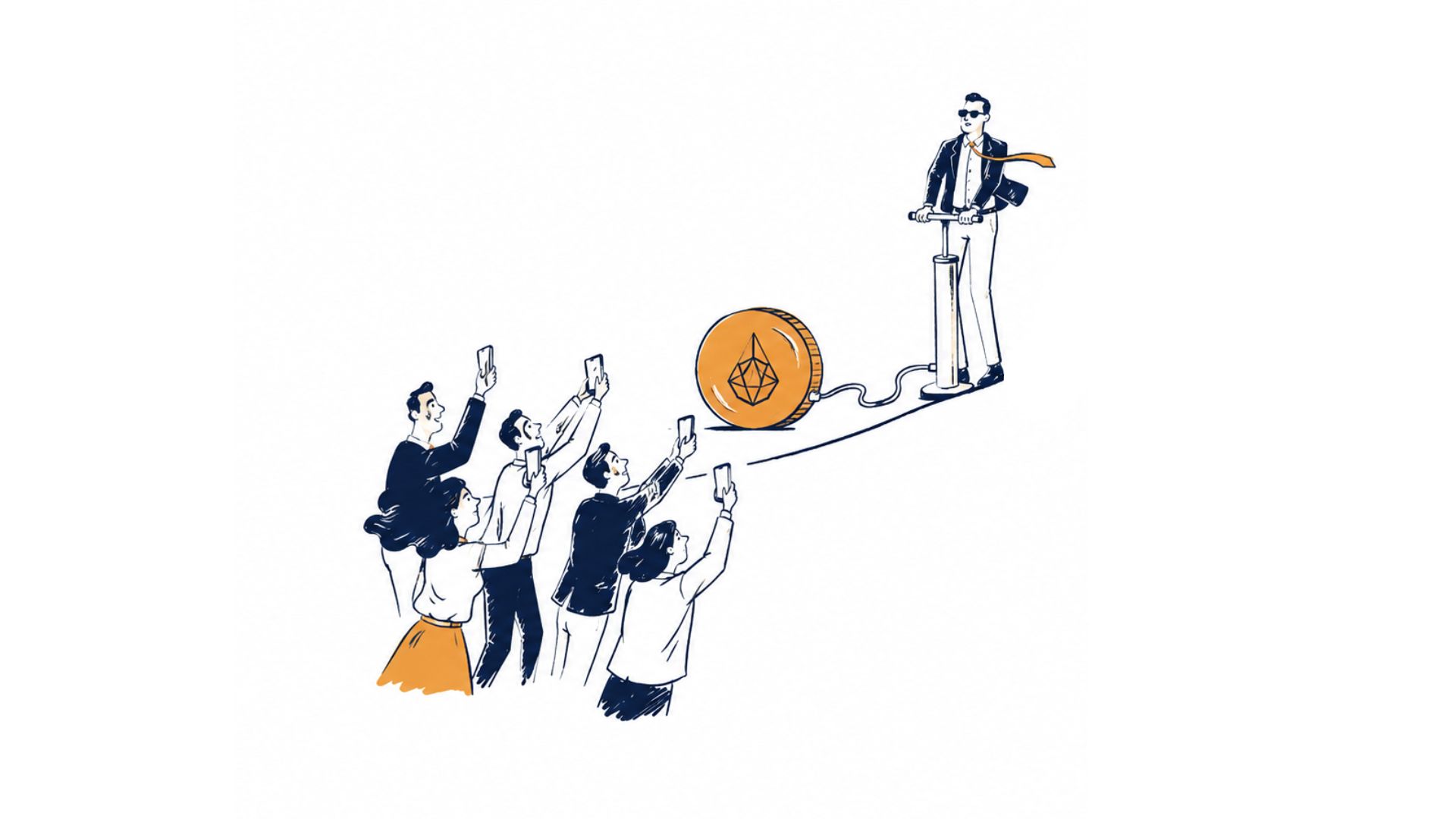

A cryptocurrency suddenly jumps 80%. Trading volume surges. Social media fills with posts about the token, and people who had never heard of it before begin asking the same question: is this the next big opportunity?
Sometimes, a sharp rise reflects genuine demand. Other times, it may be a pump and dump scheme, where the excitement around an asset is part of the mechanism used to attract buyers.
The difficult part is that both scenarios can look remarkably similar on a chart.
A pump and dump does not simply involve buying an asset and later selling it. The crucial element is the attempt to create enough attention and demand to push the price higher, giving early participants an opportunity to sell into the interest they helped generate.
That makes one question more useful than trying to predict the next crash: what is actually causing people to buy?
What makes a crypto pump and dump different from a normal price rally?
In a typical market rally, investors buy an asset because they believe something has changed: perhaps the underlying project has improved, new demand has emerged or an event has altered expectations about its future.
A pump and dump works differently. Participants first build a position and then attempt to generate interest in the asset, often through aggressive promotion, social media activity or claims about how quickly its price is rising.
As more buyers arrive, the price can climb further.
That increase then becomes part of the marketing. A token that was obscure yesterday suddenly appears to be “going up everywhere”. The rising price makes the story more convincing, which can attract even more buyers.
Eventually, the people who accumulated the asset earlier have something they did not have before: a larger pool of potential buyers to sell to.
If enough of them begin selling, the process can reverse. The same momentum that pushed the price upwards can turn into selling pressure, particularly when the token has limited liquidity.
The important point is that the pump is not merely the first half of the scheme. The rising price can itself be the tool that makes the eventual sale possible.
Why low liquidity can make a token easier to manipulate
Liquidity describes how easily an asset can be bought or sold without causing a large change in its price.
For a heavily traded cryptocurrency, a relatively large order may have only a limited effect on the market. A much smaller order can move the price substantially when an asset has fewer buyers and sellers.
That is one reason low-liquidity cryptocurrencies can be more vulnerable to manipulation.
This does not mean that every small token is suspicious. Many legitimate crypto projects have relatively limited trading activity, particularly when they are new or serve a specialised market.
The warning sign comes from the combination of factors.
A relatively obscure token with limited liquidity suddenly experiences an enormous increase in volume, attracts intense attention on social media and begins rising without an obvious, verifiable reason. Each element deserves investigation. Together, they warrant considerably more caution.
Trading volume needs context, too.
A sudden increase in volume may look like proof that genuine demand has arrived. But volume only tells you that more trading is taking place. It does not tell you why people are trading or whether the demand will last.
Which signs can make a sudden crypto rally worth questioning?
There is no single indicator that can confirm a pump and dump. Instead, the useful approach is to look for several warning signs and then investigate what sits behind them.
Start with the most basic question: what changed?
If a token has suddenly risen by a large amount, is there a concrete reason for it?
There may be a protocol upgrade, a major partnership, a new listing or another verifiable development. None of these automatically makes a price rise legitimate, but they provide something that can be examined rather than simply taking the price movement itself as evidence.
The opposite situation deserves more scrutiny: a sharp rally accompanied mostly by vague claims, urgent calls to buy and increasingly excited social media posts, with little information that can be independently verified.
Another factor is token concentration.
If a small number of wallets control a substantial portion of the available supply, large sales could potentially create significant downward pressure. On-chain data can help reveal these concentrations, although it needs to be interpreted carefully. A large wallet may belong to an exchange, a protocol or another legitimate entity rather than an individual preparing to manipulate the market.
The point is not to turn these signals into a checklist that produces a simple yes-or-no answer.
It is to recognise when price, volume, liquidity and promotion are all reinforcing one another without a clear fundamental explanation.
Why FOMO can make manipulation look like genuine demand
FOMO — the “fear of missing out” — is particularly powerful during rapid price increases.
Imagine watching a token rise 20%, then 40%, then 70%. Each new increase can make the previous one look like evidence that buying was the correct decision.
Social media can intensify this effect. Posts celebrating gains, screenshots of trading positions and claims that a token is “about to explode” create the impression that everyone else has already recognised the opportunity.
That can produce a feedback loop.
More attention brings more buyers. More buyers push the price higher. The higher price generates more attention.
The problem is that the investor may mistake momentum for confirmation.
A rising price does not prove that the underlying project has become more valuable. And a large number of people discussing a token does not necessarily mean that sustainable demand exists.
In a pump and dump, creating that perception can be part of the strategy.
Can you spot the dump before everyone else?
This is where trying to identify a pump and dump becomes particularly difficult.
Even if the warning signs are obvious, an investor cannot know exactly when the largest holders will sell, how much they intend to sell or how much liquidity will remain when they do.
A chart can show what has already happened. It cannot tell you with certainty what every participant is about to do.
Liquidity also creates another problem: the price shown on screen may not be the price at which a large order can actually be executed.
This is where slippage becomes relevant. Slippage is the difference between the price a trader expects and the price ultimately received when an order is executed. It can become particularly significant in fast-moving or thinly traded markets.
So even someone who correctly recognises that a token looks manipulated may not be able to exit before the market turns.
That is why spotting a potential pump and dump is more useful as a risk-management tool than as a way to try to profit from the scheme.
Pump and dump and rug pulls are not the same thing
The two terms are sometimes used interchangeably, but they describe different mechanisms.
In a pump and dump, the central idea is to inflate demand and the price of an asset and then sell positions into that demand.
A rug pull, by contrast, generally involves people behind a project withdrawing liquidity or otherwise taking funds before abandoning the project, leaving other participants with an asset that can become difficult or impossible to trade at a meaningful price.
A single project can potentially involve elements of both, but they should not be treated as identical scams.
For someone trying to evaluate a sudden price move, the more important distinction is whether there is evidence of genuine demand or whether the excitement itself appears to be driving the market.
The better question is not whether the token will crash
A sudden crypto rally creates a powerful temptation to focus on the chart.
How high could it go? How much longer can it rise? When should you sell?
For a potential pump and dump, those may be the least useful questions.
A better starting point is to examine the source of the demand.
Why are people buying this asset now? What changed? Who benefits if new buyers continue entering the market? Is the story behind the rally independently verifiable?
Those questions do not provide a perfect way to identify every pump and dump. No chart pattern, wallet distribution or social media signal can do that on its own.
They do, however, change the way a sudden price increase is interpreted.
That matters because the most convincing part of a pump and dump can be the pump itself. A rapidly rising token may look like an opportunity precisely because other people are buying it. But if the rise was deliberately engineered to attract those buyers, the excitement is not evidence that the opportunity is real.
It may be the mechanism that creates the exit for someone else.