
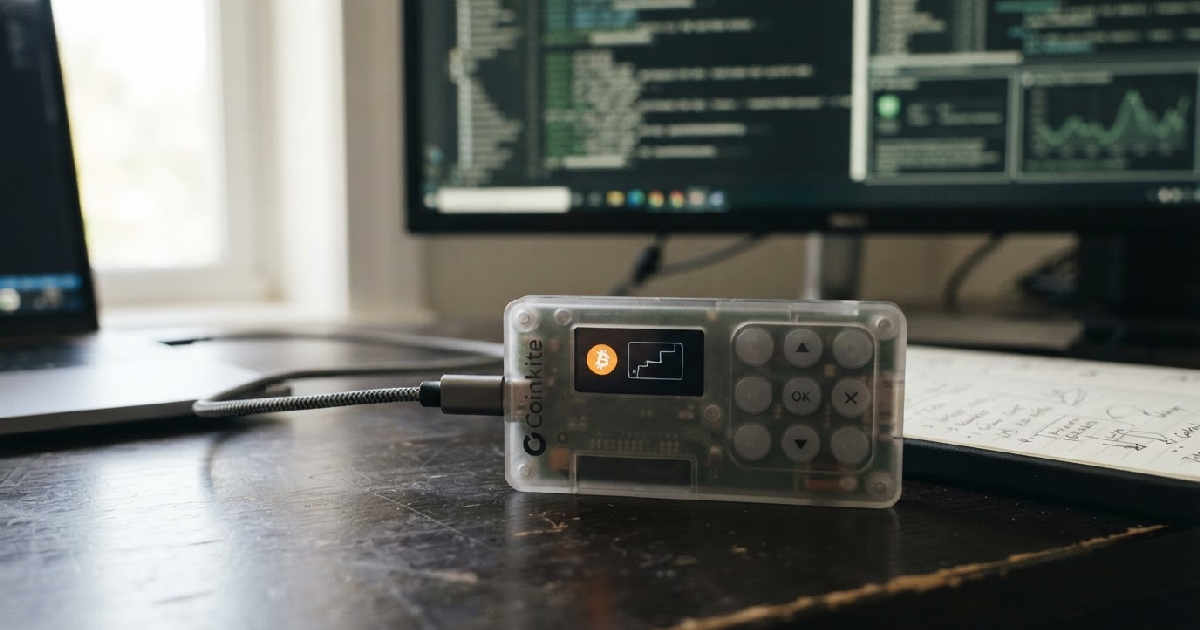

Users of Coldcard hardware wallets have collectively lost over $111 million in Bitcoin, with individual victims reporting a median loss of 1.022 BTC following a widespread Coldcard Bitcoin hack that began on July 30, 2026. The substantial theft stems from a long-standing firmware bug within Coldcard Mk3 devices, manufactured by Canadian firm Coinkite, which compromised the generation of cryptographic seeds.
Hackers exploited a vulnerability introduced in March 2021 with firmware version 4.0.1, enabling them to essentially guess investor seed phrases. Galaxy Research, a prominent digital asset research firm, confirmed the staggering sum, warning that total losses could climb past $130 million as their investigation continues.
Firmware Flaw Triggers Massive Bitcoin Theft
The core of the Coldcard Bitcoin hack lies in a critical flaw where seed generation in Mk3 devices defaulted to a weak software Pseudorandom Number Generator (PRNG), known as `libNgU`, rather than the intended hardware True Random Number Generator (TRNG). This cryptographic oversight dramatically reduced the entropy, or randomness, of newly generated seeds.
For affected Coldcard Mk3 devices running firmware versions 4.0.1 through 4.1.9, the effective search space for generated seeds dwindled to just 40 bits of entropy. This stands in stark contrast to the expected 128 bits for a 12-word BIP-39 mnemonic or 256 bits for a 24-word mnemonic.
Even Mk4, Mk5, and Coldcard Q devices were affected, albeit with a less severe reduction to approximately 72 bits of entropy.
The vulnerability remained undiscovered for years, with Coinkite acknowledging that the bug “silently went unnoticed” and its “potential impact grew with every release” of its products. This extended period allowed countless users to generate compromised seed phrases, unknowingly exposing their Bitcoin holdings.
Dormant Wallets Hit Hardest in Coldcard Exploit
Analysis by Alex Thorn, Managing Director and Head of Firmwide Research at Galaxy Digital, sheds light on the nature of the pilfered funds. His team examined 250 victim reports and found a clear pattern: the stolen Bitcoin overwhelmingly originated from long-dormant wallets.
A typical stolen coin had sat untouched for 3.5 years, and a striking 88% of all pilfered funds were at least a year old. This suggests attackers targeted less active accounts, potentially assuming their owners would be slower to notice or react to the unauthorized transactions.
While the median loss for individual victims reached 1.022 Bitcoin, the average loss was a higher 4.04 Bitcoin, illustrating a distribution where a few large holders significantly skewed the average. One unfortunate Coldcard user reportedly lost as much as 58.97 coins, highlighting the catastrophic potential of such a vulnerability.
Coinkite Responds as Industry Grapples with Trust
Once the coordinated on-chain sweeps began around July 30, Coinkite swiftly responded, publicly disclosing the firmware flaw approximately 30 hours after the initial large-scale transfers. The company urged Coldcard users to immediately update their software or move their funds to alternative storage solutions.
The incident forcefully reminds the Bitcoin community that security is an ongoing process, not a one-time product purchase. Even devices from reputable manufacturers like Coinkite, known for their Bitcoin-only focus and robust features such as dual secure elements, can harbor fundamental flaws.
This event underscores the paramount importance of True Random Number Generators in hardware wallets. When the foundational randomness is compromised, subsequent security measures, no matter how advanced, cannot fully compensate. It’s a stark lesson on the fragility of even air-gapped self-custody if the underlying entropy generation is weak.
Navigating Hardware Wallet Security After the Breach
The Coldcard Bitcoin hack presents a critical moment for re-evaluating hardware wallet security practices. For current Coldcard users, the immediate imperative is to transfer funds from any affected devices to new, securely generated wallets. This process should ideally involve generating a fresh seed phrase on a device confirmed to be free of the vulnerability.
The broader takeaway for all Bitcoin holders is the necessity of layered defenses and continuous vigilance. While hardware wallets generally offer superior security compared to software wallets or exchange custody, they are not immune to sophisticated attacks or inherent design flaws. Users should always purchase devices directly from the vendor, avoid pre-initialized wallets, and rigorously test their recovery words.
This episode also highlights the distinction between the risks of self-custody versus exchange custody. While self-custody protects against counterparty risks like exchange insolvency, it shifts the burden of technical security and vulnerability management onto the individual.
Experts note that strong user-provided entropy, such as multiple dice rolls for seed generation or the use of a robust BIP-39 passphrase (a 25th word), could have significantly mitigated the impact for many victims.
Ultimately, the incident serves as a sober reminder that in Bitcoin, true self-sovereignty demands an unwavering commitment to understanding and actively managing one’s own security.