
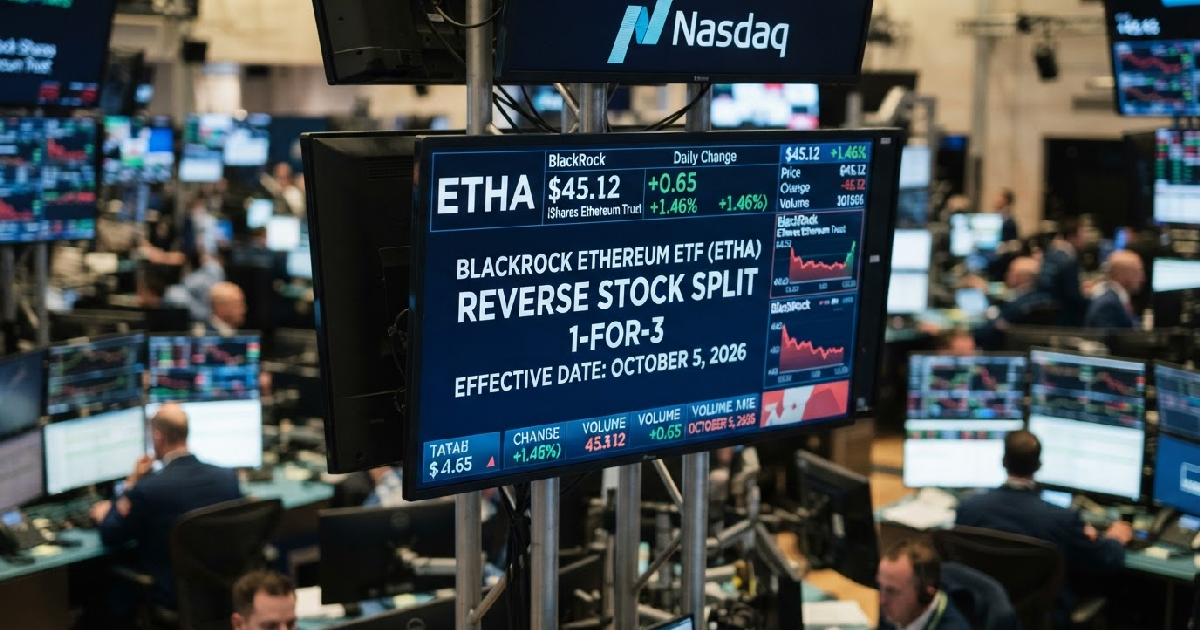

BlackRock’s iShares Ethereum Trust ETF (ETHA) is set to undergo a 1-for-3 reverse share split in October 2026, a move its sponsor, iShares Delaware Trust Sponsor LLC, approved on July 31, 2026. This corporate action, formally announced via an SEC Form 8-K filing on August 4, 2026, aims to significantly reduce trading costs for investors and increase the ETF’s nominal share price.
The upcoming BlackRock Ethereum ETF split will consolidate outstanding shares, taking effect after the close of trading on October 5, 2026, with split-adjusted trading beginning on the NASDAQ exchange on October 6, 2026. This adjustment follows a period where ETHA’s share price had fallen substantially since its launch, prompting a strategic intervention by the fund’s management.
Reducing trading costs with BlackRock Ethereum ETF split
The core objective of the 1-for-3 reverse share split is to enhance trading efficiency for investors. For every three shares of ETHA currently held, investors will receive one new share.
While the number of shares an investor owns will decrease, the total dollar value of their investment remains unchanged. The net asset value (NAV) per share will rise proportionally to reflect the consolidation.
This technical adjustment is projected to bring ETHA’s share price from approximately $14 in early August 2026 to around $42 post-split. BlackRock’s prospectus grants the sponsor the authority to initiate such actions when the secondary-market price deviates from a desirable trading range.
Bloomberg Senior ETF Analyst Eric Balchunas noted the split aims to dramatically cut the bid-ask spread for ETHA. He estimates the spread will narrow from approximately 7 basis points (bps) to around 2 bps.
Such a reduction means more cost-effective trading for market participants. It also highlights a growing emphasis on optimizing operational efficiency within the burgeoning spot crypto ETF market.
To put this in perspective, typical bid-ask spreads on many crypto exchanges often hover around 140 basis points, making ETHA’s projected 2 bps exceptionally tight. This focus on minor spread differences underscores the competitive nature of the ETF space.
Practical Implications for Investors and Market Liquidity
For current shareholders, the reverse split is largely administrative; brokerages will automatically process the consolidation. Investors won’t need to take any direct action.
One logistical detail involves fractional shares. If an investor’s holding doesn’t divide neatly by three, any leftover fractional share will be redeemed for cash at its split-adjusted net asset value. This cash redemption could lead to potential tax consequences for some investors, a factor they should consider.
The reduction in shares outstanding from 384.36 million to approximately 128 million aims to make each share represent a larger portion of the fund’s assets. This could also enhance the fund’s appeal to institutional investors.
BlackRock’s Growing Commitment to Ethereum Offerings
The iShares Ethereum Trust ETF (ETHA) launched on July 24, 2024, marking a significant entry by BlackRock into the spot crypto ETF market. As a spot Ethereum ETF, ETHA holds actual Ether directly, with Coinbase Prime acting as its primary custodian.
ETHA has quickly become a major player, managing over $5 billion in assets as of early August 2026, specifically $5.4 billion. It stands as one of the largest U.S. spot Ether ETFs available to investors.
BlackRock hasn’t limited its Ethereum exposure to just ETHA. The firm also introduced the iShares Staked Ethereum Trust ETF (ETHB) on March 12, 2026. ETHB offers investors the additional opportunity to earn staking rewards on their Ethereum holdings.
It’s crucial to note that this reverse split applies exclusively to ETHA and does not affect ETHB. The distinction reflects varying product structures and regulatory considerations within the U.S. market, particularly the SEC’s cautious stance on staking for U.S.-based spot ETH ETFs.
ETHA’s Performance Trajectory and Market Position
Despite its substantial assets under management, ETHA’s share price performance has faced headwinds. In early August 2026, the ETF was trading near $14 per share, having experienced a year-to-date decline of approximately 40%.
This decline largely mirrored the broader market performance of Ether itself, which saw a similar price depreciation over the same period. The fund’s expense ratio stands at 0.25%, aligning with competitive offerings in the sector.
When compared to other spot Ethereum ETFs, ETHA’s nominal share price of $14 was lower than some peers. Grayscale’s Ethereum fund, for instance, traded around $18, while Morgan Stanley’s MSSE hovered near $20, and VanEck’s ETHV was approximately $27.
This relative positioning underscores BlackRock’s decision to boost ETHA’s per-share value. Raising the nominal price aims to bring it into a more “desirable trading range,” as outlined in the fund’s prospectus.
Industry Precedents and Future Market Observation
BlackRock isn’t the first major issuer to employ a reverse split in the crypto ETF sector. Grayscale Investments previously conducted similar actions for its Bitcoin Mini Trust ETF and Ethereum Mini Trust ETF in November 2024.
Grayscale implemented a 1-for-5 split for its Bitcoin Mini Trust and a more aggressive 1-for-10 split for its Ethereum Mini Trust. Their stated rationale closely aligns with BlackRock’s implicit one: making trading more cost-effective for market participants.
BlackRock’s 1-for-3 split for ETHA is less aggressive than Grayscale’s previous moves. This suggests a more calibrated approach to optimizing its fund’s trading characteristics while balancing investor experience.
The industry will closely watch whether ETHA’s quoted spreads genuinely compress in basis-point terms after October 6. Successful implementation could set a precedent, potentially leading other ETF issuers to consider similar actions if their fund prices fall outside optimal ranges.
Such corporate actions reflect the ongoing maturation of the crypto ETF landscape. Issuers are actively refining their products to appeal to a broader investor base and improve market mechanics, even as the underlying asset class experiences volatility.