

When a conventional bank transfer takes longer than anticipated, standard financial protocol dictates contacting customer support or refreshing a proprietary mobile application. In that framework, authority rests entirely with the financial institution.
The account holder relies on a private database to confirm whether funds have been moved, held, or cleared.
Cryptocurrencies operate on a fundamentally different premise. The state of your assets is not locked behind corporate firewalls or maintained in closed ledgers. Instead, every transaction is broadcast across an open, distributed network.
To inspect the status of those funds, you do not ask for permission, nor do you wait for a customer representative to clear the ticket. You use a blockchain explorer.
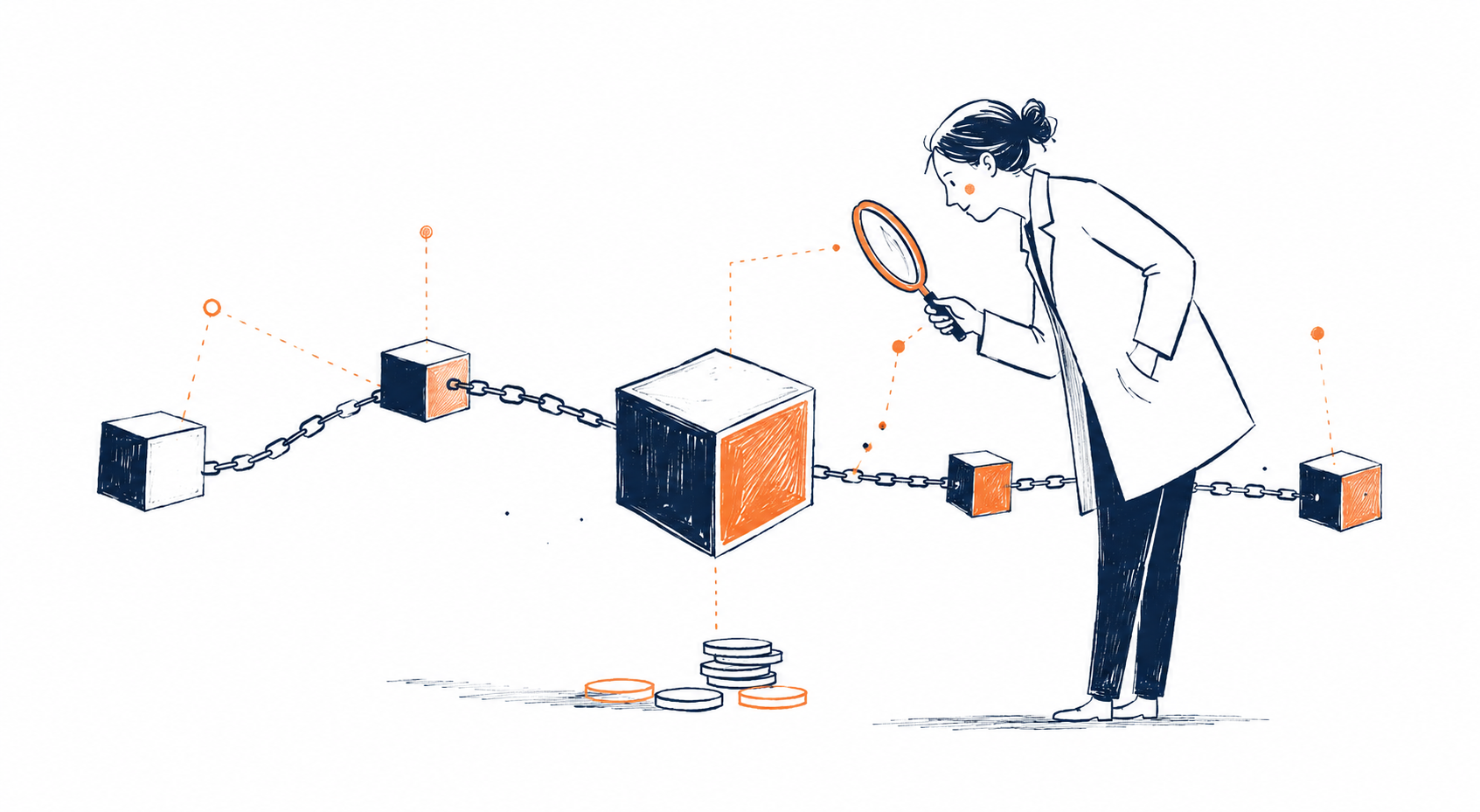
At its core, a blockchain explorer is a search engine and read-only window for distributed ledgers. It converts dense, cryptographic records into a structured format that anyone can read. Yet, treating an explorer as merely a customer service tool for missing payments understates its structural importance.
It represents one of the most significant shifts in modern finance: the transition from institutional trust to independent verification.
Decoding the ledger: how an explorer turns raw cryptography into human readability
Without an explorer, interacting with a public blockchain directly would require querying network nodes via command-line interfaces or parsing raw cryptographic code.
A public blockchain is an unbroken chain of data blocks, each packed with cryptographic signatures, hexadecimal strings, and complex state changes.
A blockchain explorer works by running an indexer alongside a network node. The node continuously receives new blocks validated by the network, while the indexer extracts this raw data, organises it into relational databases, and serves it through a clean graphical user interface.
When you input a search query, the explorer fetches the corresponding record in milliseconds.
It is helpful to distinguish a blockchain explorer from a traditional web search engine like Google.
- Web search engines rely on crawling algorithms to index web pages, using proprietary metrics to rank results based on relevance, user history, and authority. They curate what you see;
- Blockchain explorers do not curate or rank information. They serve as an objective mirror of the underlying network. Every validated block is appended strictly according to the consensus rules of that specific chain. The explorer simply displays the ledger as it exists — without editorial filtering, algorithmic bias, or personal preference.
Because each network relies on its own architecture, explorers are chain-specific. The data structure of Bitcoin, which uses an Unspent Transaction Output (UTXO) model, differs significantly from Ethereum’s account-based model or Solana’s high-throughput architecture.
Consequently, entering an Ethereum transaction hash into a Bitcoin explorer will return no results. The explorer cannot interpret data outside the specific ledger it is built to index.
The pseudonymous paradox: radical ledger visibility without personal names
A frequent point of confusion for those new to public networks is the relationship between transparency and identity. If every transaction is permanently visible on an open ledger, does that mean everyone knows who owns what?
The short answer is no, due to the pseudonymous architecture of public blockchains.
When performing a crypto transaction verification on an explorer, the platform does not list names, physical addresses, or government identification numbers. Instead, transactions are anchored to public keys — long strings of alphanumeric characters that serve as digital addresses.
Example Address: 0x71C7656EC7ab88b098defB751B7401B5f6d8976F
Example TXID: 0x4f8a…3b9e
Anyone inspecting an address on an explorer can observe its entire financial trajectory:
- Every outgoing and incoming transfer since the address was generated;
- The exact timestamp and block height of every transaction;
- The processing fee paid to network validators;
- The current balance of native assets and secondary tokens.
This structure creates a unique dynamic: total transparency of activity alongside anonymity of identity. However, this privacy is conditional. The moment an address is linked to a real-world identity — whether through an exchange enforcing identity verification, a public donation link, or an operational mistake — the pseudonymity dissolves.
From that point onward, every past and future transaction associated with that address becomes fully traceable back to that individual or entity.
Where public vision ends: the blind spots of mainnet explorers
While blockchain explorers provide unprecedented auditability, their visibility is strictly bounded by the edges of the underlying network. Assuming that an explorer tracks every movement in the crypto ecosystem is a common misconception.
Centralised exchanges (off-chain activity)
If two users trade assets within a centralised exchange, that trade does not occur on the blockchain. Instead, it is settled internally within the exchange’s private database. The ledger remains unaffected until a user initiates an actual withdrawal or deposit to an external wallet.
Consequently, off-chain order matching is entirely invisible to a public blockchain explorer.
Layer-2 scaling solutions
To alleviate network congestion and lower fees, Layer-2 networks process transactions on secondary frameworks before bundling and settling them back onto the main chain. If you execute a transaction on an Ethereum Layer-2 network, searching for that specific transaction hash on an Ethereum mainnet explorer will yield no results.
You must consult a dedicated Layer-2 explorer designed to index that specific execution layer.
Privacy-focused networks
Certain blockchains are explicitly engineered to conceal transaction details using zero-knowledge proofs or cryptographic obfuscation techniques. On these networks, an explorer might confirm that a valid block was produced and a transaction occurred, but it will hide the sender’s address, the recipient’s address, or the exact amount transferred.
Understanding these boundaries prevents misplaced assumptions about what can and cannot be audited through a public explorer interface.
Practical auditing: turning ‘don’t trust, verify’ into a daily habit
For everyday users, consulting an explorer is the primary way to confirm the status of their transfers independently.
When a transaction is broadcast to a network, it enters a staging area known as the mempool (memory pool). Here, it waits to be selected by a validator and included in an upcoming block. By pasting a transaction hash (TXID) into an explorer, you can see whether your transaction is still pending in the mempool or if it has been formally included in a block.
Mempool (Pending) ──> Block Inclusion (1 Confirmation) ──> Subsequent Blocks (Finality)
Once included, the transaction receives its first confirmation. As subsequent blocks are added on top of that block, the number of confirmations increases, exponentially decreasing the mathematical probability that the transaction could ever be altered or reversed.
Beyond simply tracking transfer statuses, advanced users rely on explorers for critical security checks:
- Inspecting smart contract code: On platforms supporting smart contracts, explorers allow users to review verified source code, inspect token distribution schedules, and verify whether a protocol’s contract functions as advertised before interacting with it;
- Evaluating gas fees: Explorers provide real-time metrics on network congestion and average transaction fees, helping users avoid overpaying during peak activity;
- Monitoring wallet interactions: Users can verify which third-party applications have approval to interact with their token balances, allowing them to revoke dangerous permissions before assets are compromised.
The shift from blind trust to public verification
The blockchain explorer is often introduced as a basic utility — a simple tool for checking if a transfer went through. In reality, it embodies the defining architectural principle of public networks: shifting financial verification from behind closed doors into the public domain.
In traditional financial systems, individuals must trust that balance sheets are accurate, that transfers are properly logged, and that intermediaries remain solvent. A public blockchain explorer replaces that blind trust with deterministic proof.
It provides the tools necessary to verify network state independently, requiring no special permission, corporate credentials, or institutional authority.
By translating raw cryptographic ledgers into an accessible digital format, the blockchain explorer turns abstract transparency into a practical capability. It ensures that the record remains open, immutable, and verifiable by anyone willing to look.