
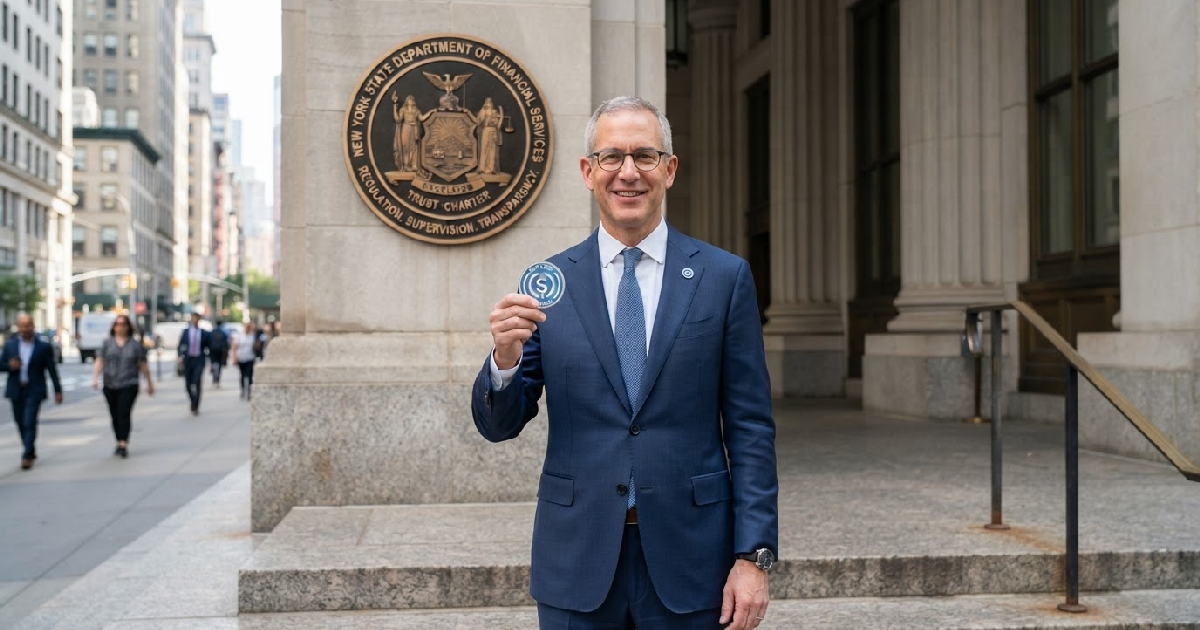

Circle Internet Group, Inc. secured a limited purpose New York trust charter for Circle Internet Trust Company LLC on July 31, 2026. (NYSE: CRCL), the issuer of the USDC stablecoin, officially secured a limited purpose trust charter from the New York State Department of Financial Services (NYDFS) for its new entity, Circle Internet Trust Company LLC, operating as Circle New York Trust, on July 31, 2026.
This pivotal approval allows Circle to hold the multibillion-dollar reserves backing USDC directly under the supervision of New York financial regulators.
New York trust charter enhances USDC regulatory framework
The regulatory milestone enhances the oversight and compliance framework for USDC, positioning Circle as a highly regulated entity. Co-Founder, Chairman, and CEO Jeremy Allaire noted that “the race-to-the-top regulatory strategy continues,” while shares of Circle Internet Group (NYSE: CRCL) experienced an unexpected intraday slide, trading around $61 on the news.
The newly granted limited purpose trust charter fundamentally changes how Circle manages its flagship stablecoin. The company can now directly custody its own reserves, which reduces reliance on third-party commercial banks.
Direct oversight by the NYDFS mitigates risks associated with bank failures and bolsters the transparency of USDC’s backing. New York’s financial regulators are widely recognized as an international standard setter for digital asset regulation, so this approval carries considerable weight.
A decade of digital asset compliance
Circle’s regulatory relationship with the NYDFS extends back more than a decade. The company notably became one of the first to receive the state’s BitLicense in 2015, establishing a long track record of engaging with stringent regulatory requirements.
This latest approval builds on that foundation, illustrating a consistent commitment to regulatory clarity and compliance. Allaire stated that Circle is now building “fundamental financial market infrastructure under supervision that spans the globe, the nation, and the world’s most important financial capital.”
USDC solidifies institutional confidence
For financial institutions and Wall Street, the NYDFS trust charter provides a clear and legally recognized signal of legitimacy. It formally integrates USDC into a recognized legal framework, something Allaire highlighted as crucial.
He added that “digital dollars are playing an increasingly important role in the global financial system.” This regulatory clarity is expected to significantly boost institutional confidence in USDC, facilitating its broader adoption in traditional finance.
The timing of this charter is particularly relevant as the digital dollar market is projected to reach an impressive $2 trillion by 2028. Establishing a robust regulatory foundation now positions USDC for substantial growth, appealing to institutions seeking secure and compliant digital assets.
Navigating the evolving stablecoin landscape
This regulatory achievement follows Ripple’s similar NYDFS approval for its RLUSD stablecoin back in December 2024. Both firms now operate under comparable state-level regulatory frameworks for their stablecoin offerings.
Despite the similar regulatory status, their market positions differ significantly. USDC remains the second-largest stablecoin with an approximate market capitalization of $73.7 billion, while Ripple’s RLUSD has a market value of $469 million, ranking 20th among stablecoins.
Circle’s pursuit of dual licensing underscores a comprehensive regulatory strategy. On July 10, 2026, the company also received final approval from the U.S. Office of the Comptroller of the Currency (OCC) to establish First National Digital Currency Bank, N.A., operating as Circle National Trust. This federal approval complements the state-level charter, providing Circle with a two-pronged approach to regulatory oversight.
Market reaction to regulatory clarity
Despite the positive news regarding enhanced regulatory clarity and operational independence, Circle Internet Group’s stock performance on July 31 proved somewhat perplexing. Shares trading under the ticker CRCL experienced an unexpected intraday slide.
The stock was trading around $61 that day, marking a steep intraday decline despite the strong fundamental catalyst provided by the NYDFS charter. This suggests that broader market dynamics or investor sentiment not directly tied to the specific news may have influenced the stock’s movement.