
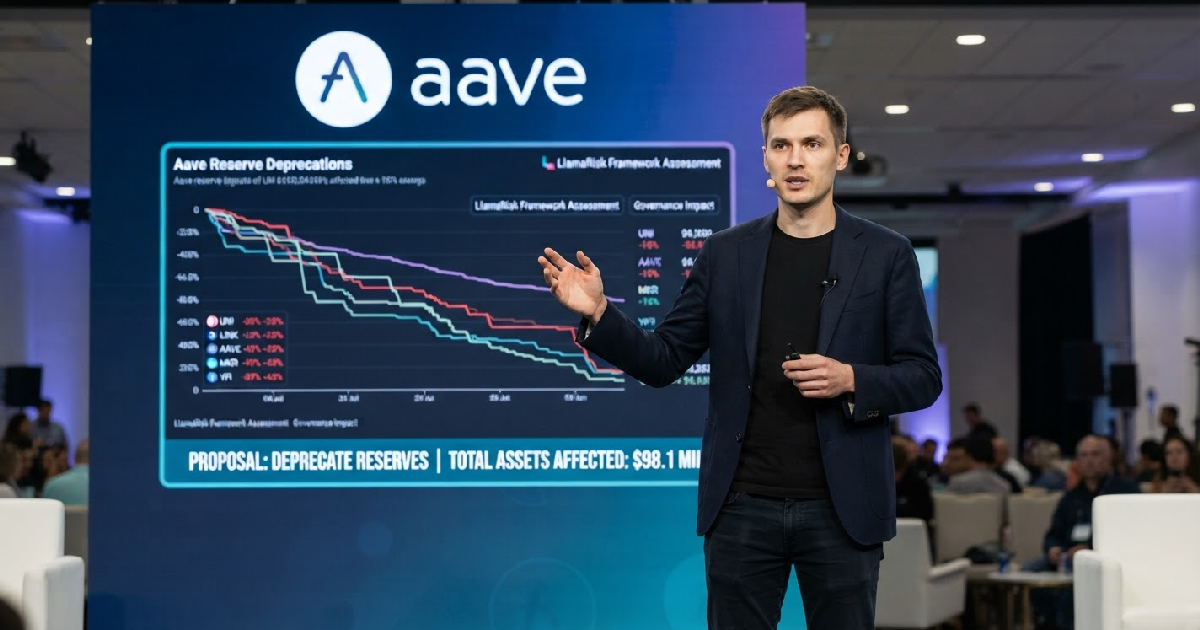

Aave, a leading decentralized finance (DeFi) lending protocol, has put forward a significant governance proposal to deprecate 75 low-adoption asset reserves and fully wind down six smaller blockchain deployments. This initiative, announced on Thursday by Aave founder Stani Kulechov, stands to affect approximately $98.1 million in supplied assets and $15.6 million in outstanding debt across its markets.
The move represents a proactive effort to bolster the protocol’s security and efficiency, stemming from a comprehensive review conducted by risk service provider LlamaRisk under Aave’s recently established Aave Risk Framework. Rather than reacting to a single incident, these changes aim to systematically reduce operational overhead and inherent risks across Aave’s extensive ecosystem.
Proactive risk management through Aave reserve deprecations
This wide-ranging deprecation proposal signals Aave’s commitment to portfolio-level risk management, moving beyond ad-hoc responses to individual asset vulnerabilities. The new Aave Risk Framework, introduced in June, is now being applied across all deployments to identify and remove assets that no longer justify the resources required for their price oracles, liquidation infrastructure, and ongoing risk monitoring.
It’s a strategic shift for the protocol, which manages vast sums in digital assets. Maintaining numerous illiquid or underutilized assets can introduce unnecessary complexity and potential attack vectors, making regular pruning essential for long-term health and stability.
The impact of KelpDAO exploit on Aave’s strategy
The development of the Aave Risk Framework itself was a direct consequence of the KelpDAO bridge exploit in April, which saw approximately $292 million compromised. That incident exposed Aave to potential bad debt after the stolen rsETH was deposited as collateral, highlighting critical vulnerabilities in bridge configurations and asset vetting.
Consequently, the framework now mandates stringent security measures, including a minimum of three independent verifiers for any bridge route involving Aave exposure, specifically banning the 1-of-N and 2-of-N configurations that proved problematic. It’s clear Aave learned a tough lesson there, and they’re applying those insights to strengthen their entire operational perimeter.
Specific assets and deployments slated for removal
The proposal targets a total of 75 reserves. This includes 50 low-adoption reserves and 21 matured Pendle Principal Tokens (PTs) spread across 11 Aave V3 deployments.
Pendle PTs, which represent the principal portion of yield-bearing assets, are being replaced with new maturities as part of the streamlining. These specific reserve removals account for a significant $85.3 million in supplied assets and $11.5 million in debt.
Six smaller blockchain deployments winding down
Beyond individual reserves, the proposal also outlines the complete wind-down of six smaller blockchain deployments: Sonic, Scroll, zkSync, Metis, Soneium, and Aptos. These deployments collectively cover another 25 reserves.
Together, these deployment-wide deprecations represent an additional $12.8 million in supplied assets and $4.1 million in debt. The rationale is simple: protocol revenue in these smaller ecosystems often doesn’t cover the maintenance costs, making them inefficient to support.
For instance, deposits on Sonic have fallen by 74% over six months, leaving $7.6 million supplied and $2.7 million borrowed. Scroll saw deposits decline 86% to $2.2 million, while zkSync’s deposits fell 88% to $844,000. Similar declines hit Metis, Soneium, and Aptos, with the latter’s liquidity dropping 94% to $1.7 million supplied.
The deprecation process and user implications
For users holding assets in the affected reserves or deployments, Aave has outlined a clear deprecation process. The protocol plans to freeze new activity, meaning new supply, borrowing, or using assets as fresh collateral will no longer be possible.
Supply and borrow caps will be drastically reduced to a single unit, effectively halting new transactions. Furthermore, reserve factors on borrowable assets will be increased. For entire deployments slated for retirement, reserve factors will be raised to 99% and base interest rates hiked to 5%.
These measures are designed to strongly incentivize users to unwind their positions gradually. By increasing costs and limiting new activity, Aave aims to facilitate an orderly migration of liquidity away from these deprecated markets, mitigating potential disruptions for users.
A broader governance overhaul and the path ahead
This proposal is part of a wider governance overhaul for Aave, where the new Aave Risk Framework is set to become the standard for asset listings, ongoing reviews, and future deprecations across Aave V3, V4, and the upcoming Aave Horizon. Assets failing to meet these new, more rigorous requirements will systematically be removed.
A companion proposal from LlamaRisk also addresses long-tail reserves identified with elevated Chainlink price-feed risk. For these, live price feeds will be replaced with fixed-price adapters, further isolating potential points of failure and reinforcing the protocol’s overall resilience.
But this isn’t a done deal just yet. The proposal is currently a governance initiative, meaning it requires approval from the Aave decentralized autonomous organization (DAO). Typically, this involves an off-chain Snapshot vote, followed by a binding Aave Improvement Proposal and an on-chain vote.
The exact timeline for implementation will depend on community feedback, the voting process, and the technical preparations. However, it underscores a maturing DeFi ecosystem where protocols are increasingly prioritizing sustainable growth and robust risk management over aggressive expansion.
What this means for the DeFi ecosystem
Aave’s proactive move to streamline its offerings and rigorously manage risk sets a significant precedent for the broader DeFi space. It suggests a shift away from simply listing every available asset or expanding to every new chain without critical evaluation.
This isn’t just about Aave; it’s about the industry recognizing the cumulative risk that comes with maintaining a sprawling, unchecked portfolio of assets and deployments. Other lending protocols might follow suit, leading to a more focused and ultimately more secure DeFi landscape.
For users, it means a clearer understanding of the protocol’s risk appetite and a more stable environment, albeit with fewer long-tail assets to interact with. The focus is clearly on core functionality and robust, well-supported markets, which can only benefit the long-term health of decentralized lending.