
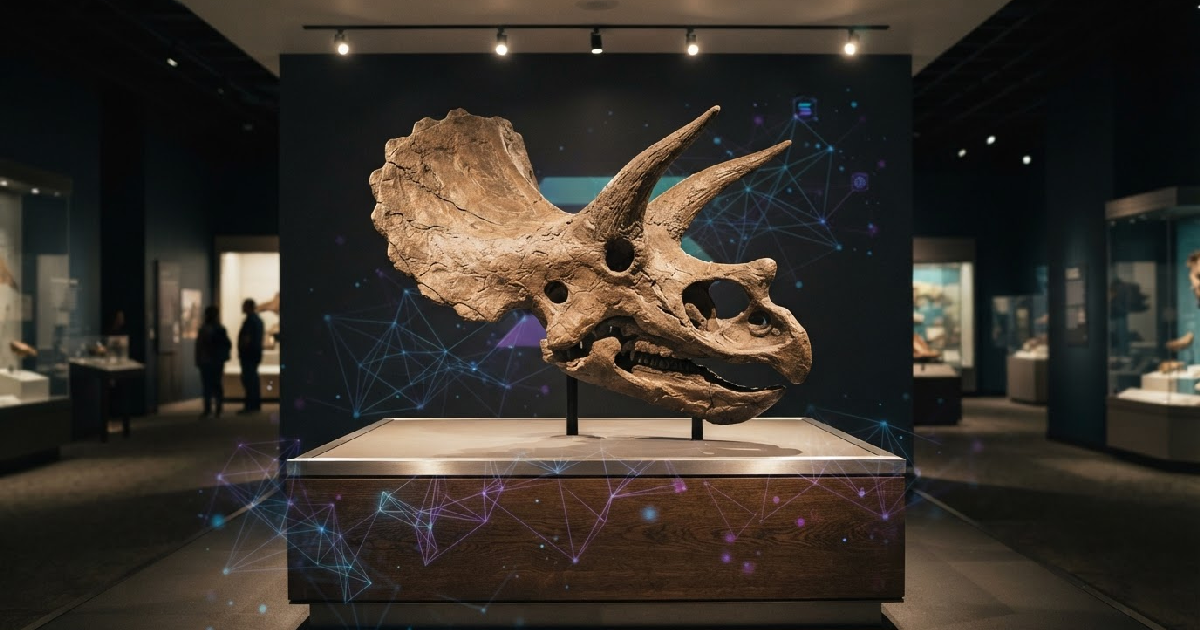

Jurassic Finance has unveiled a novel initiative, announcing it will tokenize Deaton, a museum-grade Triceratops prorsus skull, on the Solana blockchain. This move marks what the platform describes as the “first tokenized dinosaur,” pushing the boundaries of real-world asset (RWA) tokenization into unique and historically significant objects.
The project aims to democratize access to rare and valuable collectibles, traditionally reserved for high-net-worth individuals or institutions. By bringing Deaton, a skull noted for its 60% to 65% complete bone mass, onto the blockchain, Jurassic Finance seeks to enable fractional ownership and integrate these assets into decentralized finance (DeFi).
A new era for real-world asset tokenization
The tokenization market continues its rapid expansion, moving far beyond conventional assets like stocks and bonds. Issuers are increasingly looking to represent a diverse array of physical goods on-chain, from art to luxury items, and now, even ancient fossils.
This trend underscores a broader ambition within the crypto space: to bridge the liquidity of digital markets with the tangible value of real-world objects. Jurassic Finance’s approach with Deaton exemplifies this, offering a distinct use case for blockchain technology.
The mechanics of tokenizing physical artifacts
Jurassic Finance Labs, the entity responsible for sourcing and acquiring these unique assets, procures authenticated fossil specimens through established distribution networks, private collections, and auction channels. Each acquired fossil then becomes the basis for a legally structured Special Purpose Vehicle (SPV).
Each SPV subsequently issues a distinct token on Solana, adhering to the network’s SPL standard. Token holders don’t just own a digital representation; they gain economic and legal rights directly tied to the underlying asset through the vehicle’s operating agreement, which are fully transferable.
While the ownership record of these digital tokens lives transparently on-chain, the physical authentication, secure custody, and comprehensive insurance of the dinosaur skull remain robustly managed off-chain. This hybrid model ensures both the integrity of the physical asset and the immutability of its digital ownership.
Funding and revenue streams
The Deaton raise, initiated in July, targeted 660,000 USDC to facilitate the acquisition and associated operational costs. From this target, 600,000 USDC is designated for escrow to the seller, securing the purchase of the rare Triceratops skull.
The remaining 60,000 USDC will go into the RAWR token treasury, supporting the ecosystem around Jurassic Finance. The tokenized Deaton will have a total supply of 1 million tokens, with 95% allocated proportionally to investors who participated in the raise, and the final 5% reserved for the RAWR treasury.
Moreover, the project generates ongoing institutional revenue through display rights, which are managed by museums. These institutions cover all operational overhead, effectively abstracting these costs from token holders. This mechanism allows investors to benefit from the asset’s value without direct management responsibilities.
Solana’s growing real-world asset dominance
Solana has emerged as a significant player in the burgeoning real-world asset ecosystem. Data from RWA.xyz indicates Solana ranks third among networks by distributed asset value, holding a substantial 9.74% share of the market.
The network’s total distributed asset value reached an all-time high of $3.62 billion as of July 3, 2026, showcasing a consistent upward trajectory. This figure represents a 2.84% increase over the preceding 30 days, underscoring Solana’s increasing traction for various tokenized assets.
Market growth and unique offerings
Solana’s RWA ecosystem has experienced remarkable growth over the past year, with its value expanding from approximately $873 million at the end of 2025 to over $3.1 billion by June 25, 2026. This exponential increase highlights the network’s appeal for new and diverse tokenization projects.
The number of holders on Solana’s RWA platforms has also grown, reaching 312,309, a 6.28% gain over the same period. This indicates a growing community of participants engaging with tokenized real-world assets on the network, signaling broader acceptance and utility beyond traditional cryptocurrencies.
RAWR token price reflects immediate interest
The announcement of Deaton’s tokenization has already spurred significant activity around Jurassic Finance’s native RAWR token. BeInCrypto Markets data shows the RAWR token, which first launched in mid-May, surged more than 89.17% in the past 24 hours.
This sharp price movement suggests strong market interest and investor confidence in Jurassic Finance’s unique approach to asset tokenization. The project’s Initial DEX Offering (IDO) on May 15, 2026, successfully raised $200,000, selling 10 million tokens at $0.02 each.
At the time of its IDO, the RAWR token recorded a market cap and Fully Diluted Valuation (FDV) of $698,234. Its trading volume stood at $7,329, with an All-Time High (ATH) price of $0.0642. The recent surge extends this positive trajectory, indicating sustained momentum.
Unlocking access to exclusive assets
The tokenization of a museum-grade dinosaur skull like Deaton represents a fascinating evolution in the digital asset landscape. It moves beyond typical financial instruments or digital art, venturing into highly specialized and historically significant collectibles.
This initiative could pave the way for other unique, illiquid assets to find a new life on the blockchain, opening them up to a global pool of investors. It essentially democratizes what was once an exclusive domain, potentially transforming how rare physical objects are owned, valued, and traded.
For market participants, such developments mean diversifying investment portfolios with assets that offer both intrinsic historical value and the potential for digital market liquidity. It also highlights the technical and legal complexities that must be navigated to securely link physical assets to their digital representations, setting precedents for future RWA projects.