
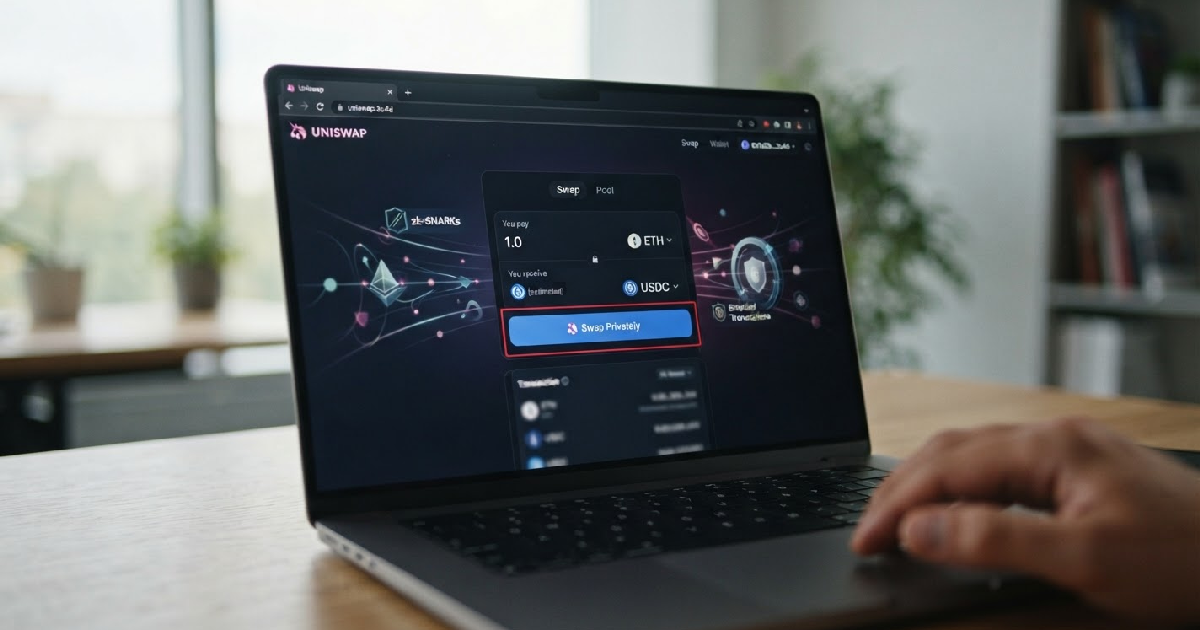

The Uniswap community is currently reviewing a significant proposal that could redefine user privacy and protection in decentralized finance (DeFi). An official Request for Comment (RFC), published on July 23, 2026, outlines an optional “Swap Privately” feature to be integrated directly into the Uniswap interface, including its official web app and wallet.
This initiative, spearheaded by the SilentSwap Core Development Team, aims to leverage existing Uniswap v4 Hooks and UniswapX technologies. Its core objective is to provide native, enhanced privacy for users, shielding them from predatory trading strategies like front-running and sandwich attacks that often plague on-chain transactions.
The Problem: DeFi’s Persistent MEV Challenge
Decentralized exchanges like Uniswap have revolutionized trading, offering unparalleled transparency and accessibility. However, this inherent transparency comes with a significant drawback: transaction intent can leak before execution, creating lucrative opportunities for malicious actors.
Bots and sophisticated traders constantly monitor the public mempool for pending transactions. They can then insert their own trades, front-running a user’s swap or sandwiching it between buy and sell orders, ultimately exploiting the user for profit. This phenomenon, known as Maximal Extractable Value (MEV), has been a persistent challenge in DeFi for years, degrading execution quality and increasing costs for ordinary traders.
Transaction Visibility Fuels Exploitation
The very nature of public blockchains means that every pending transaction is visible to everyone on the network. This visibility allows bots to analyze potential price impacts and strategically place their own orders.
While experienced users might employ private Remote Procedure Calls (RPCs), aggregators, or advanced routing tools to mitigate these risks, many mainstream DeFi participants simply lack the technical know-how or access to such specialized solutions. This leaves a large segment of the user base vulnerable to consistent exploitation, undermining confidence in decentralized trading.
Unpacking the “Swap Privately” Proposal
The SilentSwap Core Development Team’s RFC proposes a pragmatic solution: an opt-in “Swap Privately” button within the Uniswap interface. This feature would route trades through SilentSwap’s non-custodial privacy infrastructure, designed to reduce the exposure of transaction details before a swap is executed.
The proposal assures that standard swaps would remain unaffected, and pool fees wouldn’t change. This ensures that the privacy option is an enhancement, not a replacement, for the existing Uniswap experience, offering a choice to users who prioritize protection against MEV.
Uniswap v4 Hooks and UniswapX Power the Solution
The proposed architecture relies heavily on two advanced Uniswap technologies: v4 Hooks and UniswapX. Uniswap v4 Hooks, released in January 2025, are smart contracts that allow developers to customize pool behavior and execution logic.
This flexibility is crucial, as it enables the integration of new routing, fee structures, and privacy features without altering Uniswap’s core protocol. Similarly, UniswapX, launched in 2023, is Uniswap’s intent-based trading protocol. It already provides gas-free, MEV-protected, and cross-chain swaps by using off-chain orders and a network of “fillers” who compete to execute them.
By combining these two powerful mechanisms, the RFC aims to create a path where transaction details are significantly less exposed. Users would still benefit from Uniswap’s deep liquidity and familiar interface, but with an added layer of privacy. This combination helps mask user intent, making it harder for bots to front-run or sandwich trades.
Balancing Privacy and Compliance
Perhaps one of the most compelling aspects of the RFC is its integrated approach to privacy and compliance. Historically, discussions around crypto privacy often presented it as being at odds with regulatory requirements, implying that private transactions were inherently suspicious.
This RFC challenges that binary view by incorporating pre-execution compliance screening. SilentSwap’s infrastructure, which has been live in production since 2024, includes real-time Anti-Money Laundering (AML) and Office of Foreign Assets Control (OFAC) sanctions screening before any transaction authorization. Transactions that fail this screening simply cannot proceed.
The proposal explicitly clarifies that SilentSwap is “Not a mixer,” emphasizing that it never pools deposits, takes custody of funds, or touches user keys. It also highlights that the system is “Audited.” This proactive integration of compliance controls alongside privacy measures reflects a maturing DeFi landscape.
Builders are increasingly focused on creating systems that protect legitimate users from exploitation while simultaneously addressing regulatory concerns, striving for a difficult but necessary balance.
A New Standard for Decentralized Trading
Uniswap’s importance in the DeFi ecosystem cannot be overstated, having supported over $1.6 trillion in trading volume and holding a substantial market share. As of June 2023, Uniswap accounted for 64.6% of DEX trading volume.
When Uniswap, a market leader, explores new execution models, the rest of DeFi pays close attention. This RFC, therefore, isn’t just about a single feature; it represents a potential shift in what users come to expect from decentralized exchanges regarding execution quality and privacy.
Shaping User Expectations and Market Structure
A “Swap Privately” option presented as a first-class feature within Uniswap’s mainstream interface could significantly influence the broader market structure. If successful, it might push other decentralized exchanges (DEXs) and aggregators to adopt similar standards for MEV protection and privacy.
Users shouldn’t have to delve into the technical intricacies of MEV to protect themselves from exploitation. This proposal aims to offer safer defaults and more intuitive options directly at the interface level, making DeFi trading more equitable for the average participant. The goal is to keep privacy-seeking volume within the Uniswap ecosystem, preventing users from migrating to external, potentially less secure, tools.
The Road Ahead for Governance
It’s crucial to remember that this is still a Request for Comment, marking Phase 1 of the Uniswap governance process. It is not an approved or live product.
The Uniswap community and delegates must now debate the design’s feasibility, the technical implementation’s safety, the acceptability of compliance assumptions, and potential new risks. These discussions are vital to ensure the feature, if implemented, genuinely enhances user protection without creating false confidence or new vulnerabilities. The ultimate success of the “Swap Privately” feature hinges on robust community engagement and careful refinement.
This RFC, while a proposal, points towards a significant future for DeFi. It envisions swaps that are transparent enough for on-chain settlement but simultaneously shield users from exploitation during their most vulnerable moments: transaction submission. This direction could profoundly shape the evolution of decentralized trading.