
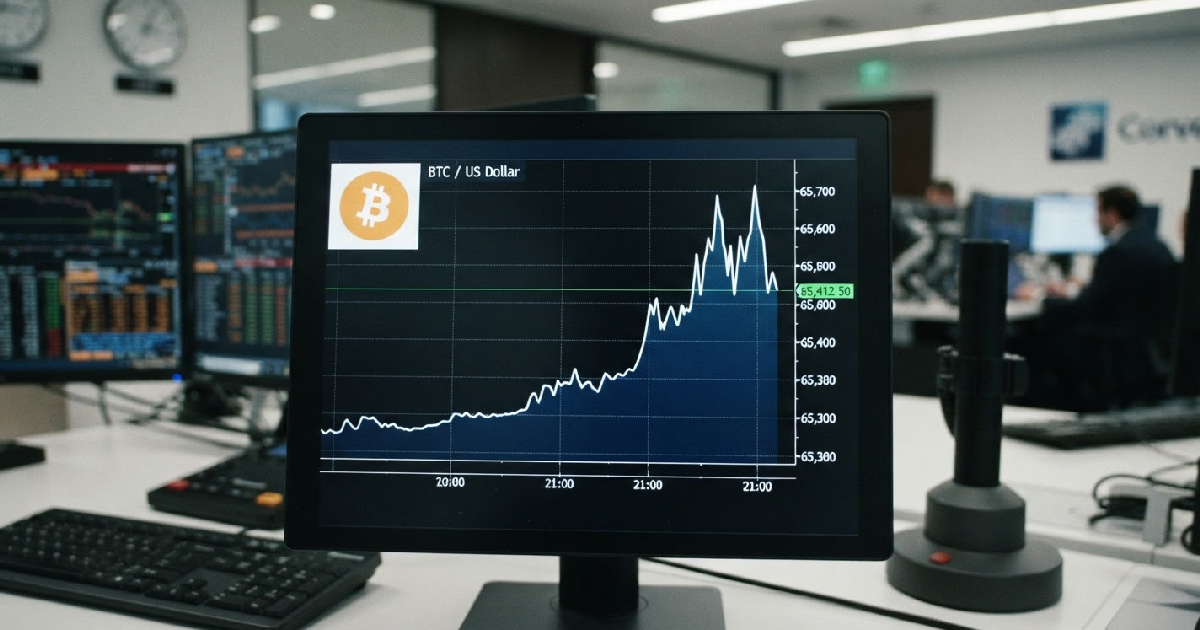

Bitcoin (BTC) has recently surged past the crucial $65,380 threshold, marking a significant recovery for the cryptocurrency. This upward movement, which saw Bitcoin reclaim the $65,000 level on July 15, 2026, and continue to hover near $66,000 as of July 21, comes amidst a backdrop of renewed institutional interest and a cooler U.S. consumer price index (CPI) print.
The latest price action represents a 29% recovery from Bitcoin’s July 5 low, signalling a shift in market sentiment. While the cryptocurrency touched a recent high of $68,560, its ability to consolidate above $65,000 is now attracting considerable attention from investors monitoring its next moves in a volatile market.
Institutional Demand Fuels Bitcoin’s Resurgence
A primary driver behind Bitcoin’s recent strength lies in the pronounced return of institutional capital. Last week alone saw spot Bitcoin exchange-traded funds (ETFs) record an impressive $1.2 billion in inflows. This influx underscores a robust demand from institutional players who, on average, entered the market with a cost basis of $58,200.
This sustained institutional engagement is a crucial indicator. It suggests that large-scale investors are increasingly confident in Bitcoin’s long-term prospects, treating it as a viable asset class despite ongoing market fluctuations. Their accumulation at levels below the current price point provides a foundational layer of support for Bitcoin’s value.
The impact of these significant inflows extends beyond mere price appreciation. Such substantial capital deployment from regulated entities often contributes to greater market stability and liquidity. It also legitimises Bitcoin further within traditional financial circles, potentially paving the way for broader adoption and investment.
Macroeconomic Factors and Market Sentiment
The broader economic landscape has also played a pivotal role in Bitcoin’s recent climb. A “cooler” U.S. CPI print helped ignite a risk-on sentiment across global markets, benefiting assets like Bitcoin. This suggests that inflation may be moderating, easing some pressure on central banks.
However, the macroeconomic picture remains nuanced. The U.S. core inflation rate grew by 3.5% annually during June 2026, which still places pressure on the Federal Reserve to potentially maintain higher interest rates for an extended period. Bitcoin remains highly sensitive to these broader economic developments, including interest rates, treasury yields, and geopolitical risks.
Market sentiment, while cautiously bullish, also reflects recent volatility. Over $1 billion in liquidations occurred in the 24 hours leading up to July 21, 2026. A high proportion of these liquidations were from short positions, indicating that the recent price gains were largely driven by short covering as bearish bets unwound.
On-chain metrics currently suggest an accumulation phase rather than a clear, confirmed new uptrend. This points to investors gradually increasing their holdings without a frenzied buying spree, which could indicate a more sustainable, albeit slower, path to price discovery.
Navigating Key Support and Resistance Levels
For investors, understanding the critical price levels for Bitcoin is paramount in the current market environment. The $65,000 to $66,000 range has emerged as a significant battleground. Sustaining above the $65,000 mark is key to validating the current recovery.
Immediate Support Zones
The first significant support for Bitcoin sits firmly at $65,000. Should the price fall below this, bearish pressure could intensify, pushing it towards the $63,000-$64,000 range. A further drop might see Bitcoin test the psychologically important $60,000 level, which has historically acted as a robust long-term support zone.
Some analysts view a pullback to the $64,200-$64,800 zone as a potential entry point for investors looking to establish or increase positions. But if Bitcoin breaks below $63,500, current advice suggests reducing positions or pausing new entries until a clearer support base is established.
Overhead Resistance Barriers
On the upside, immediate resistance levels are observed between $67,000 and $68,000. Surpassing this range is crucial for any sustained bullish momentum. Beyond this, the next major psychological hurdle for Bitcoin is $70,000.
Significant resistance is anticipated around the $67,000-$70,000 band. This is largely due to potential profit-taking by investors who accumulated long positions when Bitcoin traded closer to the $60,000 mark. Additionally, immediate liquidation levels were noted near the $66,000 cluster, indicating where many short positions would be squeezed.
Investor Strategies and Future Outlook
The short-term outlook for Bitcoin is currently described as cautiously bullish, but a confirmed bullish breakout requires more than just reclaiming key levels. For a truly sustainable uptrend, Bitcoin’s price needs to consistently close above $65,000 on multiple occasions and maintain its strength during any subsequent price pullbacks.
A controlled, gradual ascent is generally preferred over a rapid spike. This allows for the establishment of stronger support bases, preventing sharp corrections. Investors holding BTC are advised to closely monitor the $65,000 support level, using it as a critical benchmark for their holdings.
For those considering new investments, experts recommend avoiding “chasing highs” during rapid price increases. Instead, a more prudent approach involves waiting for pullbacks, ideally into the $64,200-$64,800 range, to find more favourable entry points. Implementing a strategy combining price alerts and dollar-cost averaging can help mitigate risk.
The coming weeks will undoubtedly bring further scrutiny. Expectations around Federal Reserve rate cuts, ongoing geopolitical tensions, and the upcoming month-end Federal Open Market Committee (FOMC) meeting are all significant variables. These factors will continue to influence market direction and test Bitcoin’s resilience above its hard-won $65,380 level.