
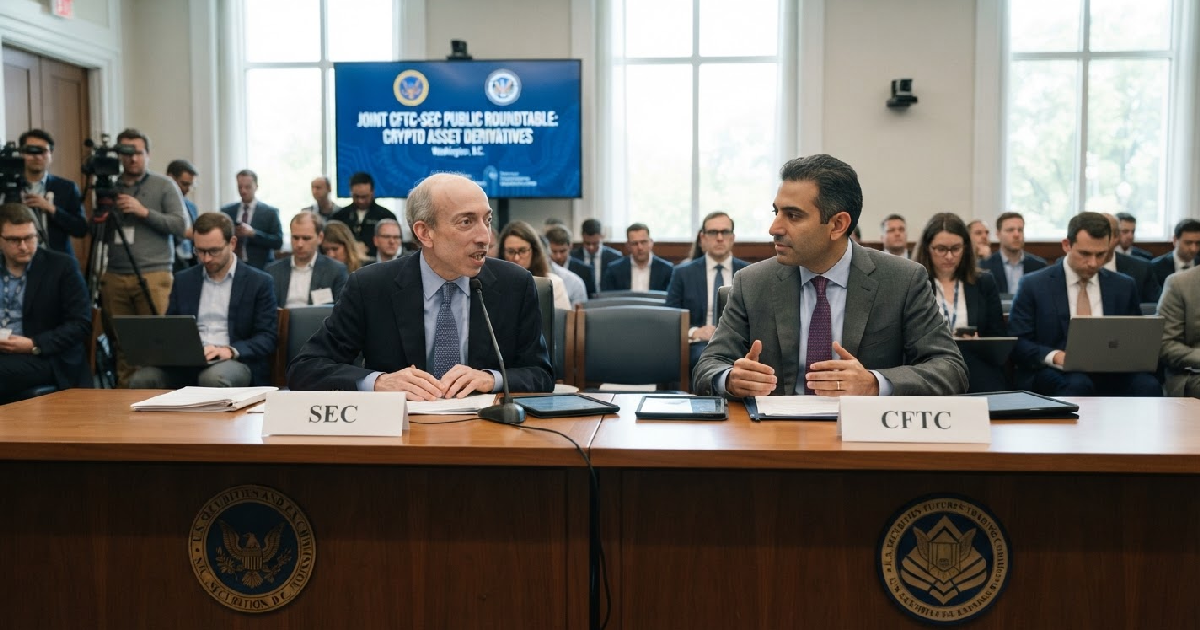

The SEC and CFTC launch a joint consultation on digital asset derivatives definitions, announced July 21, 2026. S. Securities and Exchange Commission (SEC) and the Commodity Futures Trading Commission (CFTC) have officially opened a joint consultation on digital asset derivatives definitions. This move, announced on July 21, 2026, signals a concerted effort by US regulators to untangle the complex jurisdictional lines surrounding crypto products.
The initiative seeks to reduce persistent confusion in the market, particularly for crypto assets that often blur the boundaries between securities and commodities oversight. It’s a critical step toward providing clarity for firms navigating the fragmented regulatory landscape.
bridging the regulatory divide
For years, crypto firms have voiced frustration over overlapping regulatory responsibilities. The SEC traditionally oversees securities markets, while the CFTC supervises derivatives and commodity markets. Digital assets frequently exhibit characteristics that could place them under either, or both, agencies.
This ambiguity has forced exchanges, funds, market makers, and issuers into a difficult position, uncertain which set of rules applies to their products. The joint consultation directly acknowledges this overlap, offering a more coordinated approach than agencies acting independently.
Regulators have made previous attempts to coordinate their efforts. On March 11, 2026, SEC Chairman Paul S. Atkins and CFTC Chairman Michael S. Selig signed a Memorandum of Understanding (MOU) to guide their collaboration on shared concerns, including digital assets.
Both agencies also run cross-agency initiatives: the SEC’s “Project Crypto” and the CFTC’s “Crypto Sprint” aim to coordinate efforts for trading certain spot crypto asset products.
Just prior to this, on March 17, 2026, the SEC and CFTC issued a joint interpretation to clarify how federal securities laws apply to specific crypto assets and transactions. This guidance introduced a five-part token taxonomy for crypto assets, confirming that both Bitcoin and Ether are classified as non-security digital commodities under CFTC jurisdiction for spot transactions.
clarifying digital asset derivatives definitions
The core of this new consultation focuses on definitions for security-based swaps and other digital asset derivatives. It includes a crucial 60-day public comment period, beginning after its publication in the Federal Register. This window offers market participants a formal channel to provide input on jurisdictional distinctions.
Crypto derivatives aren’t uniform; they encompass a wide range of products. A Bitcoin futures contract, for instance, operates differently from a swap linked to a tokenized security. Products can reference a single token, an index, a basket of assets, a yield stream, or even a protocol-linked asset, each potentially falling under different regulatory frameworks.
This inherent complexity underscores why precise definitions are so vital. Vague or overly broad rules could stifle innovation, deter product launches even when demand exists, or push market activity to less regulated offshore venues. The US has already seen a significant portion of crypto derivatives liquidity migrate overseas due to regulatory uncertainty.
Clearer definitions, if they lead to workable final rules, could help repatriate some of this activity to regulated domestic markets. The consultation specifically looks at harmonizing crypto derivatives and portfolio margining rules, as well as improving risk management and regulatory coordination.
institutional markets await clarity
The institutional adoption of crypto assets hinges significantly on the availability of regulated derivatives. Professional investors, market makers, and funds require sophisticated hedging tools and risk-management products to engage effectively with the market. Without these, institutions often shy away or resort to offshore platforms.
SEC Chair Paul Atkins has highlighted the potential benefits of improved coordination, stating that it can prevent regulatory overlap from hindering innovation or market efficiency. He also pointed out that “Cross-margining offers a clear opportunity to unlock liquidity that remains frozen in separate accounts,” a critical concern for large financial institutions.
This push for clarity follows recent developments like the approval of US crypto perpetual futures. Kalshi, for example, received CFTC approval to list perpetual futures tied to Bitcoin, Ether, XRP, and HYPE. Platforms such as Hyperliquid have also broadened access to perpetual products linked to tokenized securities, further complicating the regulatory landscape.
If the SEC and CFTC can successfully clarify the classification of digital asset derivatives, it could pave the way for more products within US-regulated markets. This, in turn, promises greater transparency, deeper liquidity, and a reduced reliance on less regulated platforms, benefiting the broader financial ecosystem.
a consultative step, not final regulation
It’s important to view this consultation as an initial step, rather than a definitive resolution. A request for comment doesn’t equate to a final rule; it won’t instantly legalize or ban product categories, nor will it resolve all ongoing disputes between the SEC and CFTC. Instead, it inaugurates a formal process of dialogue and feedback.
The public comment period holds significant weight because it will directly influence subsequent actions. Industry participants are expected to advocate for distinct jurisdictional lines, product-specific regulatory treatments, and viable pathways for compliant registration. Meanwhile, investor protection advocates will likely push for robust disclosure, margin, clearing, and anti-manipulation measures.
Regulators will face the delicate task of balancing the need for innovation with market integrity and systemic risk mitigation. The ultimate framework will likely take time to develop, but the immediate signal for crypto markets is a shift towards a more structured approach to derivatives regulation.
This marks a crucial evolution from a period often characterized by enforcement actions towards one focused on definition-setting and collaborative policy development. The market will closely monitor the feedback submitted during this 60-day window, watching to see if regulators can translate industry insights into a practical, workable rulebook that fosters responsible growth in the crypto derivatives space.
The CFTC itself is currently embroiled in legal disputes over crypto perpetual futures and prediction market oversight, including a case against Kentucky for attempting to apply state gaming laws to operators like Kalshi and Polymarket, with the CFTC asserting its exclusive authority under the Commodity Exchange Act. This ongoing legal friction highlights the immediate need for clear and consistent federal guidance on digital asset derivatives.