
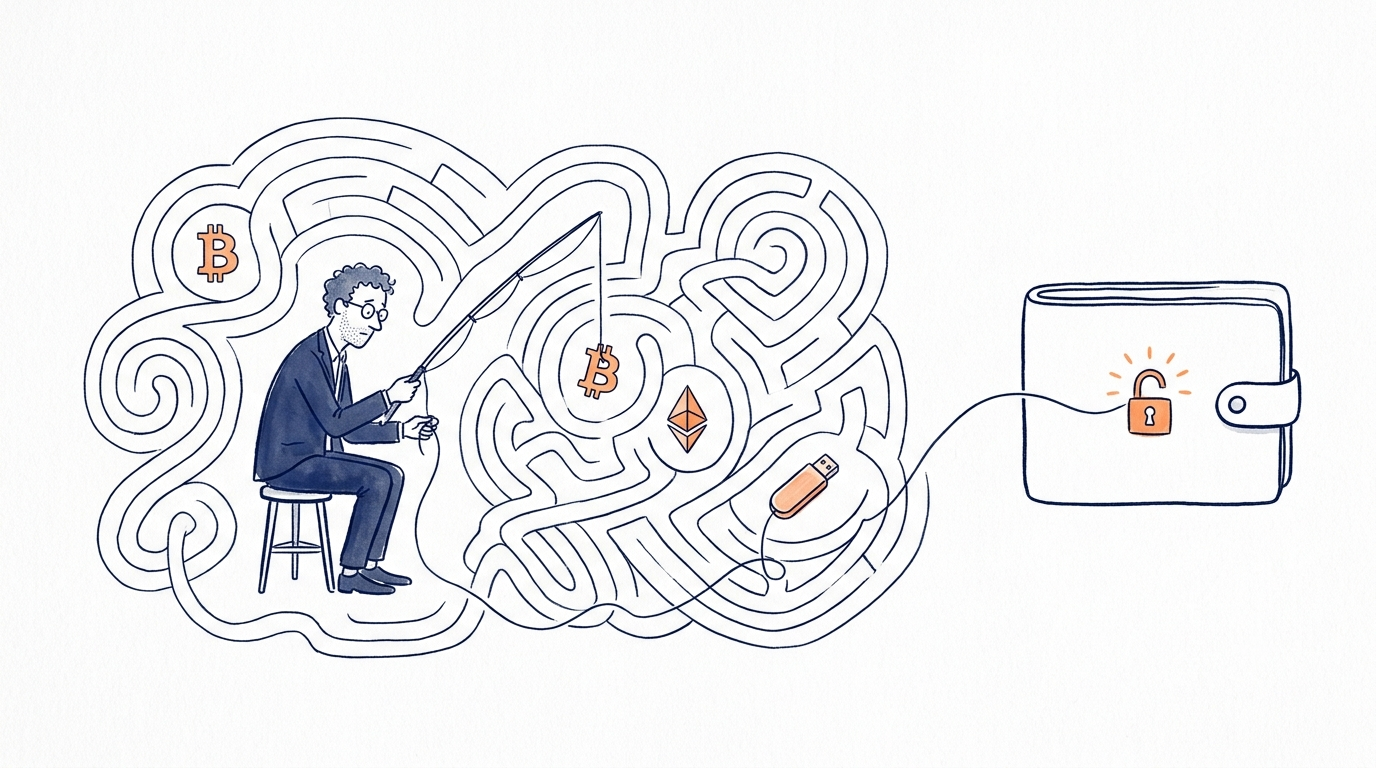

It is the specific kind of dread every crypto investor knows: the moment you click on your wallet app and it refuses to load, or you realize you’ve forgotten the login for a device you haven’t touched in months. The screen stares back with a balance of zero, or worse, a “login failed” message. The heart rate spikes. The instinct is to assume the money is gone.
But in the world of non-custodial crypto, your assets aren’t actually trapped inside your phone or laptop. They reside in a state of permanent existence on the blockchain.
The app you use is merely a viewing lens. Understanding this distinction is the difference between a minor technological headache and a catastrophic loss of wealth.
Your assets aren’t in your phone
The most important realization for any investor is that your smartphone is not a vault. If you lose your phone, drop it in a lake, or delete the app, your cryptocurrency remains untouched on the network.
When you use a non-custodial wallet, you are effectively using a piece of software that acts as a secure window into the blockchain. Your funds are bound to a set of private keys, which are mathematically derived from a string of words known as your seed phrase.
If the “window” breaks — meaning your app becomes inaccessible or your device fails — the money doesn’t vanish. The challenge is not finding the money; the challenge is reconstructing the “window” so you can interact with the blockchain again.
The disposable PIN vs. the irreplaceable master key
There is a common, dangerous confusion among beginners between the app’s password and the seed phrase.
The password or PIN you tap into your phone every day to check your balance is a layer of local security. Its sole purpose is to prevent a thief who steals your unlocked phone from moving your assets. It is disposable; if you lose this password, you can simply reinstall the app.
The seed phrase (or “Secret Recovery Phrase”), however, is the master key. It is the human-readable representation of your private keys. If you lose this, you lose the ability to prove ownership to the blockchain.
You cannot “reset” a seed phrase via email or customer support because there is no central authority to verify your identity. This is the reality of financial sovereignty: you hold the keys, but you also hold the responsibility.
The procedural reality of a crypto wallet recovery
The reason you can move your funds between different wallet applications — such as switching from MetaMask to Trust Wallet — is the BIP-39 standard.
Because of this interoperability, your security is not tied to the software developer. If the company that made your wallet ceases to exist tomorrow, your seed phrase will still be valid in any other standard-compliant wallet.
When you lose access to your wallet, the solution is almost always the same: reinstall the application and “import” the wallet using your seed phrase. However, the execution requires precision.
The BIP-39 standard uses a list of exactly 2,048 potential words. If your phrase is 12 words long, an extra space at the end of a word, a single typo, or the slightest reordering of the words will cause the system to derive a completely different private key.
You will be logged in, but your balance will show zero. It is a terrifying moment for the unprepared, but it is rarely a sign that the money is lost — it is usually a sign of a typo.
The hard limit of cryptography
If you are attempting to recover a specific account, such as an EVM-compatible wallet like MetaMask, be aware that the app typically only restores the first account created. If you had multiple accounts or sub-wallets, you may need to click “Create new account” repeatedly until the software scans and finds the historical addresses you previously used.
Similarly, if your custom tokens don’t appear, it doesn’t mean they aren’t there; you often need to manually add the token contract addresses back into the interface.
There is a segment of the crypto industry that preys on those who have lost their seed phrases: recovery services that promise to “crack” your password for a fee.
In the non-custodial world, math is the final arbiter. The encryption protecting a standard 12-word seed phrase is designed to be impenetrable by any current or near-future computational power. If you have completely lost your seed phrase and have no backups, the reality is stark: there is no “forgot password” button.
Legitimate recovery services exist only for very specific, narrow scenarios — such as hardware wallets that are physically broken but still hold the chips, or users who remember all but one or two words of a phrase.
They cannot “hack” a wallet you have simply forgotten. Any service that asks for an upfront fee to “unlock” a fully lost account is almost certainly a scam designed to steal whatever is left of your nerves.
Growing beyond the single point of failure
For long-term wealth, relying on a single piece of paper hidden in a drawer is a massive point of failure. It is a strategy that works for small amounts, but it crumbles when the capital grows.
The evolution of security for serious investors is the shift from manual freedom to automated redundancy. Technologies like Multi-signature (Multi-sig) wallets change the paradigm.
In these models, a transaction requires authorization from multiple keys held by different parties or stored in different physical locations. If one key is lost, the funds are not doomed; they can be recovered by the remaining signatories.
Transitioning to these models is not just about technical complexity; it is about acknowledging that human error — losing a notebook, forgetting a password, or a physical accident — is the greatest threat to your financial sovereignty.
Building a system that accounts for your own fallibility is the final step in mastering your own security.