
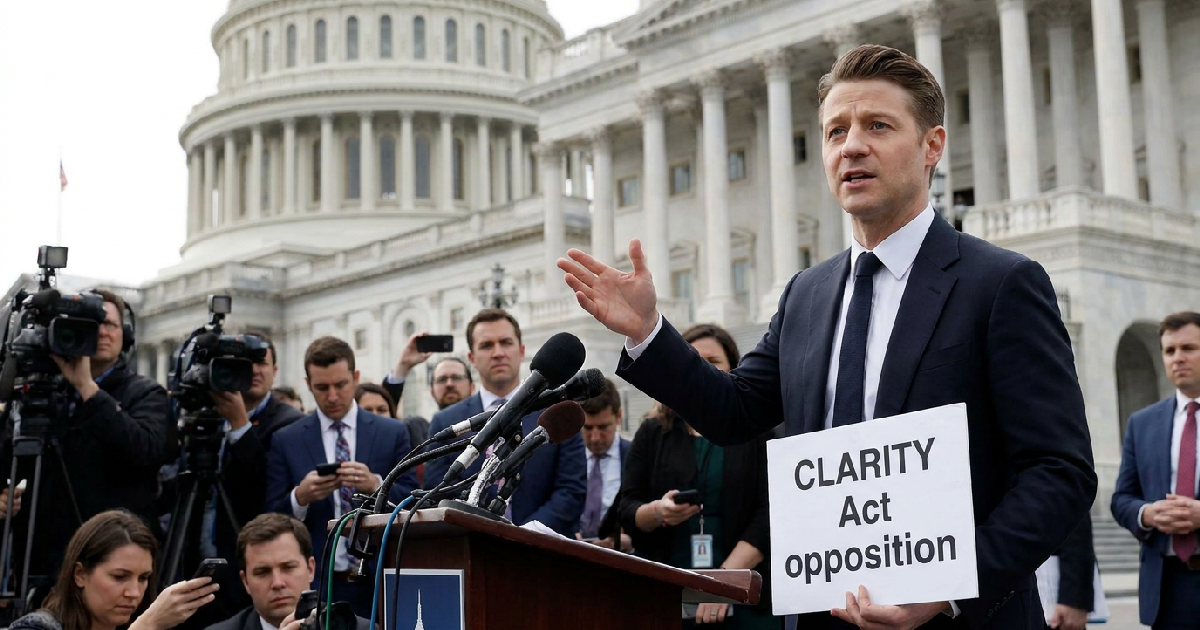

Actor and vocal cryptocurrency critic Ben McKenzie took his campaign against digital assets directly to Capitol Hill this week. On Tuesday, July 14, 2026, McKenzie lobbied U.S. senators and participated in a press conference in Washington D.C., urging them to reject the Digital Asset Market Clarity Act, often called the CLARITY Act.
His efforts, alongside several Democratic senators and advocacy groups, spotlight significant concerns about consumer protection and potential conflicts of interest in the proposed legislation. This pushback could notably influence the bill’s prospects as it approaches a crucial Senate vote.
CLARITY Act opposition builds over consumer safeguards
McKenzie’s primary objection to the CLARITY Act centers on what he views as insufficient consumer protections and troubling government ethics rules. He has specifically cited concerns that the bill could allow former President Donald Trump and his family to financially benefit from their crypto investments.
A key point of contention is the bill’s proposal to transfer regulatory oversight of blockchain-native tokens. The legislation aims to move this authority from the U.S. Securities and Exchange Commission (SEC) to the Commodity Futures Trading Commission (CFTC).
McKenzie argues this shift would lead to less stringent investor protections. He believes such a move would be detrimental to ordinary Americans involved in the digital asset space.
Lawmakers join fight against proposed crypto bill
McKenzie was not alone in his Capitol Hill advocacy. He was joined by several prominent Democratic lawmakers, including Senator Chris Murphy of Connecticut, Senator Jeff Merkley of Oregon, and Senator Chris Van Hollen of Maryland.
Advocacy organizations Americans for Financial Reform and Indivisible also participated in the lobbying effort. Their collective presence underscores a broadening coalition against the CLARITY Act.
Senator Chris Murphy articulated a strong stance against the bill’s current form. He stated, “There is no reason to pass a new regulatory system for crypto if this system does not stop Trump’s corruption of the entire industry.” Murphy added that the bill risks becoming “a fundamental corruption if it gives Trump’s corruption the protection of law.”
Ben McKenzie’s enduring critique of cryptocurrency
McKenzie, who holds an undergraduate degree in economics from the University of Virginia, has been a vocal critic of cryptocurrency since 2021. He has famously labeled the industry “the largest Ponzi scheme in history,” a stark assessment of its underlying mechanics.
He insists his activism focuses on consumer safety, not an outright ban on digital assets. “I am simply asking for it to be regulated properly,” McKenzie remarked, also stating his desire for “criminals to go to jail.”
He has also been critical of Bitcoin, claiming it “is full of lies. It’s full of misinformation. It’s also full of criminals.” McKenzie maintains that crypto can primarily serve two functions: “You can gamble with it, or you can commit crime with it.”
McKenzie also critiques the marketing tactics often used in the space. He paraphrased Matt Damon’s widely discussed Crypto.com advertisement, noting how messages can pressure young men: “what are you, a pussy? Buy crypto.”
CLARITY Act faces legislative hurdles ahead of recess
The CLARITY Act faces a limited window for a Senate vote before the upcoming August recess. McKenzie’s high-profile opposition appears to be influencing the bill’s legislative momentum.
Market pricing for the CLARITY Act being signed into law in 2026 has reportedly fallen to 38% YES, down from 46% a week prior. This reported decrease suggests McKenzie’s actions may have introduced some uncertainty regarding the bill’s passage.
The bill has already passed the House of Representatives and advanced through the Senate Banking Committee. But it still requires 60 Senate votes to become law, a significant hurdle in a divided Congress.
This legislative push is part of the Republicans’ “Crypto Week” agenda, which recently saw the GENIUS stablecoin bill signed into law. However, the CLARITY Act continues to face stiff resistance, particularly from Democrats pushing for stronger ethics provisions to address potential conflicts of interest.
The cryptocurrency industry spent over $200 million on lobbying during the 2024 election cycle. This figure represents approximately 40% of all corporate contributions in that cycle, highlighting the substantial financial investment in shaping digital asset legislation.
Former President Trump’s reported earnings of $1.4 billion from crypto ventures in 2025 add another layer of complexity. Any legislation perceived to benefit him financially, especially with a potential return to the presidency, is likely to draw intense scrutiny and opposition.
Broader implications for crypto regulatory landscape
McKenzie’s intensified lobbying efforts could significantly impact the future of crypto regulation in the United States. His focus on investor protection and ethical governance resonates with broader public and political concerns surrounding the industry.
The debate over whether the SEC or CFTC should oversee blockchain-native tokens remains central to the CLARITY Act. Critics argue that moving oversight to the CFTC, which some perceive as having a lighter regulatory touch, could expose retail investors to greater risks.
Estimates from a crypto company suggest that an estimated $150 billion in criminal activity was facilitated by crypto in 2025. This figure provides ammunition for those advocating for more robust regulatory frameworks, rather than what they view as less stringent oversight.
As the Senate deliberates, the pushback from McKenzie and his allies highlights a critical tension. It’s a conflict between an industry seeking clear, potentially favorable, regulatory frameworks and a growing contingent of critics demanding stronger protections and ethical safeguards. The outcome for the CLARITY Act will set a precedent for future crypto legislation and could reshape the industry’s regulatory landscape.