
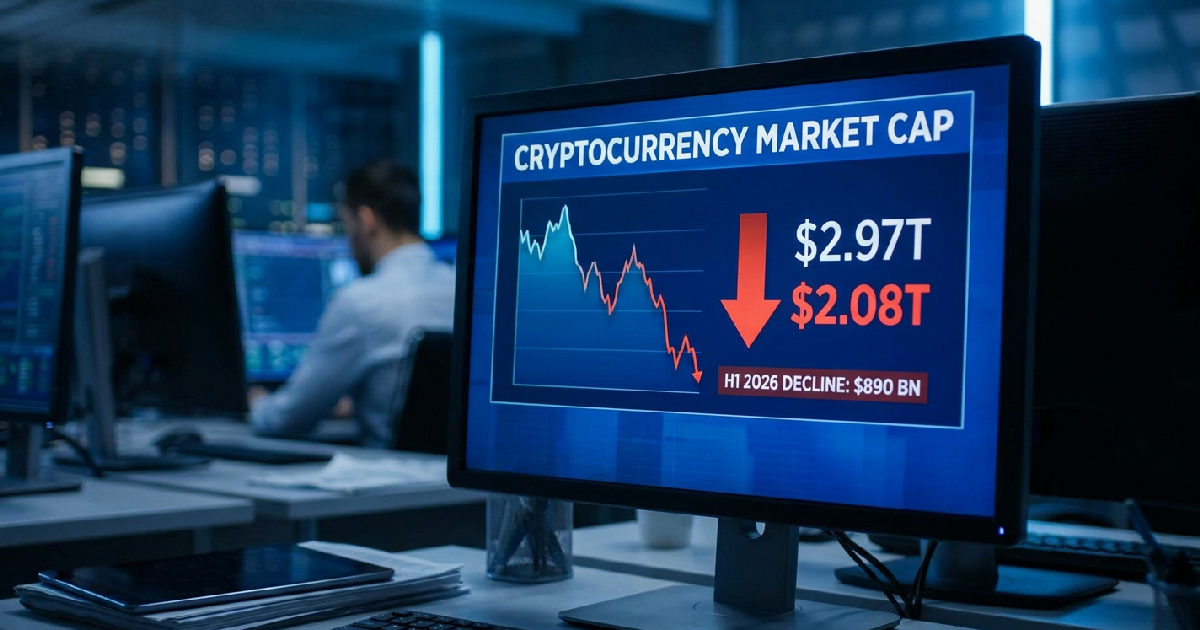

The cryptocurrency market endured a punishing first half of 2026, shedding approximately $890 billion from its valuation as major digital assets experienced significant declines. While recent weekly inflows into Bitcoin and Ethereum exchange-traded funds (ETFs) have offered a flicker of optimism, the broader outlook for the second half of the year remains clouded by persistent macroeconomic headwinds and geopolitical uncertainties.
This period of intense selling saw the total market capitalization plummet from $2.97 trillion on January 1 to around $2.08 trillion by June 30, marking a 30% contraction. For investors, it was a brutal stretch reminiscent of previous downturns, with many now questioning if the worst is truly over.
Cryptocurrency market endures severe first-half losses
H1 2026 proved particularly challenging across the board for digital assets, with the market’s total valuation taking a substantial hit. The $890 billion drop represents a significant deleveraging and a shift in investor sentiment away from riskier assets.
Another report painted an even starker picture, indicating a 48% wipeout in total market capitalization from a $4.2 trillion peak in October 2025 down to $2.18 trillion by June 2026. This erased nearly $2 trillion in value over just eight months, returning the market to levels last observed before the 2024 U.S. election.
Bitcoin and Ethereum lead declines
As the market’s bellwethers, both Bitcoin (BTC) and Ethereum (ETH) saw substantial price corrections. Bitcoin’s value fell by 32%, or roughly $29,102, dropping from $87,656.91 on January 1 to $58,554 by June 30.
Bitcoin had briefly spiked to $97,008 by January 15 but failed to sustain that momentum, registering a 21.7% decline in February alone. This 27.7% loss during the first half of the year stands as Bitcoin’s second-worst H1 performance on record, exceeded only by 2022.
Ethereum, too, faced considerable pressure, with its price tumbling by 47% during the same period. It lost $1,408, falling from $2,976.87 on January 1 to $1,569 by June 30. Its market capitalization drifted under $1,600 by late June.
Other major digital assets suffer significant drops
The downturn wasn’t limited to Bitcoin and Ethereum. XRP’s market cap declined by approximately $45.68 billion, a 40.9% reduction from $111.72 billion to $66.04 billion. The token traded near $1.18, representing a 37.7% year-to-date loss.
Solana (SOL) experienced an even sharper decline, falling to as low as $61 in June 2026. This marked a significant 78% drop from its 2025 peak above $280, and a year-to-date loss of roughly 47.3%.
Even Tether (USDT), a stablecoin, saw its market capitalization slightly contract by $2.52 billion, from $187 billion to $184.48 billion. This stability, however, suggests some investors opted for safer crypto assets rather than exiting the market entirely.
ETF inflows hint at potential shift
Amidst the widespread declines, a recent uptick in exchange-traded fund (ETF) inflows has provided a glimmer of hope for some market participants. Crypto funds recently reported $281.8 million in weekly inflows, marking their first positive week since the second week of May.
Of this total, Bitcoin funds attracted $197.4 million, while Ethereum funds drew $84.4 million. These inflows successfully ended an eight-week outflow streak that had seen more than $7 billion drained from cryptocurrency ETFs. It suggests buyers might be starting to return after two grueling months.
Long-term flow trends remain muted
However, zooming out reveals a more sobering picture for overall inflows. Despite the recent weekly positivity, 12-month inflows into crypto funds fell to about $1 billion. This is a sharp contrast to the peak of $12 billion in October 2025 and $10 billion in late April, highlighting a significant slowdown in sustained institutional interest.
No one is yet prepared to declare a definitive bottom for the market. But the first two weeks of July did appear to mark a period where the intense outflow momentum finally stalled, offering a cautious signal to observers.
Macroeconomic and geopolitical pressures persist
Several significant factors contributed to the crypto market’s poor performance in the first half of 2026. A notable driver was the shift in investor focus and capital towards artificial intelligence (AI) stocks, which largely took center stage in the broader financial markets.
Hawkish policies from the Federal Reserve also played a crucial role. Minutes from the Federal Open Market Committee (FOMC) on June 17, 2026, confirmed a hawkish tilt, with nine of 18 officials projecting at least one 25 basis point rate hike before the end of 2026.
The central bank maintained interest rates between 3.50% and 3.75% through mid-2026, signaling no rush to lower rates as inflation remains above its target.
Regulatory uncertainty, particularly the ongoing delays in the passage of the U.S. Clarity Act, also contributed to investor caution. This bill, intended to establish clear rules for cryptocurrency, has left market participants in limbo, affecting sentiment. Additionally, a stronger U.S. dollar compounded the price declines for digital assets.
Geopolitical events further stained the H1 performance. The conflict in the Middle East was a major contributor to Bitcoin’s bearish momentum earlier in the year. Even after President Donald Trump withdrew from the Iran ceasefire, reigniting macro uncertainty, Bitcoin’s price showed comparative resilience above the $60,000 mark.
Rising security incidents compound woes
The cryptocurrency market also contended with a notable rise in blockchain security incidents during H1 2026. These incidents increased by approximately 50% year-over-year, totaling 182 separate events. Despite the higher frequency, overall losses from these exploits decreased by about 60% to $956 million, down from $2.37 billion the previous year, suggesting improved security measures or smaller individual breach impacts.
Adding to the market’s underlying stress, a company known as Strategy executed a sale of 3,588 BTC, valued at roughly $216 million, in July. This move was to fund preferred stock dividends, stirring concerns about institutional BTC holdings and hinting that investors may be awaiting more convincing evidence of decreasing inflation before committing further capital.
Real-world assets offer a counter-narrative
Despite the broader market slump, the sector of Real-World Assets (RWAs) presented a strong counter-narrative of growth. The total distributed RWA market capitalization has now exceeded $33 billion, a remarkable 200% year-over-year growth.
This figure also represents a nearly 20x increase since January 2024. The robust growth of RWAs, highlighted in a recent H1 2026 report from Birdeye Research, significantly outpaced the 2.4x growth seen in stablecoins over the same period, indicating a growing utility and interest in tokenized real-world assets within the broader blockchain ecosystem.
H2 2026 outlook: Mixed signals and continued caution
Looking ahead to the second half of 2026, the crypto market faces a landscape of mixed signals. While the recent influx into ETFs provides a much-needed psychological boost, market participants largely agree that a definitive bottom has not yet been confirmed.
The $7 billion in outflows witnessed over eight weeks simply can’t be reversed by a single strong week of inflows. This cautious sentiment is accurately reflected by the Crypto Fear and Greed Index, which remains firmly entrenched in the “Extreme Fear zone” at press time. Continued regulatory clarity, particularly in the U.S., and a more stable macroeconomic environment will be critical for any sustained recovery.
Investors will likely watch Federal Reserve policy closely, especially any indications regarding future rate adjustments. Geopolitical developments, which have proven to be a significant drag on sentiment in the first half, will also continue to shape market dynamics. The path forward for the crypto market appears fraught with ongoing challenges, requiring sustained positive catalysts to emerge from its prolonged downturn.