
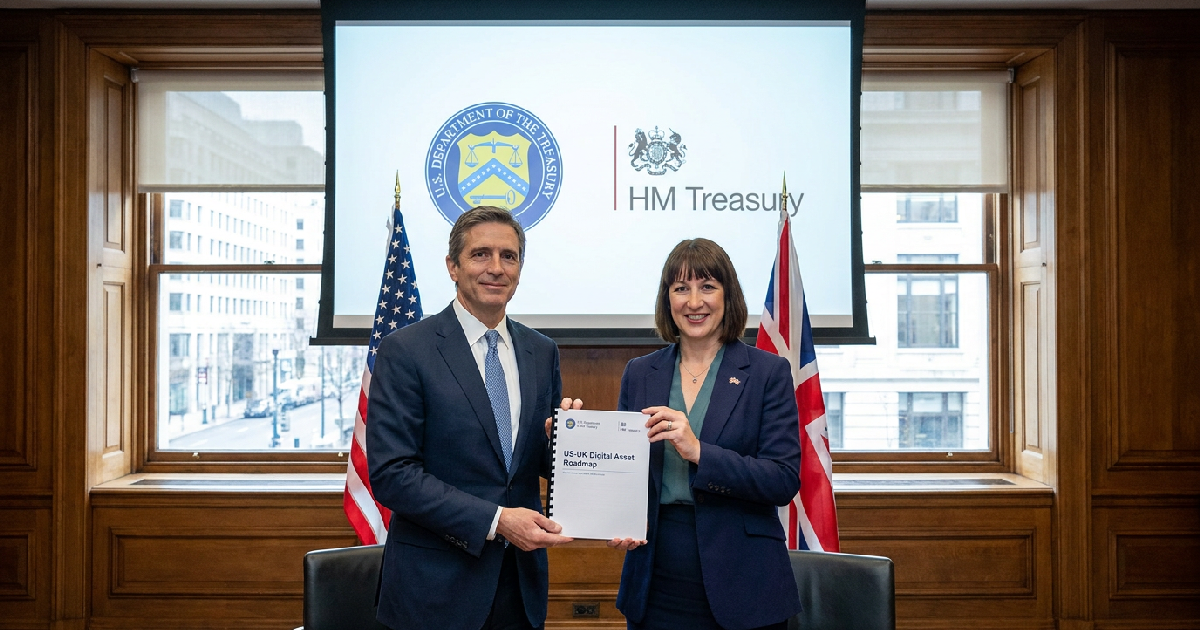

The US-UK digital asset roadmap, released July 14, 2026, by the Treasury departments of both nations, outlines a plan for cryptocurrency cooperation and stablecoin policy. S. Department of the Treasury and HM Treasury today unveiled a joint digital asset roadmap and statement on stablecoins, charting a course for closer cooperation in the rapidly evolving cryptocurrency landscape. Issued on July 14, 2026, this initiative by the Transatlantic Taskforce for the Markets of the Future (TTMF) aims to foster innovation and strengthen cross-border financial activity between the two nations.
U.S. Treasury Secretary Scott Bessent and UK Chancellor of the Exchequer Rachel Reeves established the TTMF in September 2025 during a U.S. presidential state visit to the UK. Their goal is to leverage the market positions of both countries to actively shape digital asset markets and next-generation financial infrastructure. Both governments believe well-regulated stablecoins can significantly boost financial system efficiency and competitiveness.
Charting the future of transatlantic digital assets
The core of this initiative is a 10-point roadmap, covering both digital assets and traditional capital markets. This framework outlines a cooperative path for oversight and a unified approach to digital finance. Crucially, it does not introduce new binding regulations.
One key recommendation involves establishing an industry-led working group. This group will conduct experimentation and testing for cross-border tokenized asset use cases, sharing best practices. The engagement is set for a one-year term, signaling a practical, hands-on approach to development.
The roadmap advocates for coordinating regulations around tokenized securities and supports developing cross-border stablecoins. It also suggests reviewing global banking standards for cryptoassets. The goal is to build policy frameworks allowing stablecoins, tokenized bank deposits, and other digital money forms to coexist in a “multi-money ecosystem.”
Beyond digital assets, the roadmap addresses broader capital market objectives. It explores ways for the U.S. Securities and Exchange Commission (SEC) and the UK Financial Conduct Authority (FCA) to ease cross-border capital raising. Additionally, it calls for reviewing derivatives market supervision, market data transparency, and international accounting standards, showing a comprehensive approach to financial modernization.
A united front on stablecoin regulation
A joint statement specifically on stablecoins complements the broader roadmap. This document emphasizes the potential of well-regulated stablecoins to enhance efficiency, drive competition, and modernize financial market infrastructure. It also highlights their role in improving cross-border payments and transactions.
The US-UK statement aims to integrate well-regulated stablecoins into payments, settlement systems, and tokenized financial markets. It affirms the private sector’s crucial role in money and payments. At the same time, it stresses the public sector’s responsibility for setting standards and updating regulatory policy.
Both nations intend to advance a “timely, clear, and consistent legal, regulatory, and supervisory pathway” for digital financial innovation. They endorse market-driven access for stablecoin issuers and users to banking and financial services. This includes using them as settlement instruments in securities and commodities markets, subject to appropriate safeguards.
The joint statement emphasizes setting high standards for the custody, segregation, and protection of stablecoin reserves. The UK’s domestic regulatory approach, for instance, includes statutory trust arrangements for backing assets, providing holders with a direct legal claim on assets if an issuer faces issues.
The regulatory timeline and next steps
This transatlantic cooperation comes as both the U.S. and UK progress their domestic stablecoin frameworks. The U.S. Guiding and Establishing National Innovation for U.S. Stablecoins, or GENIUS Act, celebrated its first anniversary. Signed into law on July 18, 2025, it established a federal framework for payment stablecoins.
The GENIUS Act mandates full backing by liquid assets and annual audits for issuers with market capitalizations over $50 billion. Federal agencies are currently working on rule proposals to implement its provisions. Full implementing rules for US stablecoins are expected by mid-2026, with enforcement beginning in January 2027.
Across the Atlantic, the UK has also made significant advancements. The Bank of England published a detailed policy statement on stablecoins on June 22, 2026. The Financial Conduct Authority (FCA) then finalized its crypto asset regime rules on June 30, 2026.
The UK’s stablecoin regime distinguishes between systemic and non-systemic issuers. Systemic issuers face dual oversight from both the Bank of England and the FCA. The application gateway for this new regime is targeted to open in late 2026, with the full framework taking effect in 2027.
Industry perspective on coordinated regulation
This collaboration reflects a growing recognition that regulatory fragmentation challenges the global digital asset industry. The U.S. and UK aim to prevent innovators from moving offshore due to inconsistent rules. This strategic alignment could set a powerful precedent for other jurisdictions.
U.S. Treasury Secretary Scott Bessent stated: “The Transatlantic Taskforce for Markets of the Future reflects the strength and depth of U.S. and UK markets and our shared commitment to fostering economic growth and advancing global standards that reward innovation and competition.” His remarks highlight a joint effort to both regulate and actively promote growth within the digital economy.
Industry stakeholders like Coinbase, Circle, Ripple, Citi, Bank of America, and Barclays have participated in shaping the task force’s agenda. Their involvement suggests a pragmatic approach from regulators. They seek input from those directly engaged in the crypto and traditional finance sectors, which is crucial for developing robust and practical regulations.
For the crypto market, this transatlantic effort signals a maturing regulatory environment. Stablecoins are increasingly seen as foundational rather than peripheral. Clearer rules and cross-border consistency could unlock new use cases for tokenized assets.
This could also drive institutional adoption and improve liquidity across global markets. It suggests a future where digital currencies integrate more deeply into the financial system. This integration could offer tangible benefits in efficiency and cost reduction for payments and settlements worldwide.