
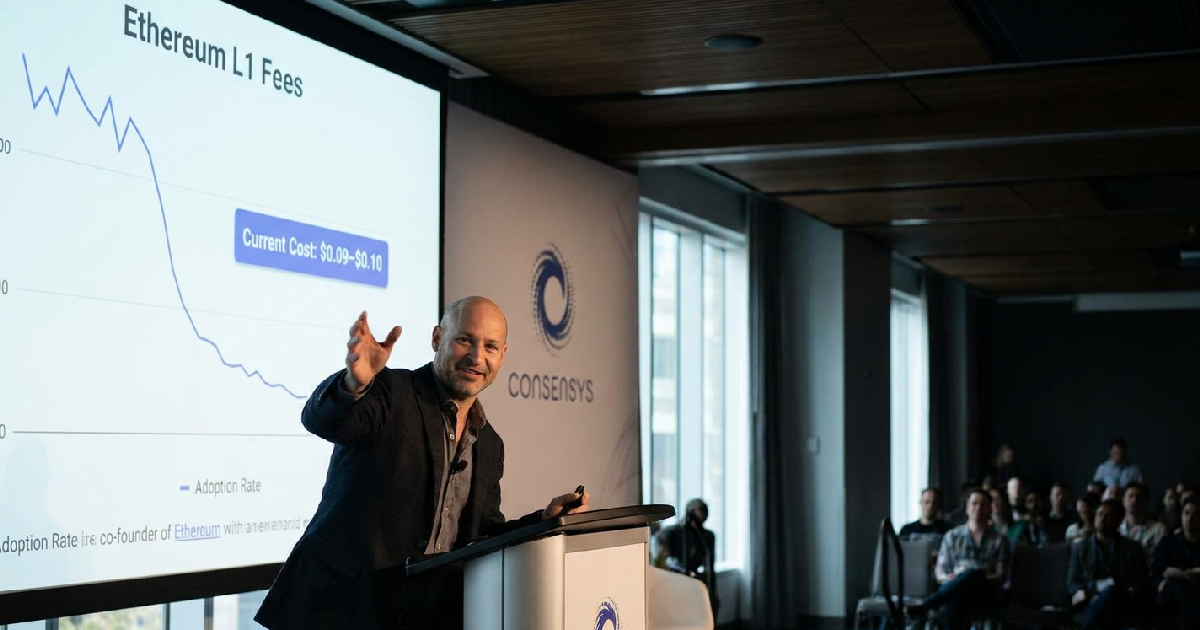

Joseph Lubin, a co-founder of Ethereum and the visionary behind ConsenSys, has publicly championed maintaining low Layer 1 (L1) transaction fees on the Ethereum network. His remarks, made around July 14, 2026, signal a strategic pivot towards mass adoption and sustained long-term value, moving beyond short-term revenue gains.
This position marks a notable evolution in thinking for Lubin, who once considered high gas fees a “measure of success” back in December 2021. Now, with L1 transaction costs sitting at approximately $0.09–$0.10, he argues that keeping these Ethereum L1 fees minimal is crucial for attracting both enterprises and individual users.
Lubin’s vision for accessible Ethereum L1 fees
Lubin’s current advocacy stems from a belief that an affordable base layer is essential for Ethereum’s widespread integration into the global economy. He contends that fostering ecosystem growth through lower transaction costs will solidify Ethereum’s competitive standing among leading blockchain platforms.
The ultimate goal, he explains, is to boost the utility and demand for Ether (ETH) itself. Lubin posits this strategy will generate more substantial and sustainable revenue over time, rather than relying on high per-transaction fees in the immediate future. It’s about strategically positioning Ethereum’s L1 as a high-security, low-cost settlement layer.
Revisiting the “Measure of Success” Debate
In 2021, when Ethereum gas fees frequently soared, Lubin characterized them as a sign of the network’s surging popularity and a “growth pain.” While that perspective highlighted strong demand, it also underscored a significant barrier to entry for many potential users and developers.
His updated stance reflects a more mature understanding of the blockchain’s economic model and its path to mainstream acceptance. This shift prioritizes scalability and cost-efficiency as fundamental drivers for the network’s future expansion. It aligns with the ongoing technical evolution of the Ethereum blockchain itself.
Technical Advances Drive Fee Reduction
The dramatic reduction in L1 fees, now averaging around $0.09–$0.10 per transaction, isn’t merely a philosophical change. Technical advancements, including the recent “Glamsterdam upgrade,” have played a significant role. These upgrades improve network efficiency, directly lowering operational costs.
Crucially, the increasing migration of activity to Layer 2 (L2) solutions like Arbitrum and Base has substantially offloaded transactions from the mainnet. These L2s process transactions more cheaply and then batch them back to the L1, allowing the base layer to function efficiently as a secure and cost-effective settlement layer.
The Economics of Ecosystem Revenue
Lubin’s comments directly feed into an active debate within the Ethereum community regarding the revenue distribution from its vast ecosystem. This discussion gained considerable traction following crypto commentator Lorenzo Valente’s detailed analysis of Robinhood Chain’s financial performance.
Valente’s audit revealed that Robinhood Chain generated close to $816,000 in gross revenue. Of this, Robinhood kept approximately 89%, while its middleware provider, Arbitrum, took about 10%, amounting to around $80,000. In contrast, Ethereum L1, acting as the final settlement layer, received a mere 0.15%, or roughly $1,538, from Robinhood Chain’s revenue.
This stark imbalance prompted Valente to suggest that a healthier split for Ethereum L1 might be closer to 15%. But Lubin’s argument counters this, asserting that optimizing for broad utility and increased network activity will ultimately generate greater overall value and demand for ETH, overshadowing the benefits of higher individual transaction fees.
Layer 2s Reshaping the Value Proposition
The rise of Layer 2 solutions has fundamentally altered Ethereum’s economic landscape. By handling the bulk of transactions at significantly lower costs, L2s extend Ethereum’s reach and utility. They make the ecosystem more attractive for everyday applications and smaller-scale interactions.
This distributed processing allows the core Ethereum L1 to focus on its role as a secure, decentralized settlement layer. The interaction between L1 and L2s creates a multi-layered system that balances security, scalability, and affordability, enhancing the network’s appeal to a wider audience.
Lubin’s Vision for Enterprise Adoption
Lubin’s strategic outlook extends far beyond current network mechanics. He predicts a future, within the next two to three years, where tens of thousands of enterprises will operate using a combination of Ethereum L1, L2 solutions, and private permissioned EVM networks, such as Besu. These systems, he emphasizes, will be fully interoperable.
This interoperability is key to creating a seamless and integrated blockchain experience for businesses. It allows companies to leverage the security of the mainnet while benefiting from the speed and cost-efficiency of L2s and the privacy of permissioned chains for specific use cases.
Driving ETH’s Monetary Premium and Deflation
A core tenet of Lubin’s long-term vision is the significant rise in ETH’s monetary premium. He foresees staking and other mechanisms that lock up ETH supply contributing to scarcity. Under conditions he terms “ultrasound” economics, the net burning of ETH will further enhance its value, making the asset deflationary.
This dynamic ensures that while individual L1 fees might be low, the overall value proposition of the Ethereum ecosystem grows. An increased demand for ETH, driven by widespread adoption and utility, combined with a diminishing supply, creates a powerful upward pressure on its price.
Institutional Engagement Takes Center Stage
Further underscoring the push for broader adoption, July 1, 2026, saw the launch of Ethereum Institutional, a new independent nonprofit. Joseph Lubin is one of its anchor funders, signaling a concerted effort to accelerate the integration of Ethereum—including its L2 solutions—into traditional financial and corporate sectors.
This initiative aims to bridge the gap between enterprise needs and blockchain capabilities, fostering a regulatory-compliant and scalable environment. It reflects a growing recognition that institutional buy-in is vital for Ethereum to achieve its full potential. Institutional adoption remains a critical metric for the wider crypto market.
Implications for Ethereum’s Future
Lubin’s advocacy for low Ethereum L1 fees represents a significant strategic direction for the network. It prioritizes long-term growth and utility over immediate revenue generation from high transaction costs. This approach aims to make Ethereum a more attractive and accessible platform for a diverse range of users and applications.
The success of this strategy hinges on the continued efficiency of L2 solutions and the seamless interoperability across the Ethereum ecosystem. It suggests a future where Ethereum