
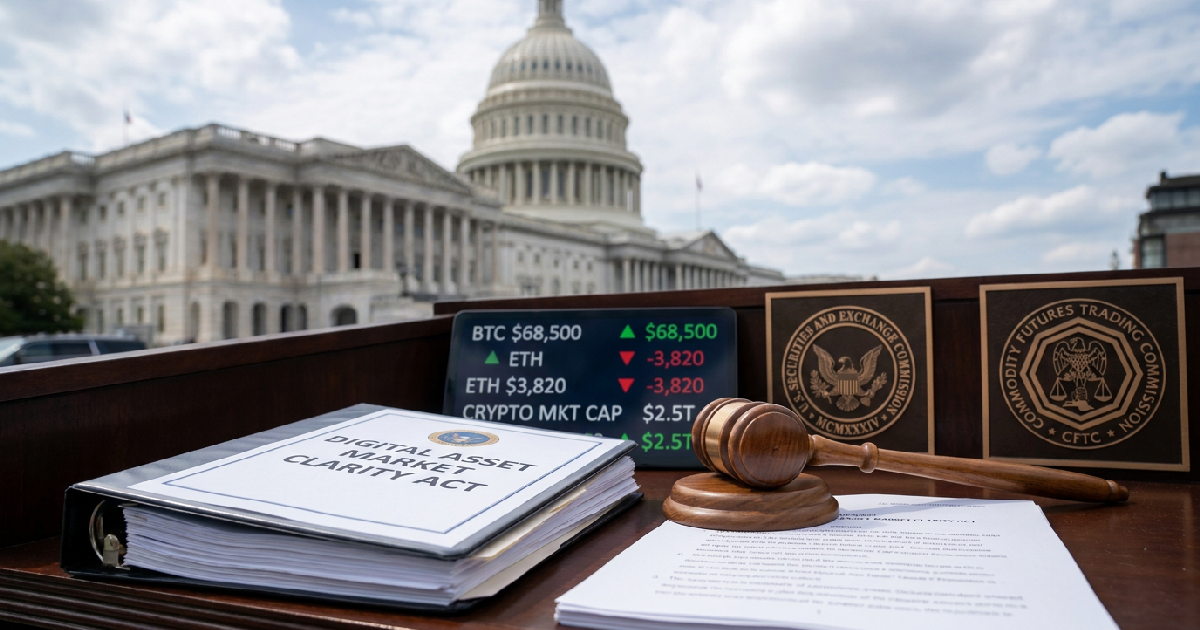

The Digital Asset Market Clarity Act, aiming to divide crypto oversight between the SEC and CFTC, faces an uncertain future this July. C. remains a crucial battleground for cryptocurrency regulation, with the proposed Digital Asset Market Clarity Act facing an uncertain future this July. Lawmakers have yet to schedule the bill, designed to split crypto oversight between the Securities and Exchange Commission (SEC) and the Commodity Futures Trading Commission (CFTC), for a Senate floor vote.
This legislative stall comes as the crypto market itself hovers near a $2.3 trillion capitalization, reflecting a 47% drawdown from its October 2025 peak. It’s a period of both cautious optimism and lingering fragility, with July 2026 seen by analysts as a month where the market is largely “catching its breath.”
Legislative Hurdles for the Clarity Act
The path forward for the Digital Asset Market Clarity Act looks increasingly steep. Despite its importance to the industry, the bill has not secured a slot for a Senate floor vote, with the August 7 recess fast approaching.
The White House had previously set a July 4 deadline for the act’s signing. However, Polymarket has significantly trimmed the odds of 2026 passage down to 48%, citing unresolved Senate cloture math as a major impediment.
Passing the bill would likely require at least 60 votes in the Senate. This means gaining support from at least seven Democrats, a challenging prospect if any Republicans were to vote against it or be absent during the vote.
A key sticking point remains the absence of an ethics provision within the bill. U.S. President Donald Trump’s disclosure of over $1.4 billion in crypto earnings adds complexity to this debate, making bipartisan agreement on such a provision critical for securing sufficient Democratic backing.
On a brighter note for proponents, a provision banning the Federal Reserve from issuing a central bank digital currency (CBDC) for at least four years has taken effect. This ban was included in a housing bill, effectively resolving a potential source of contention that might have further strained the Clarity Act’s timeline and negotiation process.
Broader Regulatory Spotlight on Digital Assets
Beyond the Clarity Act, the wider regulatory landscape for digital assets is seeing intensified activity. The SEC has outlined three crypto-focused rulemakings in its 2026 Unified Regulatory Agenda, with proposed rules potentially surfacing as early as this month.
These cover key areas, including crypto asset offerings, broker-dealer requirements, and market structure for trading venues. SEC Chair Paul Atkins has framed these initiatives as efforts to bring more crypto products onshore, aiming for clearer rules around capital raising, custody, and on-chain trading.
However, the legal authority for the SEC’s “Crypto Assets” proposal remains “not yet determined,” indicating potential statutory vulnerabilities. Meanwhile, five U.S. regulators have jointly proposed bank-grade Know Your Customer (KYC) rules specifically for stablecoin issuers, operating under the GENIUS Act.
Internationally, regulatory bodies are also tightening their grip. The European Securities and Markets Authority (ESMA) launched a Common Supervisory Action (CSA) on July 8, focusing on the digital operational resilience of crypto-asset service providers (CASPs). This follows the conclusion of the Markets in Crypto-Assets (MiCA) transitional period on July 1.
The Commodity Futures Trading Commission (CFTC) has also been active, filing a civil enforcement action on July 7. This action targeted a commodity pool operator and their company for allegedly fraudulently soliciting over $14 million from at least 60 participants between March 2022 and February 2026.
Crypto Market Feels Macroeconomic Squeeze
The cryptocurrency market continues to grapple with significant macroeconomic headwinds. Its total capitalization remains near $2.3 trillion, representing a substantial 47% drop from its October 2025 peak.
Analysts often describe this “crypto winter” as milder than previous downturns in 2018 or 2022. But sticky interest rates, a stronger U.S. dollar, reduced risk appetite, geopolitical tensions, and competition from surging AI-related equities all weigh on market sentiment.
Recent stronger-than-expected U.S. jobs data has lowered the probability of another Federal Reserve rate hike, which many see as a positive signal for non-yielding assets like Bitcoin and Ethereum. Even so, Bitcoin’s performance shows mixed signals, having opened around $63,997 on July 7.
While it was up 0.7% on that day, it remains far below its 52-week intraday high of $126,198.07, reached on October 6, 2025. Bitcoin ETFs, key vehicles for institutional exposure, experienced their worst month on record in June, with $4.5 billion in outflows.
This led Citi to cut its 12-month inflow forecast for these products to zero. Additionally, Bhutan-linked wallets moved 700 BTC, valued at $43.75 million, to Binance, creating short-term sell pressure.
Ethereum, similarly, opened near $1,798 on July 7, up 0.8%, but significantly down from its past-year high of $4,953.73 in August 2025. The asset entered July 2026 trading around $1,570, close to multi-month lows, after enduring three consecutive red quarterly candles.
Glassnode data also indicates a troubling trend of active addresses falling to new lows, even as whale addresses are on the rise.
Institutional Players Deepen Digital Asset Integration
Despite the current market volatility and regulatory uncertainty, 2026 marks a crucial shift in institutional engagement with digital assets. Large financial players are moving beyond cautious observation to active integration, signaling strong long-term confidence.
U.S. spot Bitcoin ETFs have become primary conduits for this institutional exposure. After early 2026 corrections, these funds hold about $97 billion, with institutions owning approximately 24.5% of their shares.
Data from Coinbase Institutional reinforces this trend, showing 76% of global institutions plan to expand their digital asset allocations. Furthermore, 59% of these institutions aim to dedicate over 5% of their Assets Under Management (AUM) to digital assets.
EY-Parthenon’s findings support this outlook, revealing that more than three-quarters of institutions anticipate increased digital asset exposure, and 86% are either already invested or planning their entry. Michael Saylor, founder of Strategy, stated on July 6, 2026, that institutional capital flows will be the main driver of growth for Bitcoin over the next decade, overriding traditional four-year halving cycles.
He believes Bitcoin is poised to become the foundation for capital, credit, and financial infrastructure. Asset managers like Franklin Templeton now warn that a lack of a comprehensive crypto strategy poses a significant risk to portfolios.
JPMorgan’s JLTXX tokenized money market fund on Ethereum has seen its AUM surge by 250% in just one month, while BlackRock’s staked ETH ETF (ETHB) distributes monthly yield, attracting institutional demand independent of short-term price momentum.