
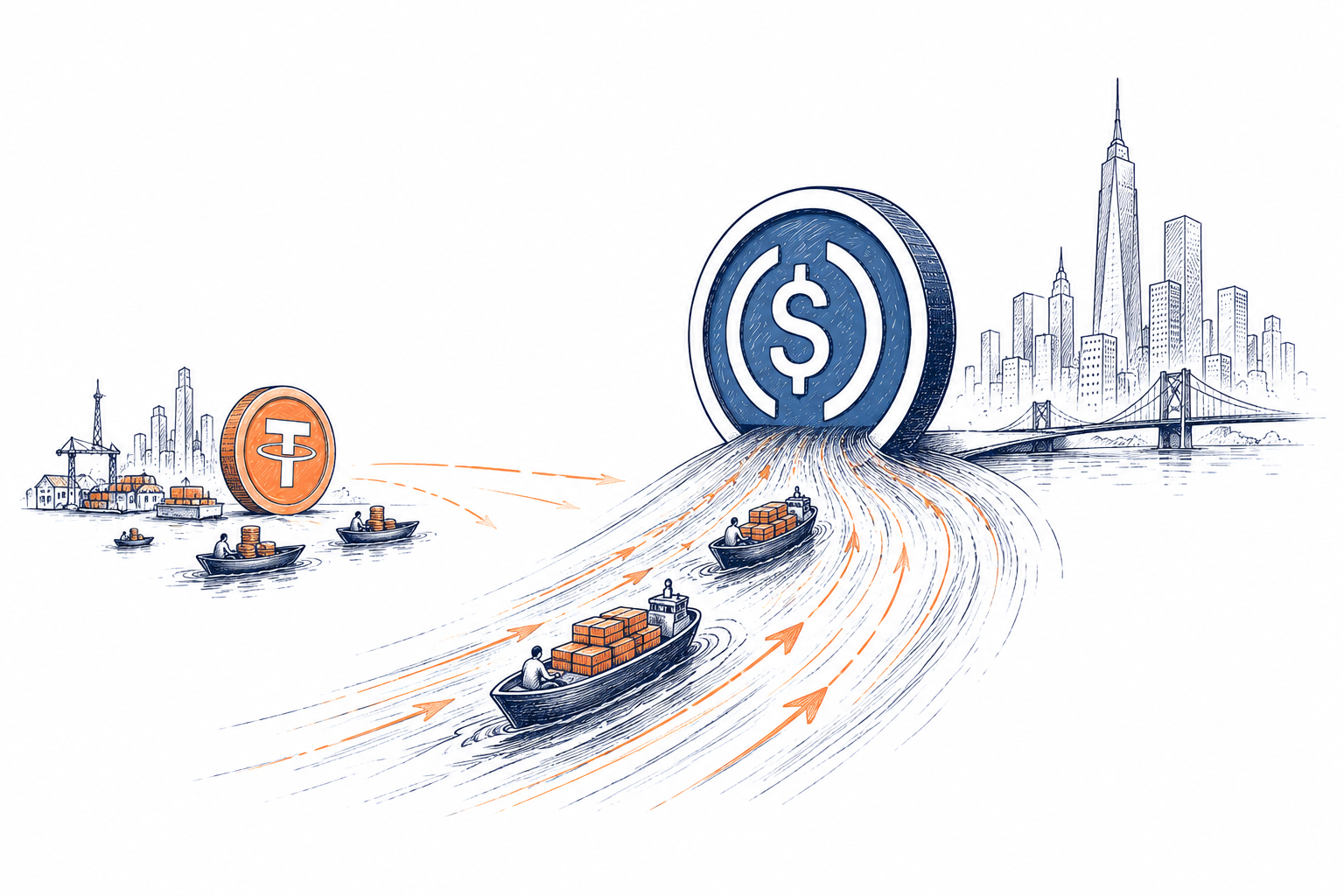

Tether remains the world’s largest stablecoin by a comfortable margin, with a market capitalization that is more than twice the size of USD Coin (USDC). Yet one of the most important metrics in the digital asset industry is beginning to tell a different story.
According to data from Visa Onchain Analytics and blockchain analytics firm Allium, USDC accounted for roughly 70% of adjusted stablecoin transaction volume during the first half of 2026, while USDT represented about 25%. The figures suggest that although Tether continues to dominate in supply, USDC is increasingly becoming the preferred vehicle for real economic activity.
The difference highlights an important shift in how stablecoins are being used as the crypto industry matures.
Market capitalization no longer tells the whole story
For years, investors measured the success of stablecoins primarily by the number of tokens in circulation.
That metric remains important because it reflects liquidity and market size, but it does not necessarily indicate how frequently those assets are being used for payments, settlements or commercial transactions.
Adjusted transaction volume attempts to answer that question.
Unlike raw blockchain activity, the methodology filters out transfers that add little economic value, including exchange reshuffling, arbitrage loops and other repetitive on-chain movements. The result provides a clearer picture of how stablecoins are being used in the real economy.
Under that measure, USDC has established a significant lead despite having a much smaller circulating supply than Tether.
USDC is becoming the preferred choice for regulated finance
One reason behind USDC’s growing transaction activity is its expanding role within regulated financial infrastructure.
Banks, payment providers, asset managers and tokenization platforms have increasingly adopted USDC for settlement, cross-border payments and digital asset services. The stablecoin’s regulatory positioning and close integration with traditional financial institutions have made it particularly attractive for organizations operating under stricter compliance requirements.
As tokenized assets and institutional blockchain applications continue to grow, demand for a stablecoin designed around transparency and regulatory compatibility has increased alongside them.
That trend helps explain why USDC is processing a larger share of meaningful economic transactions even without matching Tether’s overall size.
Tether continues to dominate crypto trading
The new data should not be interpreted as a sign that Tether is losing relevance.
USDT remains the dominant source of liquidity across centralized exchanges, particularly in international markets where it serves as the primary trading pair for thousands of digital assets.
Its deep liquidity, widespread exchange integration and global availability continue to make it the preferred stablecoin for traders and crypto-native users.
Rather than replacing each other, the two largest stablecoins appear to be strengthening different parts of the digital asset ecosystem.
Stablecoins are becoming more specialized
The latest transaction data suggests the market is entering a new phase.
Instead of competing for exactly the same users, USDC and Tether are gradually developing distinct roles.
USDT continues to power trading activity and crypto liquidity, while USDC is expanding across institutional payments, tokenized finance and regulated financial infrastructure.
For investors, that distinction may become increasingly important.
As stablecoins evolve beyond trading tools into core components of the digital economy, success will likely be measured not only by how many tokens exist, but by how effectively those tokens move capital across the financial system.
If that trend continues, the future of stablecoin competition may be defined less by market capitalization and more by real-world economic usage.