
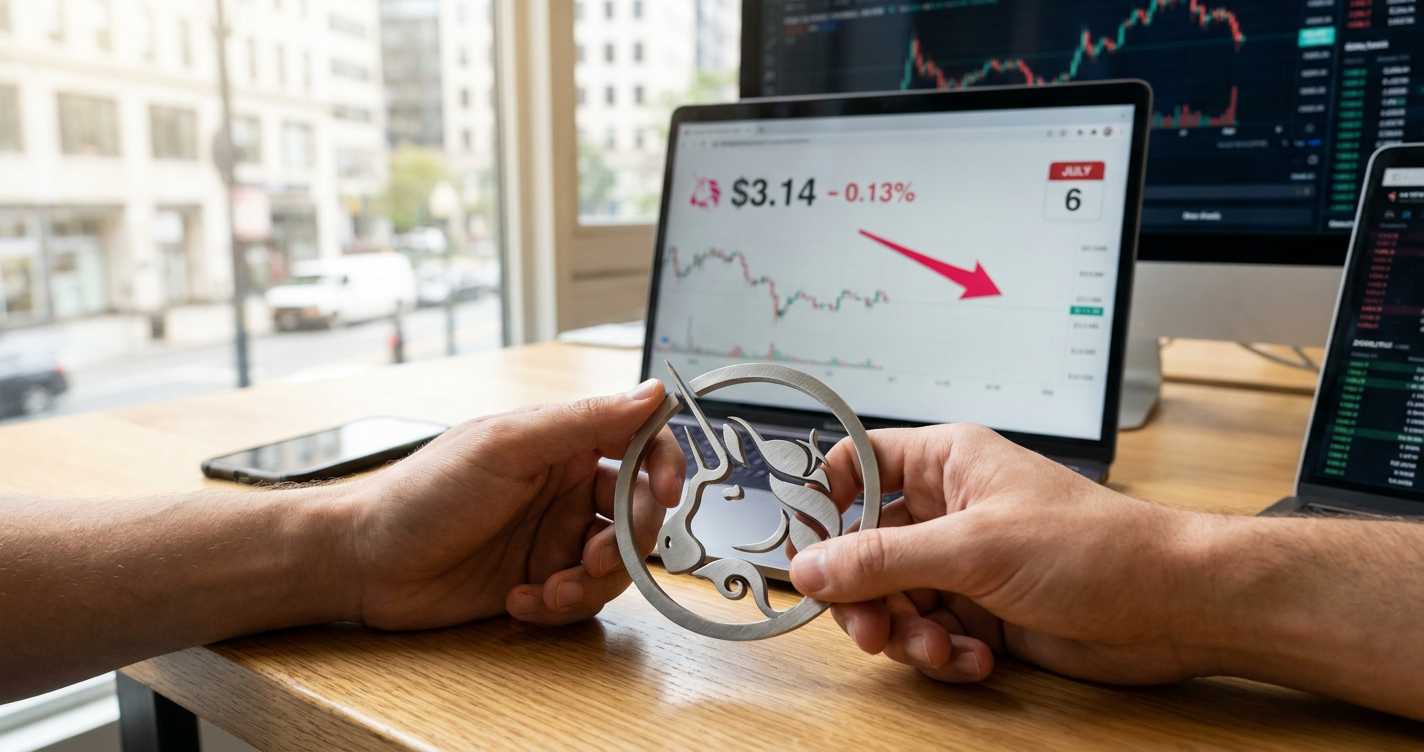

The Uniswap token price is currently navigating a period of market correction, with technical indicators reflecting a “Fear & Greed Index” reading of 24, which denotes extreme fear.
On July 6, 2026, the governance token for the leading decentralized exchange (DEX) reported a 0.13% loss over 24 hours, trading near $3.14 as selling pressure persisted across the broader altcoin market.
Uniswap token price analysis
This minor correction follows a momentary jump to $3.28 on July 2, with current price action aligning with a larger bearish macro structure and underlying selling pressure around local highs.
The 100% on-chain automated market maker (AMM) remains a cornerstone of the Ethereum blockchain, yet its token price continues to face overhead resistance. While short-term analysis on the four-hour chart indicates the price is attempting to sustain levels above $3.00, high volatility on daily timeframes suggests further unpredictability.
Market participants are closely watching support around the $2.97 level to determine if the coin can maintain its current footing or if further declines are imminent in the coming days.
Technical analysis of the daily chart confirms that the UNI/USD pair is caught in a bearish push. The distance between the Bollinger Bands indicates considerable volatility, with the upper limit shifting to $3.30 as breached resistance and the lower limit moving to $2.73 to establish a new support floor.
Key details
The Relative Strength Index (RSI) is currently in the neutral region at a value of 57, but a downward curve suggests that more instability could occur if the indicator’s score continues to decrease due to intensifying selling momentum.
Moving averages present a mixed outlook but largely lean toward a sell bias for the current period. The 50-day Simple Moving Average (SMA) sits at $2.98, while the 200-day SMA is recorded at $3.81. These figures highlight the gap between short-term stability efforts and long-term price recovery.
Despite the immediate bearish pressure, the four-hour chart recently showed a slight RSI increase to 52, signaling a balanced trading setup that could allow for further appreciation if buyers successfully bypass existing resistance zones.
While Uniswap remains a dominant force in DeFi, its price often fluctuates based on general sentiment shifts. As crypto market liquidations rise during periods of macro-economic uncertainty, governance tokens like UNI often see reduced speculative demand.
This is evident in the current market environment where the majority of top-tier cryptocurrencies are shedding value alongside the Uniswap token, regardless of the protocol’s protocol utility or liquidity depth.
Medium-term Uniswap price prediction for 2026 and 2027
Forecasts for the remainder of 2026 suggest a conservative trading range for the UNI token. Analysts project a maximum potential price of $3.65 for the year, with an average trading value expected to hover around $2.56.
For the current month of July 2026, the anticipated minimum value is $2.25, though wild swings could potentially push the price as high as $3.61.
This cautious outlook follows a period of decline from January 2026, when the token was trending near $5.80, before decreasing to $3.79 in March and dropping further to $2.30 by the start of June.
Key details
Looking toward 2027, the outlook shifts to a more constructive growth pattern. The minimum projected value for Uniswap in 2027 is $3.87, with an average price of $4.12 and a maximum target of $4.77.
This gradual rise is supported by the protocol’s expanding footprint, such as the recent integration where Uniswap v2, v3, v4, and UniswapX went live on Robinhood Chain, a Layer 2 network. Such moves into secondary scaling layers are intended to improve efficiency and maintain Uniswap’s competitive edge in the DEX landscape.
The broader growth of decentralized tools continues to influence long-term projections. As the Ethereum network outlook strengthens through increased activity in AI-driven decentralized exchanges, Uniswap’s role as an AMM protocol remains central. By allowing users to swap ETH for any ERC-20 token without intermediaries, the protocol addresses major liquidity challenges, a utility that analysts believe will eventually decouple the token’s price from current bearish trends.
Long-term price targets and the road to 2032
Extending the forecast through 2032 illustrates a path of steady appreciation for UNI holders. By 2028, the average price of the token is expected to reach $5.46, with a maximum potential of $5.87. This growth is anticipated to accelerate in the following years.
By 2030, estimates show a minimum price of $7.96 and an average of $8.61, finally crossing the $10.00 psychological threshold in 2031, where the maximum price is projected to reach $10.70.
- 2029: Average price of $6.89 with a high of $7.38.
- 2030: Average price of $8.61 with a high of $9.30.
- 2031: Average price of $9.85 with a high of $10.70.
- 2032: Average price of $11.64 with a high of $12.50.
By the end of 2032, the token is projected to reach a maximum value of $12.50. While this is a significant increase from current levels, it remains far below the $100.00 milestone often speculated upon in retail markets.
Historical data shows that UNI reached an all-time high of $44.93 on May 3, 2021, and its future trajectory will likely depend on whether the broader cryptocurrency market enters a sustained bullish phase driven by political and economic factors.
Assessing Uniswap’s role as a long-term investment
Despite the current bearish sentiment, Uniswap’s status as a top-tier decentralized exchange provides it with a distinct advantage. Founded by former mechanical engineer Hayden Adams in 2018, the protocol has built a wide user base and maintained deep liquidity across many token pairs.
Unlike traditional exchanges, the AMM model ensures that liquidity problems are solved on-chain, making the UNI governance token attractive for institutional and retail traders who prioritize decentralized infrastructure.
And so, the primary challenge remains overcoming the current “Extreme Fear” in the market. Traders continue to watch the $3.31 and $3.82 resistance levels as the primary hurdles for a short-term breakout. If these levels are successfully breached, the path toward the $11.00 range becomes more viable before 2031.
For now, the focus is on stability, as the coin attempts to move past its recent yearly lows and establish a higher floor for the upcoming quarters.