
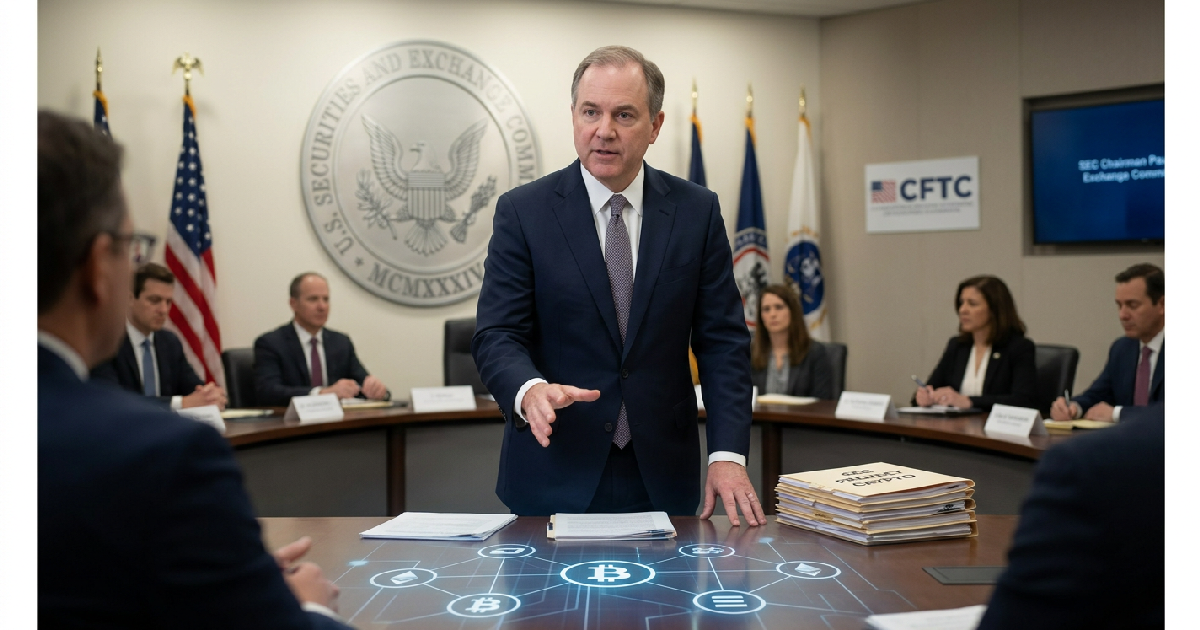

SEC Project Crypto is at the centre of this story. The U.S. Securities and Exchange Commission (SEC) is aggressively pursuing its “Project Crypto” initiative, a comprehensive overhaul of digital asset regulations designed to reverse years of industry exodus from the United States. Spearheaded by SEC Chairman Paul Atkins, who first announced the initiative on July 31, 2025, this effort aims to establish the country as the premier global hub for cryptocurrency and blockchain innovation.
For too long, regulatory uncertainty has driven digital asset companies overseas.
SEC Project Crypto: Defining Clear Regulatory Boundaries for Digital Assets
An unnamed individual on X sharply criticized this trend, stating, “An entire generation of digital asset innovation developed outside the U.S., not because American entrepreneurs lacked the ambition, or American investors lacked the appetite, but because American regulators lacked the will.” The SEC now seeks to bring “basic fairness and common sense” to how securities laws apply to digital assets, Atkins noted.
At the core of Project Crypto is a new, clear framework for token classification, moving beyond the much-criticized “regulation by enforcement” approach. This model previously left crypto firms guessing their compliance obligations until they faced legal action, often waiting for a Wells notice to understand regulatory intent.
The initiative fundamentally shifts the SEC’s stance, now asserting that a majority of digital assets should not be classified as securities. This position is intended to ease regulatory pressure and eliminate existential legal risks for many token projects, a welcome change for an industry stifled by ambiguity.
By defining clear regulatory boundaries based on the traditional Howey test, the SEC hopes to provide the predictability the market has long demanded. This clarity is crucial for investors and developers alike, particularly as shifting market sentiment often reacts to legislative progress that brings more certainty.
Strategic Exemptions and Interagency Coordination Efforts
Project Crypto also introduces crucial regulatory carve-outs for specific crypto activities. These exemptions include airdrops and network incentives such as staking rewards, designed to foster innovation without imposing undue regulatory burdens on nascent industry practices.
A significant aspect of the initiative is its emphasis on interagency coordination, particularly with the Commodity Futures Trading Commission (CFTC). SEC Chairman Paul Atkins and CFTC Chair Michael Selig have framed this collaboration as a generational opportunity, moving past historical jurisdictional disputes toward a unified federal strategy for digital assets.
This joint effort was formally announced on January 29 or 30, 2026, with a Memorandum of Understanding (MOU) expected by March 2026. This MOU aims to establish joint frameworks for classifying tokens outside securities law. It signals a unified front to harmonize federal oversight, a development that could deeply influence broader market dynamics and investor confidence.
Modernizing Trading and Custody for On-Chain Markets
The scope of Project Crypto extends well beyond token classification, addressing critical infrastructure components like trading venues, custodial services, and on-chain software architectures. The SEC proposes allowing broker-dealers operating alternative trading systems (ATS) to facilitate non-security digital assets alongside digital asset securities, traditional equities, staking, and lending services under an optimized licensing framework.
Furthermore, the initiative aims to modernize rules governing the custody of crypto assets for market intermediaries while facilitating self-custody for individuals. This dual focus acknowledges the evolving nature of digital asset ownership and aims to integrate it into a regulated yet flexible system.
Creating a path for trading tokenized securities on Decentralized Finance (DeFi) protocols, such as automated market makers, is another key objective. This move would enable on-chain trading systems without requiring a central intermediary, paving the way for a more integrated financial ecosystem.
This ambitious program directly responds to calls from the President’s Working Group for a cleaner approach to crypto rules. It also aligns squarely with President Donald Trump’s stated goal of establishing the U.S. as the global leader in cryptocurrency, signaling a broad governmental push for digital asset dominance.
The Road Ahead for the SEC’s Crypto Initiative
Despite the grand vision, Project Crypto remains a work in progress, currently existing as a statement of regulatory intent rather than binding policy. The SEC still needs to release formal proposed rules, gather extensive public feedback, and then make a final decision on its implementation.
Yet, the progress thus far represents the most significant evidence to date that U.S. regulators are genuinely moving toward a more predictable system for digital assets. SEC Commissioner Hester Peirce is leading the agency’s Crypto Task Force, which is actively developing this comprehensive regulatory framework through public and industry engagement.
The commission recently launched a token taxonomy, also based on the enduring Howey test, which categorizes digital assets into five groups. Only one category is typically considered a security. This taxonomy clarifies how regulators will approach elements like airdrops, protocol mining, staking rewards, and token wrapping, providing much-needed clarity for the market.
Key details
Legal experts and market participants widely view Project Crypto as the most thorough attempt to date to make the United States truly competitive in the digital finance arena. Its success could not only stem the tide of companies leaving but also attract new innovation, profoundly reshaping the global crypto landscape and potentially boosting the growth of decentralized exchanges and other blockchain applications.
SEC Chairman Paul Atkins has described Project Crypto as a “defining moment for American leadership in the crypto asset markets.” He also noted, “We are taking historic steps to modernize our rules and regulations to facilitate markets’ moving on-chain,” reflecting a determined effort to embrace rather than stifle digital innovation.
This represents a stark departure from the prior administration’s “regulation-by-enforcement” approach, which Atkins previously called a failure.