
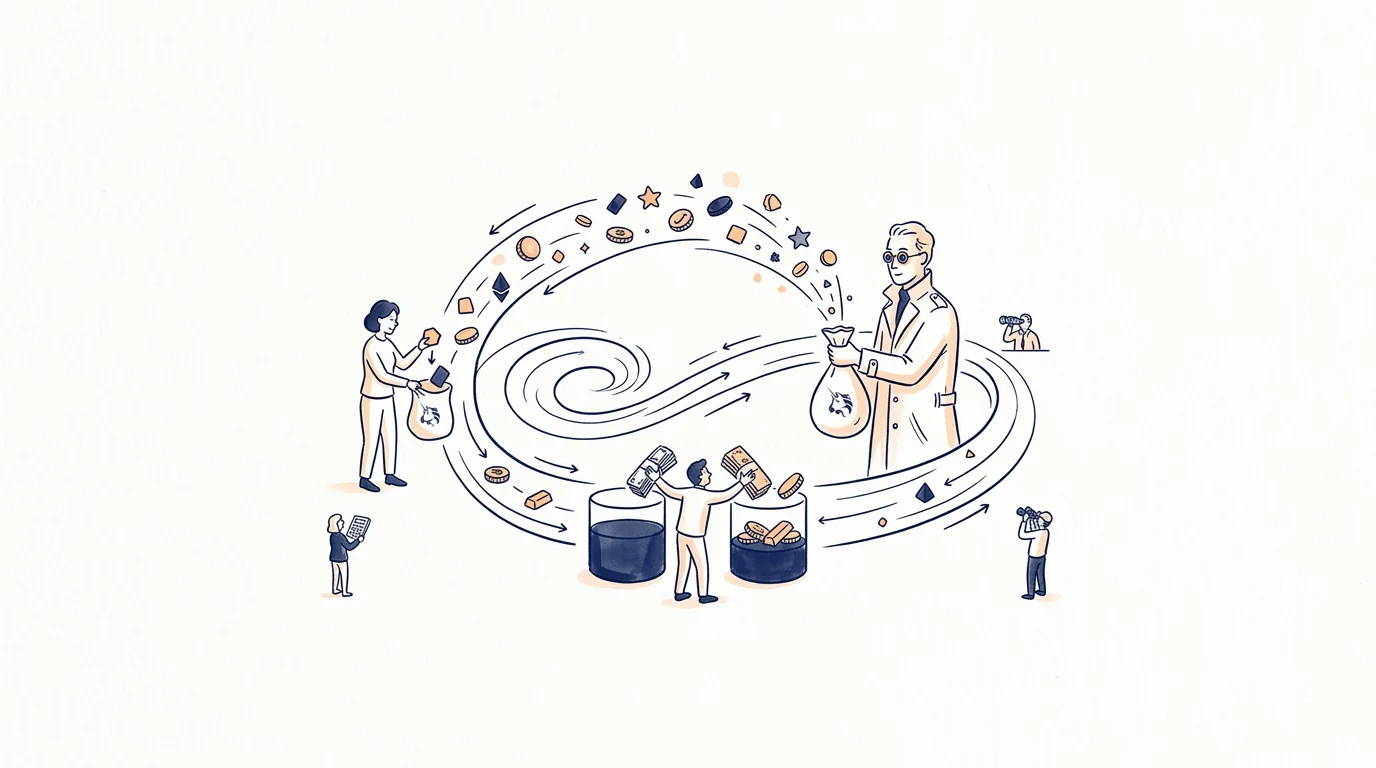

Imagine a global financial market with no central headquarters, no chief executive officers, and no closing bell. If you are dipping into the world of decentralized finance, the first question you probably have is: what is Uniswap? It is the infrastructure that made this vision a reality, replacing corporate middlemen with public, verifiable code.
For decades, the financial system relied on trusted intermediaries to facilitate trades, hold assets, and settle transactions. Uniswap flipped this model entirely, proving that a sprawling, billions-of-dollars market could operate efficiently on an open blockchain; leveraging smart contracts on the Ethereum network, it created a system where anyone can trade digital assets instantly, without ever asking for permission.
However, stripping away the middleman also means stripping away the safety nets of traditional finance. The platform shifts the ultimate burden of security, asset protection, and risk management directly onto the user. Understanding this protocol is not just about learning a new trading tool; it is about grasping a fundamental shift in how digital ownership and value exchange operate in the modern era.
The Foundation: Centralized vs. Decentralized Exchanges
To truly understand the innovation behind this protocol, we first need to look at how traditional crypto trading platforms operate. When you create an account on a major centralized exchange (CEX) like Binance, Coinbase, or Kraken, you are participating in a system that closely mirrors Wall Street. You deposit your funds into their corporate wallets, and in return, the exchange updates an internal database to reflect your balance.
This model is convenient, but it carries a significant structural risk. When your assets are sitting on a centralized platform, you do not technically own them; you hold an IOU from a corporation. If that company faces insolvency, gets hacked, or faces regulatory pressure to freeze withdrawals, your funds are trapped. The crypto community describes this vulnerability with a famous maxim: “not your keys, not your coins.”
This is where a decentralized exchange crypto platform changes the paradigm. Instead of handing your funds over to a company, you retain complete control of your assets using a self-custody crypto wallet. You connect this wallet directly to the trading platform, execute your trade, and the new assets are deposited straight back into your possession within seconds.
When comparing Uniswap vs Binance, the core difference lies in custody and execution. Binance uses a traditional order book, matching buyers and sellers through its proprietary matching engine while holding everyone’s funds. Uniswap, on the other hand, never holds your assets. It acts merely as a digital public utility, a set of immutable rules living on the blockchain that facilitates the swap between two private wallets.
How Does Uniswap Work? The End of the Order Book
The earliest attempts at building decentralized exchanges struggled with a fundamental problem: liquidity. Replicating a traditional order book on a blockchain was slow, expensive, and required buyers and sellers to be online at the exact same moment with overlapping price expectations. If you wanted to buy an obscure token, you had to wait for someone else willing to sell it at your exact price point.
Automated Market Makers (AMMs) Explained
The breakthrough came when developers decided to completely abandon the order book model. Instead of connecting a specific buyer to a specific seller, the automated market maker explained a new way to trade: users trade against a smart contract holding a reserve of tokens.
Think of an automated market maker (AMM) like a massive, autonomous vending machine. Instead of holding soda and snacks, this machine holds two different digital assets. If you want to put one asset into the machine, it will automatically calculate how much of the other asset it should give you in return, based on how much inventory it has left. There is no human negotiation, just a pure mathematical relationship.
The price of assets within this system is governed by a beautifully simple constant product formula: x × y = k. In this equation, x represents the total amount of the first token in the reserve, y represents the amount of the second token, and k is a fixed constant that must always remain the same after a trade.
If someone buys a large amount of token x , they are removing it from the machine and adding token y to pay for it. Because the supply of x decreases, its price algorithmically increases to ensure the constant k remains balanced. The market dictates the price entirely through supply and demand mechanics embedded in the code.
The Role of Liquidity Pools and Providers
If there is no central company funding this decentralized vending machine, where do the tokens come from? The answer lies in the community. The reserves of tokens are stored in smart contracts known as liquidity pools. Anyone in the world with digital assets can choose to deposit their tokens into these pools to facilitate trading for others.
These individuals or entities are called liquidity providers (LPs). In exchange for locking up their capital and providing the necessary inventory for the market to function, they earn a portion of the trading fees generated every time someone uses that specific pool. It democratizes the role of the market maker, allowing regular users to earn yields that were historically reserved for large financial institutions.
However, the size of the liquidity pool directly impacts the efficiency of the trade. If a trader tries to swap a massive amount of tokens in a relatively small pool, they will drastically alter the ratio of the assets. This causes the price to move unfavorably against them during the execution of the trade, a phenomenon known in the crypto market as slippage.
A Quick Step-by-Step: Executing Your First Swap
Operating this decentralized infrastructure is surprisingly straightforward once the foundational concepts are understood. The first step is to secure a non-custodial wallet and fund it with the assets you wish to trade, along with some native network tokens (like Ethereum) to pay for the transaction processing fees.
Next, you navigate to the decentralized interface and connect your wallet. You select the asset you currently hold and the asset you wish to receive. The smart contract instantly calculates the exchange rate based on the current balance of the liquidity pool and displays the expected output, alongside the estimated network fee and potential slippage.
Once you review the terms, you sign the transaction using your wallet’s cryptographic keys. The blockchain network processes the request, deducts the original tokens from your balance, and simultaneously deposits the new tokens back into your wallet. The entire settlement process occurs in seconds, operating flawlessly without human intervention.
What Are the Risks? Security, Custody, and Impermanent Loss
While the narrative of a fully decentralized, unstoppable financial market is compelling, it is crucial to approach this ecosystem with rigorous analytical scrutiny. Removing the corporate middleman eliminates counterparty risk, but it amplifies technical and operational risks. You are no longer trusting a bank; you are trusting computer code and your own security practices.
The Realities of Self-Custody
When you step into the decentralized arena, you become your own bank administrator, security guard, and compliance officer. There is no customer service hotline to call if you make a mistake. If you lose the recovery phrase to your wallet, your funds are permanently inaccessible. If you accidentally approve a malicious smart contract designed to drain your wallet, the blockchain will execute that transaction faithfully and irreversibly.
Because anyone can create a liquidity pool for any token, the ecosystem is a fertile ground for sophisticated scams. Malicious actors frequently create counterfeit tokens with identical names to legitimate projects. If a user fails to verify the specific smart contract address before trading, they can easily swap valuable assets for worthless imitations.
For long-term wealth management and serious capital allocation, standard self-custody is often insufficient. This is why institutional players and advanced users rely heavily on multi-signature (multisig) wallets when interacting with decentralized protocols. A multisig setup requires multiple independent cryptographic approvals before a transaction is executed, ensuring that a single compromised device or a moment of human error does not result in the total loss of assets.
The Threat of Impermanent Loss Crypto
For those looking to earn passive income by depositing assets into liquidity pools, there is a complex, often misunderstood risk known as impermanent loss crypto. While earning a share of trading fees sounds appealing, liquidity providers take on a unique form of market exposure that differs significantly from simply holding an asset.
Imagine you deposit an equal value of US Dollars and Ethereum into a liquidity pool. If the price of Ethereum skyrockets on external markets, arbitrage traders will rush to your pool to buy the artificially cheap Ethereum, draining it from the smart contract while depositing more US Dollars.
Because the AMM formula forces the pool to rebalance, you as the liquidity provider will end up with less of the appreciating asset (Ethereum) and more of the stable asset (US Dollars). Even after collecting trading fees, your total portfolio value might be lower than if you had simply held the two original assets securely in your wallet. The more volatile the tokens in a pool, the higher the risk of this mathematical loss.
Is Uniswap Worth It? A Long-Term Perspective
Evaluating the true value of Uniswap protocol requires looking beyond the short-term price action of volatile tokens. From an institutional and macroeconomic perspective, the platform represents a monumental leap forward in financial infrastructure. It offers a global, permissionless trading environment that operates 24/7, settling trades with absolute mathematical certainty.
Uniswap has also proven its ability to iterate and evolve. The introduction of concentrated liquidity in earlier upgrades allowed providers to allocate their capital to specific price ranges, vastly improving capital efficiency. Recent advancements have introduced customizable hooks, allowing developers to program dynamic fees or institutional-grade compliance checks directly into specific pools.
Historically, the biggest barrier to entry was the exorbitant cost of executing trades on the Ethereum base layer, where fees could spike to dozens of dollars during periods of high congestion. However, the aggressive expansion of Layer-2 scaling solutions has fundamentally changed this dynamic, compressing execution costs down to mere cents while inheriting the security of the main network.
For individuals who prioritize absolute ownership of their wealth and wish to operate outside the confines of traditional banking, decentralized exchanges are an indispensable tool. However, it is not a playground for the careless. Success in this environment requires a deep commitment to operational security, an understanding of smart contract risks, and a methodical approach to asset protection.
The Bottom Line: Redefining Digital Ownership
At its core, understanding what is Uniswap is about recognizing a paradigm shift in global finance. It has definitively proven that a multi-billion dollar market can function flawlessly without corporate custodians, relying entirely on cryptography, mathematics, and decentralized incentives.
Replacing the traditional order book with automated liquidity pools, Uniswap has democratized market-making and provided global access to digital asset trading. Yet, this total financial autonomy demands total financial responsibility. Eliminating the centralized middleman means assuming their role in safeguarding your capital.
Whether you are executing a simple token swap or deploying capital as a liquidity provider, the rule remains the same: education and secure custody must precede participation. In the decentralized world, mathematics guarantees the execution, but only your operational discipline can guarantee the preservation of your wealth.
This content is for informational purposes only and does not constitute financial advice.