
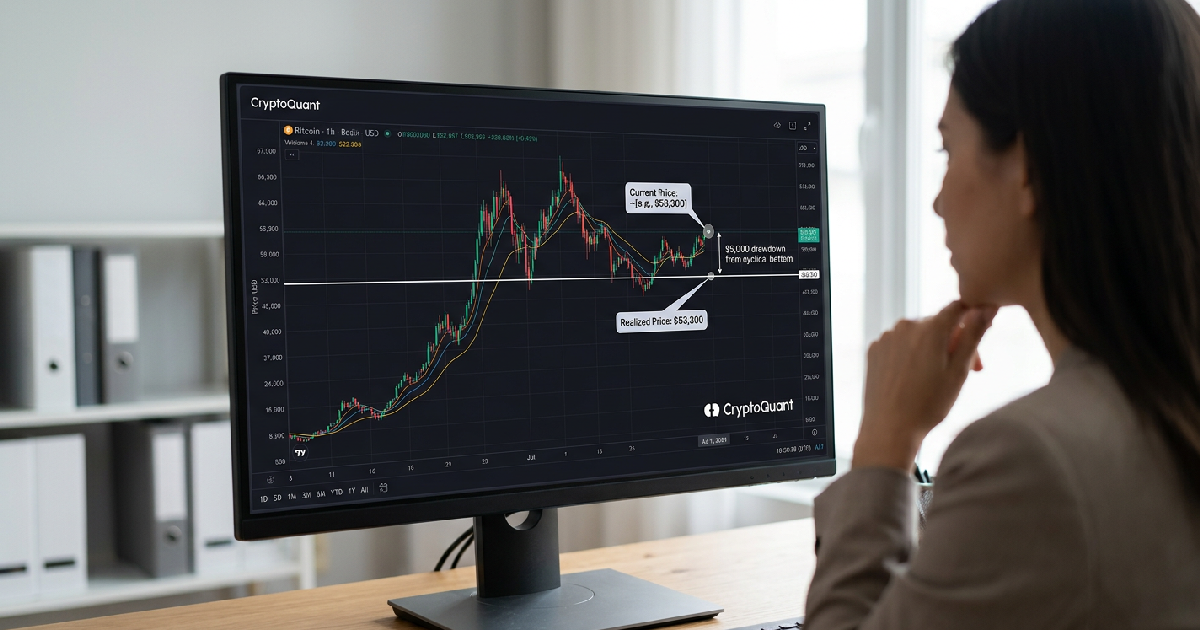

Bitcoin (BTC) is approaching a price level identified by analysts as the single best investment opportunity of the current bear market cycle. Data from on-chain analytics firm CryptoQuant shows the digital asset is now less than 10% away from its aggregate realized price of $53,300, a threshold that has historically signaled cyclical bottoms.
As of July 1, 2026, Bitcoin is trading near $58,387, leaving just a $5,000 gap before it reaches this critical cost-basis support.
Realized price as a historical bear market floor
The market’s current trajectory follows a steep 53.9% drawdown from its all-time high (ATH) of $126,000, which was established in late 2025. Crypto Sunmoon, a contributor to CryptoQuant, noted that every recurring bear market has included a “bleak period” where the price slipped below the realized cost basis.
Historically, these moments have provided the most lucrative entry points. However, the path to this floor has been volatile, as Bitcoin price analysis shows recent rejections at key resistance levels have kept the pressure on buyers.
The aggregate realized price represents the average value at which all circulating Bitcoin last changed hands. This metric currently sits at approximately $53,300 as of early July 2026. Because this level reflects the collective cost basis of the market, prices falling toward it suggest widespread holder capitulation. This environment often creates the “bottom zone” seen in previous cycles, such as the 2022 low of $15,600.
While the $53,300 mark is the immediate focus, other technical indicators highlight the intensity of the current downturn. Bitcoin is now trading significantly below its 50-month exponential moving average (EMA) of $65,600. This specific EMA is widely regarded by institutional traders as the primary boundary between bull and bear market regimes.
The market has also seen the breach of the $61,500 support level last week, which accelerated the slide toward the current $58,000 range.
Long-term holder resilience amid $2 billion in losses
Despite the prevailing bearish sentiment, on-chain data confirms that the largest market participants are not exiting the space. Long-term holders currently sit on a record 16.1 million BTC even as the market recorded over $2 billion in realized losses from sell-offs in late 2025 and early 2026. This accumulation phase mirrors trends where Bitcoin exchange supply maintains multi-year lows as assets move into private custody.
These long-term players maintain an average buy-in price of roughly $48,400. This figure could represent the “final act” of the bear market if volatility continues through the second half of 2026. For comparison, the True Market Mean—the cost basis for active investors—is currently much higher at $77,000. This gap illustrates the extent to which current prices have decoupled from recent investor expectations.
Market outlook and potential for deeper price slides
The road to recovery may not be immediate once the realized price is tested. Analysts at Bitfinex have warned that Bitcoin could potentially sink into the $40,000s by the end of 2026 if broader economic headwinds persist.
Key details
Rekt Capital has also pointed to a lack of historical buying volume in the $47,000 to $57,000 zone, suggesting a rapid price vacuum could form if the $53,300 support fails to hold.
Sentiment in the derivatives market remains similarly cautious. Options traders appear convinced that a drop to $52,000 is likely before the year concludes. Meanwhile, Niels Klaver has suggested that a dip to $55,000 might act as a necessary catalyst for a “big move” back toward the 200-week moving average. That average currently stands at $61,000 according to PlanB’s recent assessments.
Despite the current 52% slide over the past month, Bitcoin’s long-term relative strength has remained intact for five-year participants. As of June 24, 2026, Bitcoin has outperformed the S&P 500 by nearly 2% per year over the preceding five years and remains up 85% cumulatively.
For those tracking the aggregate realized price, the coming weeks will determine if history repeats and provides the generational buying opportunity analysts are anticipating.