

Crypto whales are repositioning for July 2026, with on-chain flows revealing significant accumulation of Aave (AAVE), Uniswap (UNI), and Ethena (ENA) despite recent market volatility. While retail sentiment remains cautious, institutional-grade wallets have used a soft session to increase their holdings in protocols that demonstrate high utility and consistent fee revenue.
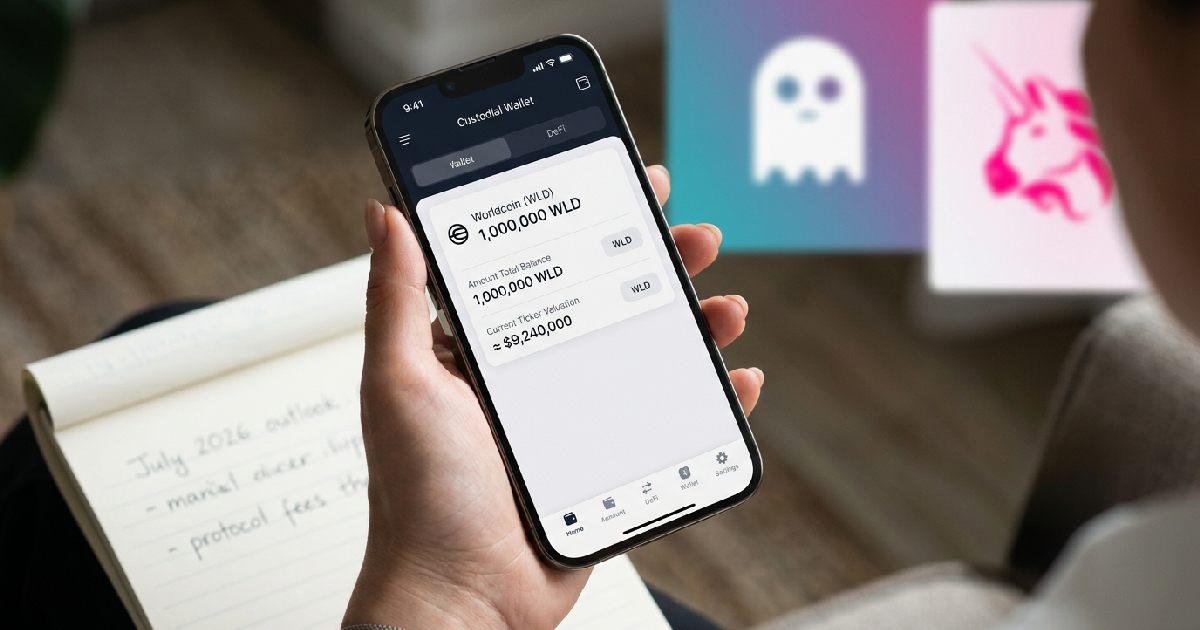
The accumulation trend is particularly visible in Worldcoin (WLD), where large-capital addresses added approximately 30 million tokens to their private balances between May 26 and May 29. Valued at roughly $9 million, this surge in demand followed an 11% price correction, which whales interpreted as a buyer’s opportunity.
Aave attracts mid-tier whales with strong fee generation
This activity coincided with a bullish divergence in the RSI, often a technical signal that a market floor is forming.
Aave (AAVE) anchors the list of tokens drawing interest because its decentralized lending base continues to expand. Analysts tracking the 10,000 to 100,000 AAVE wallet cohort found these mid-sized holders lifted their collective stake from 4.09 million to 4.27 million tokens over a 48-hour window. This addition of 180,000 units is worth about $16 million.
The protocol’s fundamentals support this aggressive buying. Aave currently holds nearly $13.04 billion in total value locked (TVL), with borrowers maintaining approximately $10.25 billion in active loans. This infrastructure generates roughly $937 million in annualized fees. Compared to a market capitalization of $1.4 billion, the protocol is producing annual revenue equivalent to two-thirds of its entire token value.
Although AAVE eased about 1.6% over the last 24 hours to $90.49, the cohort of smaller whales continued adding. Their willingness to buy into price weakness suggests these participants views the current levels as a strategic entry. This mirrors broader trends where decentralized finance platforms are seeing renewed interest regardless of short-term price fluctuations.
Uniswap supply tightens as burn mechanism gains traction
Uniswap (UNI) is also seeing whale activity, though the build-up is more measured than aggressive. Non-exchange whale supply edged up from 778.56 million to 778.94 million UNI recently. This modest addition of 380,000 UNI signals careful accumulation rather than a speculative rush.
The patient stance taken by these holders is likely linked to the protocol’s fee switch mechanism. In June 2026, Uniswap on-chain trading volume reached nearly $2.2 billion per day. This activity feeds a mechanism that buys back and burns UNI, which effectively removed $22.5 million of supply during the first half of the year.
As whales add to their holdings, they are competing for a float that is actively shrinking.
UNI slipped 2.4% over the last 24 hours to $2.87, having traded largely flat for several weeks. With total exchange supply reaching multi-year lows across many major assets, the steady absorption of UNI suggests a slow-burn conviction build among larger participants.
Ethena whale balances jump 3,166% in 24 hours
Ethena (ENA) has recorded the most aggressive whale movement in the group. Over a single 24-hour period, ENA whale balances surged by 3,166%, climbing from 0.63 million to 20.63 million ENA. This move involved the acquisition of 20 million tokens, worth roughly $1.5 million, despite a 4.4% drop in the token’s price during the same timeframe.
This divergence between price action and on-chain demand appears rooted in the recovery of Ethena’s synthetic dollar, USDe. The supply of USDe on Ethereum has climbed roughly 19% from its late-April lows and has stabilized near $4.5 billion for six weeks. Since USDe serves as the protocol’s fee base, whales likely view the stablecoin’s stabilization as a sign that the previous deleveraging phase has concluded.
The aggressive buying into a falling tape suggests that large holders believe the price lag is a temporary inefficiency. For July, the Ethena setup remains a high-conviction play for whales looking to front-run returning yield demand within the DeFi ecosystem.