
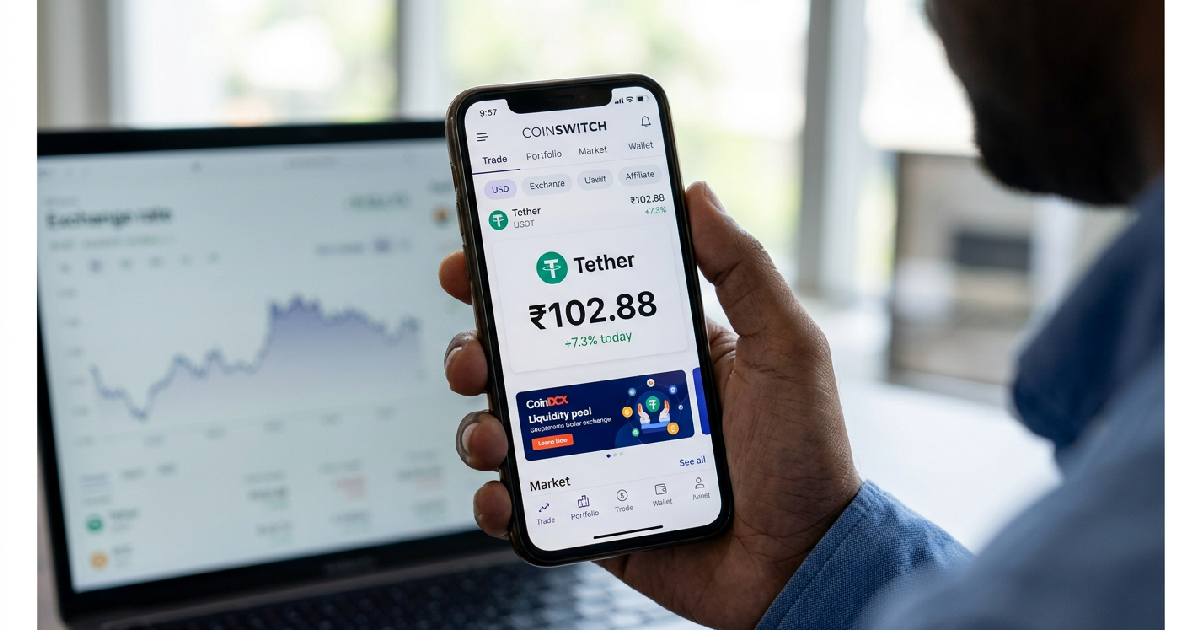

Tether (USDT) is trading at a significant premium in India as of June 30, 2026, with local prices climbing between 7% and 10% above the global dollar peg. Executives from major domestic exchanges, including CoinDCX and CoinSwitch, attribute this price surge to a persistent supply-and-demand imbalance and thin liquidity.
Over the weekend of June 28, the stablecoin reached approximately ₹102.88 on local platforms, while the official USD/INR exchange rate sat near ₹94.65.
Indian exchanges cite organic market dynamics for price gap
The premium, which typically fluctuates between 3% and 4%, more than doubled following recent enforcement actions by the Enforcement Directorate (ED), India’s financial-crime agency. These regulatory interventions disrupted the domestic supply of stablecoins and reduced active inflows, making market makers cautious about bringing new USDT into the country.
Consequently, Indian traders are paying a steep markup to maintain dollar-pegged positions during periods of rising market volatility.
Top executives at India’s leading platforms emphasize that the premium is a result of market forces rather than platform-imposed fees. Minal Thakur, the Executive Vice President of Mumbai-based CoinDCX, explained that the INR price of USDT is determined by local order-book depth relative to the global reference price.
Key details
Since India is structurally a net buyer of digital assets, local demand frequently outpaces the available sell-side liquidity, forcing the market to clear at higher rates.
Ashish Singhal, the co-founder and CEO of CoinSwitch, stated that the premium reflects broader market conditions and liquidity constraints rather than manual price settings by exchanges. On the CoinSwitch platform, USDT has traded at roughly a 9% premium in recent days.
Singhal noted that buyers and sellers determine these prices through active trading, and users see live buy and sell rates transparently before placing orders. This scenario often mirrors times when bitcoin exchange supply maintains multi-year lows, trapping liquidity within local borders.
Regulatory pressure and unauthorized transfer allegations
The liquidity crunch aligns with heightened scrutiny from the Enforcement Directorate, which has been investigating the misuse of virtual digital assets for unauthorized cross-border transfers. Reports indicate that over ₹2,500 crore (approximately $265 million) has been moved through unauthorized channels, bypassing documentation required under the Foreign Exchange Management Act (FEMA). These actions have notably slowed the rate at which liquidity providers replenish local token stocks.
The disruption has particular significance for India’s massive user base, as the country has ranked first globally for crypto adoption for three consecutive years.
While many use USDT as an alternative for faster remittances or to hedge against the rupee, the Financial Action Task Force (FATF) reported in March 2026 that stablecoins accounted for 84% of illicit virtual asset volumes in the previous year.
Key details
This has led to a climate where tether is increasingly urged to address regional compliance and security concerns.
Structural hurdles under the current tax regime
India’s difficult fiscal environment continues to contribute to these market dislocations. Traders currently face a flat 30% tax on all crypto gains and a 1% Tax Deducted at Source (TDS) on every transaction. Because there is no allowance to offset losses, high-frequency market makers find it difficult to execute the arbitrage trades that would normally narrow the gap between Indian and global USDT prices.
The lack of domestic stablecoin sources or large-scale mining operations means India must import nearly all its USDT supply. When regulatory pressure makes these import channels riskier, the “arbitrage band” widens significantly. For local investors, this means the cost of entry remains high regardless of global market stability, as thin liquidity near the global reference price forces buyers to pay the prevailing local markup.
Upcoming policy shifts and the July 2 meeting
The current price dislocation serves as a backdrop for critical discussions regarding India’s approach to virtual digital assets. The Parliamentary Standing Committee on Finance is scheduled to meet with the Reserve Bank of India (RBI) and the Institute of Chartered Accountants of India (ICAI) on July 2, 2026.
This meeting aims to address the regulation of digital assets and the potential for stricter oversight of stablecoin use in remittances.
Sudhakar Lakshmanaraja, the founder of the crypto policy advocacy group Digital South Trust, recently stated that regulation has become a vital necessity as agencies increase their focus on crypto misuse. The RBI has historically warned that cryptocurrencies pose risks to macroeconomic stability.
As the government weighs its next steps, the 10% premium stands as a concrete indicator of the friction between high domestic demand and a restricted, highly regulated supply chain.