
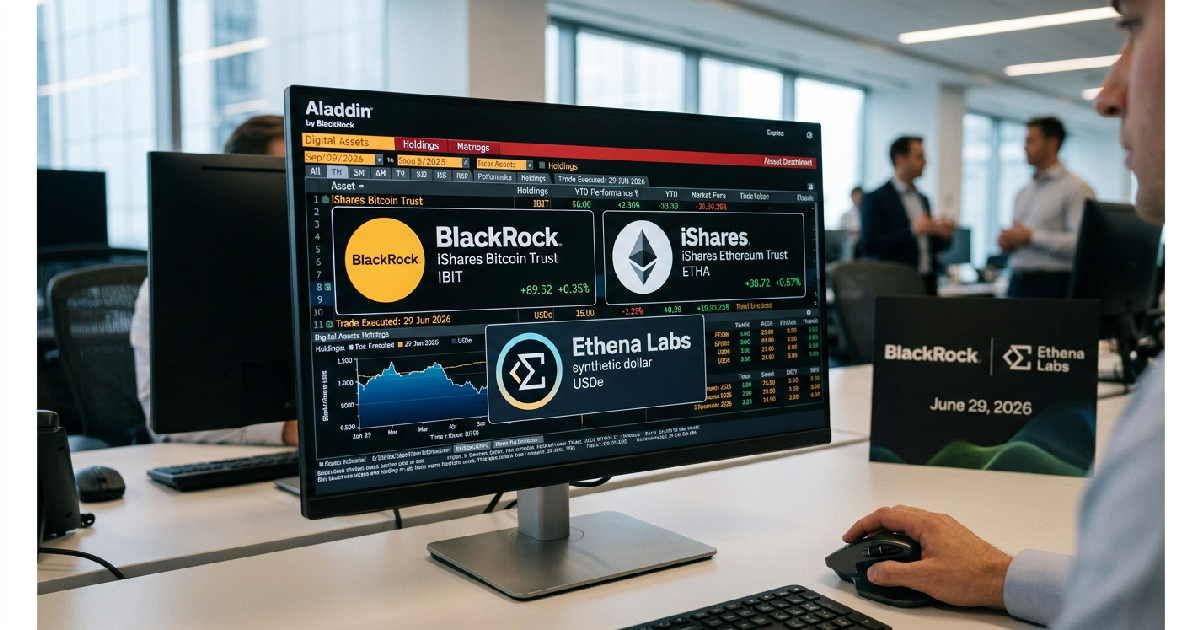

BlackRock, the world’s largest asset manager, officially integrated Ethena Labs’ USDe synthetic dollar into its Aladdin investment platform on Monday, June 29, 2026.
The expanded partnership allows institutional clients to track and evaluate the USDe token directly through BlackRock’s enterprise risk management and portfolio analytics suite, which manages approximately $25 trillion in assets under management (AUM).
Infrastructure for traditional finance adoption of USDe
USDe joins the iShares Bitcoin Trust (IBIT) and the iShares Ethereum Trust (ETHA) as one of only three crypto assets supported on the platform.
The deal includes a $100 million liquidity facility provided by Ethena Labs through Securitize, the regulated transfer agent for BlackRock’s tokenized Treasury fund, BUIDL. This facility enables eligible BUIDL holders to exchange their tokens for stablecoins like USDC and USDtb, even outside of normal market hours.
In a reciprocal move, Ethena Labs will now utilize BUIDL as the primary backing asset for its whitelabel stablecoin products. This step aligns with broader market shifts as updated filings for spot ETFs continue to draw institutional focus toward on-chain liquidity solutions.
Key details
BlackRock’s Global Head of Digital Assets, Robert Mitchnick, described the integration as a way to deliver “frictionless movement” between tokenized funds and digital dollars. He noted that such interoperability is central to the utility of tokenizing a Treasury fund.
By embedding USDe into Aladdin, BlackRock allows financial institutions to interact with decentralized products through the same workflows they use for traditional equities and fixed-income assets. This bridge-building address one of the primary hurdles for institutional entry into the digital asset space: the lack of familiar risk management tools.
The Aladdin platform functions as an end-to-end system for investment construction and execution. With USDe integrated, fund managers can now apply standard institutional risk oversight to a synthetic dollar that reached a $10 billion market cap faster than any other stablecoin.
Ethena founder Guy Young emphasized that this phase of adoption is driven by infrastructure that allows institutions to use “familiar systems” for on-chain products. This development comes as lawmakers in various regions push to legalize P2P crypto trade, reflecting a global trend toward legitimizing digital asset infrastructure.
Synthetic dollar mechanics and BUIDL liquidity facility
Unlike asset-backed stablecoins like USDT or USDC, USDe is a synthetic dollar that maintains its peg through a delta-neutral hedging strategy. Ethena pairs spot crypto holdings, such as liquid-staked Ethereum and Bitcoin, with offsetting short perpetual futures positions.
This mechanism has allowed USDe to maintain a circulating supply of approximately $4.45 billion as of late June, despite a broader decline in DeFi total value locked (TVL). The Aladdin integration provides a stabilizing institutional layer for a protocol that has seen $1.6 billion in redemptions earlier this year.
The $100 million liquidity facility managed through Securitize specifically supports BlackRock’s BUIDL fund, which currently has a TVL of roughly $3 billion. This arrangement ensures that the tokenized Treasury fund remains liquid, allowing for conversions into USDC and other stablecoins outside of standard trading windows.
For institutional investors, this 24/7 interoperability is a significant upgrade over traditional banking rails that close on weekends. As altcoin demand shifts toward new tokens with high utility, the formal backing of BlackRock positions Ethena’s native token, ENA, as a key player in the institutional DeFi landscape.
Market reaction to BlackRock and Ethena Labs partnership
Ethena’s native token, ENA, climbed approximately 10% following the announcement on Monday, briefly trading near $0.08 with a market capitalization of roughly $740 million. The market’s positive response underscores the importance of the Aladdin platform as a gateway for institutional liquidity.
Institutions manage trillions through Aladdin, and the inclusion of USDe signals a growing acceptance of crypto-native financial engineering within the world’s most conservative investment portfolios.
This integration marks a point of convergence where tokenized real-world assets (RWAs) meet decentralized synthetic dollars. By using BUIDL as the backing for USDe products, Ethena creates a loop where tokenized U.S. government debt supports digital dollar stability.
As the regulatory environment evolves, this model provides a blueprint for how traditional asset managers can leverage blockchain technology to optimize capital efficiency without abandoning the risk frameworks that govern global finance.