
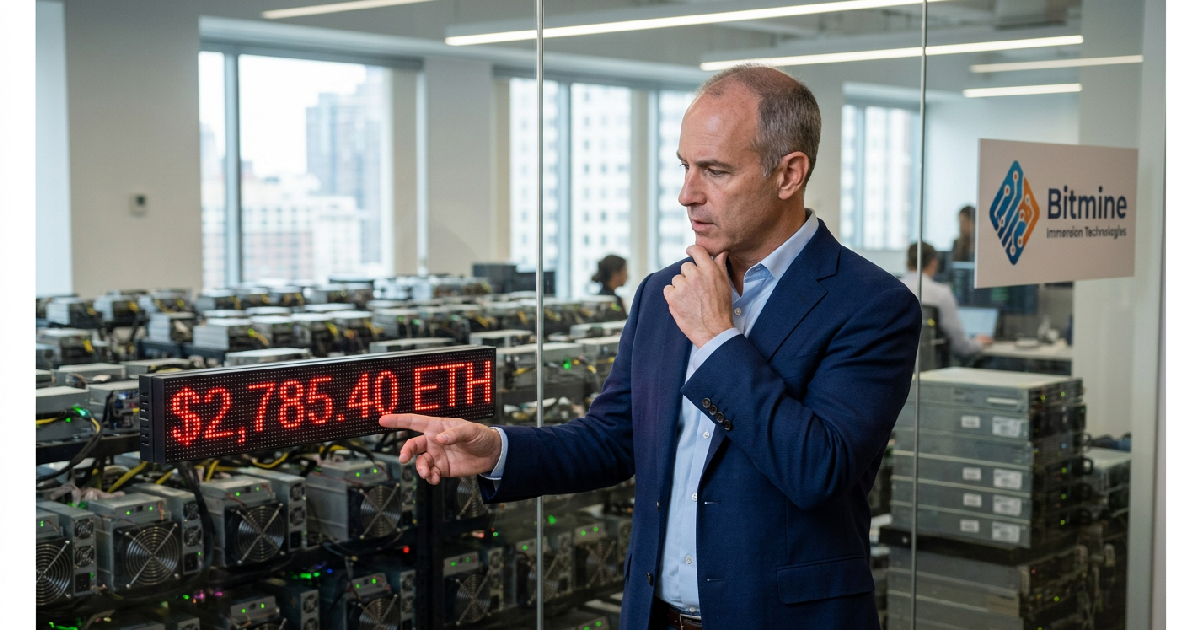

Thomas Lee, the chairman of Bitmine Immersion Technologies and cofounder of Fundstrat Global Advisors, has attributed the recent downturn in digital asset prices to a practice known as “window dressing.”
According to a Monday company update released on June 29, 2026, Bitmine Immersion Technologies (BMNR) continued its aggressive accumulation strategy by purchasing 27,084 ether (ETH) last week. This acquisition, valued at approximately $43 million based on market pricing, took place despite ether falling 8% over the same seven-day period.
Tom Lee explains the impact of rebalancing on crypto markets
The purchase brings the company’s total holdings to approximately 5.7 million ETH, representing roughly 4.7% of the token’s circulating supply. Chairman Thomas Lee noted that the seasonal selling pressure is likely calendar-driven, as investors are “cutting their losses” on underperforming assets before the conclusion of the second quarter.
He suggested that such rebalancing is a typical behavior for investors seeking to clean up their visible holdings as they enter the second half of the year.
The concept of “window dressing” entails investors reducing their exposure to assets that have declined significantly over the previous three months to present a stronger portfolio for quarterly reporting.
This trend has placed downward pressure on the Ethereum price outlook, contributing to what is expected to be a third consecutive quarter of losses for both bitcoin and ether. So far in the second quarter of 2026, bitcoin is down 12%, while ether has slid roughly 25%.
Despite the price action, Thomas Lee highlighted several positive fundamental developments that have been overshadowed by this “window dressing” behavior. He specifically mentioned the creation of Ethlabs, a new Ethereum research organization established following a period of turmoil at the Ethereum Foundation.
Key details
Additionally, Lee pointed to the Bank of England’s decision to soften its regulatory stance regarding stablecoins as a sign of progress that the market has yet to fully price in.
Bitmine Immersion Technologies nears ownership milestone
As the largest Ethereum treasury company, Bitmine Immersion Technologies is currently nearing a stated goal of owning 5% of all ETH in circulation. While the firm added $43 million to its coffers last week, this acquisition was its smallest purchase since early May.
This reflects a deceleration from earlier in the month when the company purchased 126,971 ETH in a single week. Bitmine remains one of the few institutional players consistently adding to its digital asset reserves as Ethereum navigates key support levels.
The company’s liquid treasury is currently valued at approximately $9.8 billion when combining its crypto holdings with other investments. This diverse balance sheet includes the nearly $8.9 billion ether stash, 206 bitcoin, and approximately $555 million in cash and marketable securities. Bitmine also holds equity stakes in Beast Industries and Eightco Holdings.
The firm’s consistent buying underscores a long-term commitment to the Ethereum ecosystem, independent of the shorter-term rebalancing cycles currently impacting retail and fund investors.
Market sentiment at the close of the second quarter
The current market weakness arrives at a busy time for the digital asset industry. While the White House has reportedly engaged with law enforcement groups to push for the “Crypto’s Clarity Act,” the immediate price action appears strictly tied to the quarter-end calendar.
Investors are balancing these regulatory shifts with the reality of three straight quarters of price declines—a streak for ether that has not occurred since 2019.
Bitmine’s decision to slow its buying pace to 27,084 ETH suggests a tactical shift as the firm approaches its 5% threshold. With holdings already at 5.7 million ETH, the company controls a significant portion of the network’s liquidity.
As the industry moves into the third quarter of 2026, analysts will be watching to see if the removal of “window dressing” selling allows the positive catalysts cited by Thomas Lee to eventually drive a market recovery.