
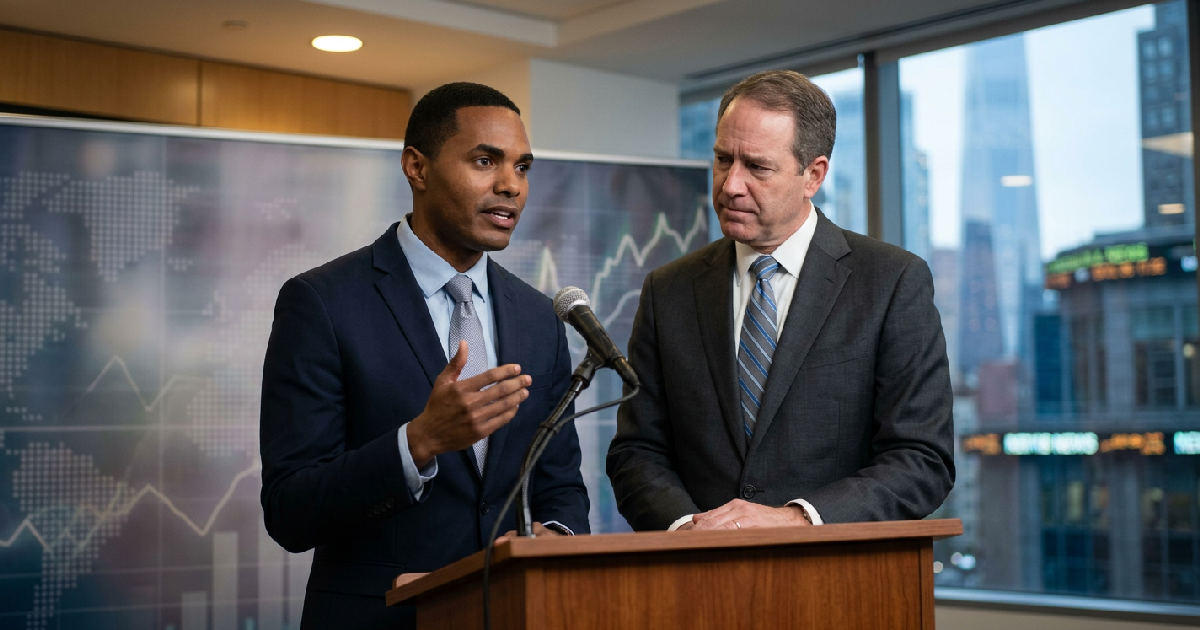

Ritchie Torres, a Democratic Representative from New York, and Don Graves, former Deputy Secretary of Commerce, have warned that the People’s Republic of China (PRC) is leveraging U.S. financial market access to compromise the life savings and sensitive data of tens of millions of Americans.
In an opinion piece published by The Washington Post on June 29, 2026, the authors argue that Beijing uses market access as a weaponized “tool for capital.” This strategy reportedly allows the PRC to steal intellectual property, monitor citizens, and conduct economic espionage through U.S. financial platforms.
Beijing uses market access to weaponize American financial data
The warning centers on the vulnerability of Americans who trust financial institutions with their personal data while saving for homes, college funds, and retirement. Representative Ritchie Torres, who serves on the Select Committee on the Chinese Communist Party, and Don Graves argue that these platforms are being exploited.
When fintech platforms or broker-dealers fall under the influence of Chinese law, the private information of U.S. savers can be reached by foreign security services. This risk highlights how macro warning signs emerge when national security and global finance intersect.
The authors contend that Beijing’s integration into Western markets is not a sign of liberalization but a method for state-directed intelligence gathering. By allowing Chinese-linked firms to operate in the United States, American officials may be opening doors for economic espionage.
This creates a fundamental clash between a democratic financial system and an economy that requires corporate entities to serve the state. The PRC effectively “wields U.S. market access” to facilitate the theft of proprietary information from the very people using these services.
Key details
A primary driver of this threat is the legal framework established by the PRC, including the Cybersecurity Law (CSL) and the 2021 Data Security Law (DSL). These regulations, alongside the updated Counter Espionage Law, mandate that Chinese nationals and organizations under Chinese jurisdiction must cooperate with national security agencies.
The State Secrets Law of 2024 further requires companies to disclose any data that could have an “adverse impact” on the state. For American users, this means their financial data exists within a “one-way data flow” that benefits China’s strategic development.
This exposure is particularly concerning as institutional shifts occur in other sectors of the market. For instance, Bitcoin exchange supply maintains lows as some investors pivot toward alternative assets to avoid traditional systemic risks.
However, for the tens of millions of Americans in traditional savings accounts or college funds, such alternatives are often out of reach. Representative Ritchie Torres and Don Graves argue that the security of these platforms is essential to protecting the capital that serves as the foundation of the U.S. economy.
Legislative responses to foreign data exploitation
The United States has developed a regulatory apparatus to address these risks, primarily through the Committee on Foreign Investment in the United States (CFIUS). Following the 2018 Foreign Investment Risk Review Modernization Act (FIRRMA), CFIUS has increased its focus on transactions that grant foreigners access to sensitive data.
Historically, Chinese investments have faced significant scrutiny, making up 15% of CFIUS reviews despite representing only 4% of U.S. mergers and acquisitions. This rigour reflects a growing bipartisan consensus that China presents a unique security challenge.
Other lawmakers have raised similar alarms regarding the technical “backdoors” created by foreign technology. Congressman Zach Nunn introduced the CLARITY Act to address the risks posed by Chinese-developed cloud storage technology. Congressman Zach Nunn warned that such technology could allow the PRC to steal Social Security numbers, passwords, and bank information.
Key details
This legislative effort aligns with the concerns of Ritchie Torres and Don Graves, who view the mass aggregation of American data by foreign adversaries as a form of “data trafficking.”
Existing precedents illustrate the federal government’s willingness to intervene when data security is compromised. The forced divestiture of TikTok and restrictions on Huawei equipment serve as examples of this defensive posture. But protecting life savings requires even deeper oversight of “covered data transactions.”
As market sentiment shifts regarding financial transparency, regulators are being forced to define which entities can be trusted with the bulk personal identifiers of millions of U.S. citizens.
Implementation of new Department of Justice data rules
A significant regulatory shift arrived earlier this year via the Department of Justice (DOJ). Under the DOJ Final Rule, which became effective April 8, 2025, U.S. persons are prohibited or restricted from engaging in data transactions that provide “countries of concern,” including China, access to bulk sensitive information.
This rule specifically protects personal health and financial data for groups of more than 10,000 individuals. It aims to prevent the CCP from using American consumer data to develop dual-use technologies like AI.
Don Graves, who served as deputy secretary of commerce from 2021 to 2025, notes that China’s state-owned enterprises (SOEs) act as instruments of state policy. With approximately 150,000 SOEs accounting for up to 40% of China’s GDP, the PRC has the scale to exert immense pressure on global markets.
Key details
When these entities or their subsidiaries operate as broker-dealers in the U.S., they remain beholden to Chinese national security laws, regardless of where their customers are located. This creates a permanent risk of data handover for Americans using those platforms.
The forward-looking implications for U.S. financial institutions are clear: compliance costs and regulatory friction will likely increase. As federal privacy legislation such as the SECURE Data Act 2026 is debated, the focus remains on ensuring digital sovereignty.
The warning from Representative Ritchie Torres and Don Graves suggests that if the PRC holds the keys to American life savings, it holds the power to destabilize the American dream. Protecting the financial sector is no longer just about preventing fraud; it is a critical component of national security.