
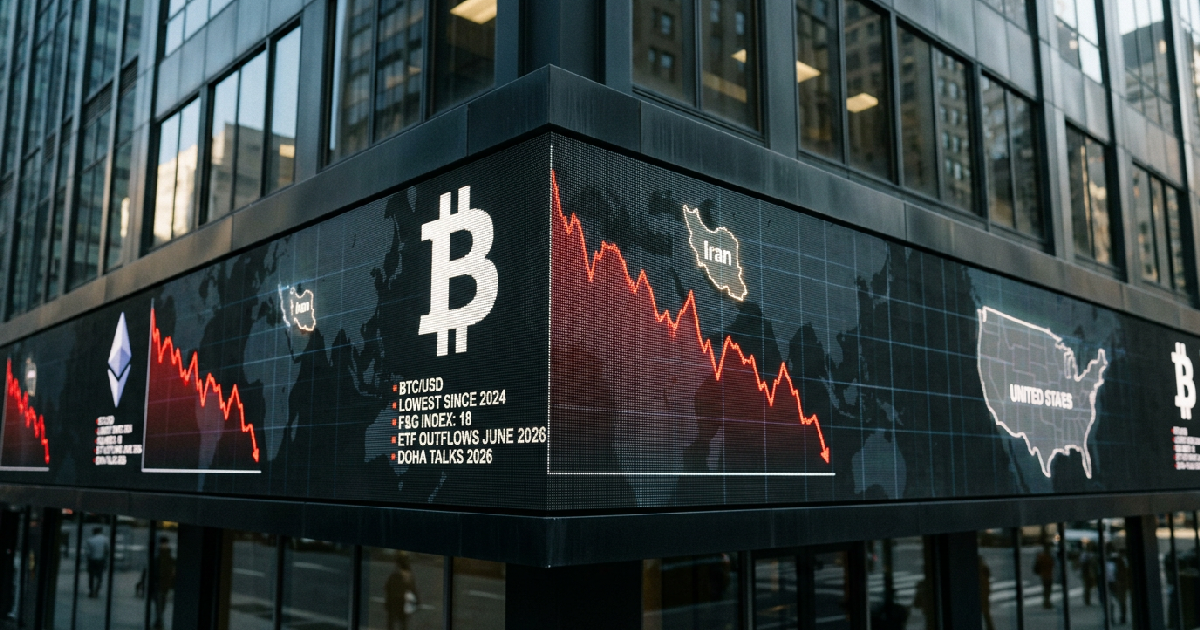

Bitcoin, Ethereum, and Dogecoin prices dropped sharply overnight on Sunday, June 28, 2026, as escalating tensions between the United States and Iran soured investor appetite for risk. The global cryptocurrency market capitalization fell 3.38% over a 24-hour period, sliding to $2.02 trillion as a fragile ceasefire in the Middle East appeared to collapse.
The latest market volatility follows a weekend of direct military confrontations. U.S. forces struck multiple Iranian targets on Saturday, June 27, including coastal radar sites and drone storage facilities, in response to an attack on the Panama-flagged tanker Kiku.
Bitcoin hits lowest daily close since 2024
By Sunday, Iran’s Islamic Revolutionary Guard Corps (IRGC) claimed responsibility for retaliatory drone and missile strikes against Bahrain and Kuwait, leading U.S. President Donald Trump to warn that Iran “will no longer exist” if war resumes.
Bitcoin (BTC) retreated below the $59,000 mark after briefly attempting to break above $60,000 earlier in the weekend. Trading near $59,427 as of June 29, the asset is currently on pace for a nearly 19% loss for the month. This represents the weakest June performance for the cryptocurrency since mid-2022, as investors react to macro warning signs and rising geopolitical uncertainty.
Technical indicators have turned decidedly bearish for the market leader. Analysts Benjamin Cowen and Cheds Trading noted that Bitcoin recently saw its lowest daily close since 2024. Additionally, the asset recorded its first close below the 200-week moving average (200-WMA) since 2023. Rekt Capital has identified $61,000 as a key resistance level that Bitcoin must reclaim to shift the current downward momentum.
Institutional flows offer little relief, with spot Bitcoin ETFs recording over $4 billion in outflows during June. This marks the largest monthly exit of capital since the products launched in January 2024. Last week alone, outflows reached $1.79 billion, hitting their highest level since February as professional traders distance themselves from Bitcoin price analysis models that suggest further downside risks.
Ethereum and Dogecoin slide as fear dominates
Ethereum (ETH) followed the broader market lower, meandering in the $1,500 region. The second-largest cryptocurrency was trading around $1,567.29 on June 29, representing a minor 0.14% intraday decline. Despite the price slide, trading volume for the asset jumped 10% over the last 24 hours, suggesting an active struggle between buyers and sellers at current levels.
Other major altcoins also ended the weekend in the red. Dogecoin (DOGE) fell to $0.0727, down 0.41%, while XRP slipped slightly by 0.48% to trade at $1.04. The collective downturn pushed the Crypto Fear & Greed Index to a reading of 18, a level indicating “Extreme Fear” among the trading community.
This marks a sharp reversal from earlier in June when a tentative U.S.-Iran deal briefly pushed Bitcoin above $65,500.
While institutional sentiment remains bearish, some “interesting signals” are emerging from retail segments. Data from Binance suggests that retail and whale traders actually increased their long exposure during the recent price dip. This divergence comes as the Ethereum price outlook weakens technically, yet some market participants anticipate a rebound if upcoming diplomatic efforts prove successful.
Diplomatic talks in Doha offer potential relief
The immediate future of the digital asset market may depend on high-stakes talks scheduled for June 30, 2026, in Doha, Qatar. Washington and Tehran reportedly agreed to halt military strikes late Sunday following the weekend’s hostilities. The summit is expected to focus on the security of the Strait of Hormuz and nuclear issues, areas that remain critical to global trade and oil price stability.
Iran’s Foreign Minister Abbas Araghchi warned on Sunday that any attempts to bypass Iran’s preferred shipping routes would only increase tensions. Meanwhile, internal market pressures, such as concerns over MicroStrategy’s capital structure, continue to weigh on Bitcoin’s recovery. As the largest corporate holder of BTC, MicroStrategy’s situation remains a focal point for traders worried about systemic risk during periods of high price volatility.