
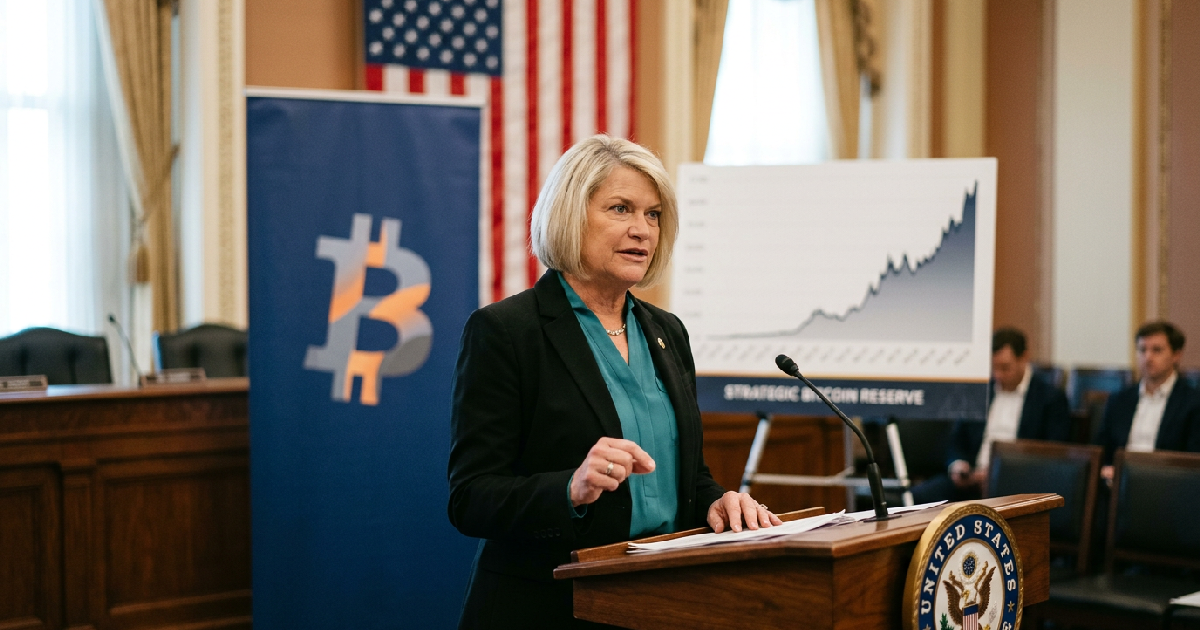

U.S. Senator Cynthia Lummis (R-Wyo.) has proposed a strategy for the United States to eliminate its national debt by acquiring and holding 5% of the global Bitcoin supply.
During a June 24, 2026, appearance on a podcast with Spencer Nichols of Bitcoin Magazine, the senator argued that establishing a strategic reserve of approximately 1 million BTC could reduce the country’s debt by one-third to one-half if held for 20 years.
Senator Cynthia Lummis outlines BITCOIN Act for strategic reserve
Senator Lummis further stated that if the government chose to hold even more than 5% of the world’s supply, the asset could potentially erase the federal debt entirely, positioning the cryptocurrency as a “generational hedge against currency debasement.”
The proposal comes as the U.S. national debt remains at a record high of $39.20 trillion as of June 3, 2026. Data shows the debt is growing at a staggering rate of approximately $8.19 billion per day, or roughly $94,804.90 every second.
At this current trajectory, the national debt is projected to reach $40 trillion by late September 2026. Senator Cynthia Lummis intends to use the “BITCOIN Act” (S. 954) to formalize a buy-and-hold strategy, modeling the digital reserve after the nation’s existing gold stockpiles to provide a credible fiscal tool for future economic stability.
The legislative framework known as the BITCOIN Act proposes that the U.S. Treasury acquire 1 million BTC over a five-year period. This amount represents roughly 5% of the 21 million total possible coins that will ever exist.
Senator Lummis explained that this multi-decade strategy is necessary to address a ballooning debt that now exceeds $290,860 per household. While Bitcoin price analysis often focuses on short-term volatility, the senator emphasizes a minimum 20-year lock-up period to allow the asset to mature as a national reserve.
Currently, the U.S. government is already the largest known state holder of the digital asset, with 328,352 BTC in its possession. These holdings, valued at approximately $20.29 billion, were not acquired through purchase but were primarily seized during criminal and civil forfeiture proceedings.
Key details
Senator Lummis aims to shift this dynamic toward intentional accumulation, especially as Bitcoin exchange supply maintain multi-year lows, suggesting a tightening market where sovereign accumulation could prove strategically advantageous.
Budget neutral funding strategies for Bitcoin acquisition
To fund the purchase of 1 million BTC without increasing taxpayer burdens, the BITCOIN Act suggests several budget-neutral strategies. These include the revaluation of gold certificates held by the Treasury and the use of Federal Reserve remittances.
By utilizing these existing financial mechanisms, the government could theoretically build its “Digital Asset Stockpile” without new deficit spending. Senator Lummis views this as a historical necessity, comparing the potential of a decentralized reserve to the security provided by traditional hard assets.
The urgency of the situation is highlighted by the scale of the current fiscal challenge. The national debt increased by $2.99 trillion between June 2025 and June 2026, meaning the U.S. adds millions of dollars in liability every minute.
Senator Lummis has been active in discussing these figures with media outlets like Roxom TV News, where she told host Hank Hudson that Bitcoin serves as an “important asset” for a nation facing rapid currency debasement.
She argues that the capped supply of Bitcoin makes it a unique tool for outpacing the growth of traditional debt obligations.
U.S. national debt trajectory and the shift to digital reserves
The push for a strategic reserve follows broader shifts in U.S. digital asset policy. On March 6, 2025, an Executive Order was signed establishing a Strategic Bitcoin Reserve, which signaled a policy change toward holding seized assets as a national stockpile rather than auctioning them immediately.
The BITCOIN Act seeks to expand this by authorizing the Secretaries of Treasury and Commerce to develop additional strategies for acquiring Bitcoin. This shift reflects growing institutional interest, as seen in Italy’s largest bank increasing its Bitcoin exposure, suggesting that sovereign and major financial entities are increasingly viewing the asset as a legitimate reserve.
Despite the high-profile nature of the proposal, it faces significant procedural hurdles in the U.S. Senate. Senator Cynthia Lummis first introduced the idea of a strategic reserve in July 2024, but the bill has faced political opposition in a divided Congress.
However, the senator remains committed to the 20-year holding strategy, arguing that the decentralized nature of the reserve would protect it from being used for short-term political spending. With Bitcoin currently trading around $59,204, the conversation has moved from if the U.S.
should hold the asset to how it can best leverage it to secure the nation’s long-term fiscal health.